Data Leakage vs Target Leakage in Machine Learning
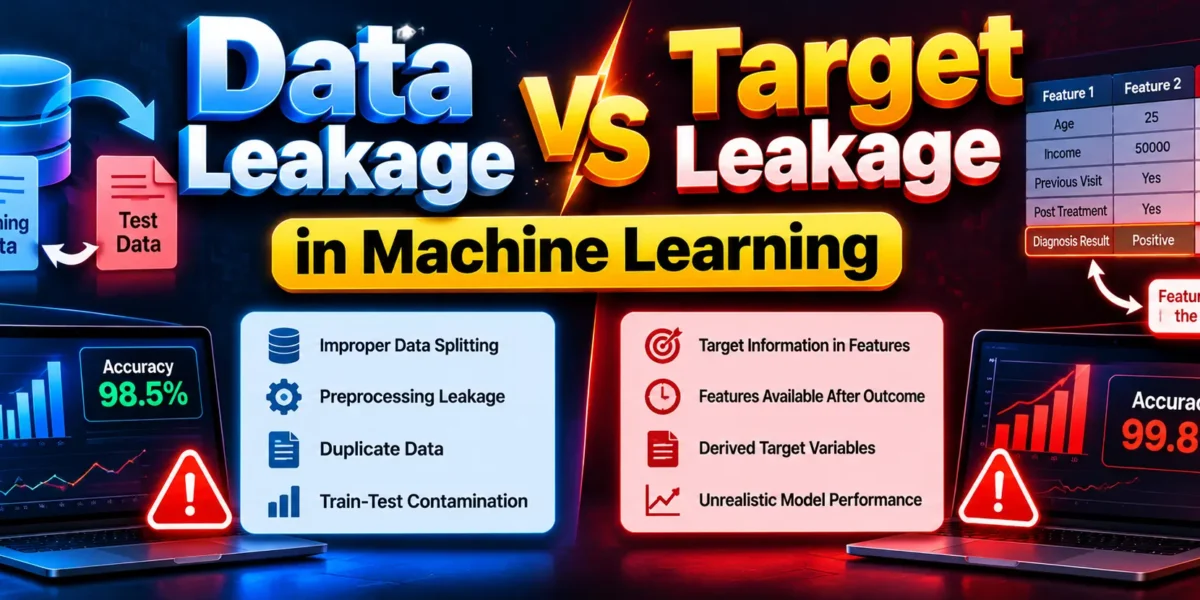
Data Leakage vs Target Leakage is an important topic in machine learning because both can make a model appear more accurate than it actually is. Data leakage occurs when a model receives information during training that would not legitimately be available when making predictions, while target leakage is a specific form of leakage where information directly or indirectly reveals the target variable.
Understanding these concepts helps data scientists build reliable machine learning models, evaluate performance correctly, and avoid misleading results in real-world applications.
Complete Advance AI Topics: Click Here
Real Time Projects on YouTube:- DecodeIT
What Is Data Leakage in Machine Learning?
Data leakage occurs when information from outside the permitted training information influences model development or evaluation. As a result, the model may achieve excellent test scores but perform poorly on genuinely unseen data.
Data leakage can happen during data preprocessing, feature engineering, dataset splitting, or model evaluation. For example, calculating missing-value replacements or scaling parameters using the entire dataset before splitting it can allow information from the test set to influence the training process.
What Is Target Leakage in Machine Learning?
Target leakage occurs when a model uses a feature that contains information about the target outcome that would not be available at the time of prediction. This makes the prediction task unrealistically easy.
For example, suppose a hospital develops a model to predict whether a patient will be admitted to intensive care. If the dataset contains a feature recorded only after the patient enters intensive care, that feature may reveal the outcome the model is supposed to predict.
Target leakage is especially dangerous because the model may appear highly accurate during development while failing in actual deployment.
What Is the Difference Between Data Leakage and Target Leakage?
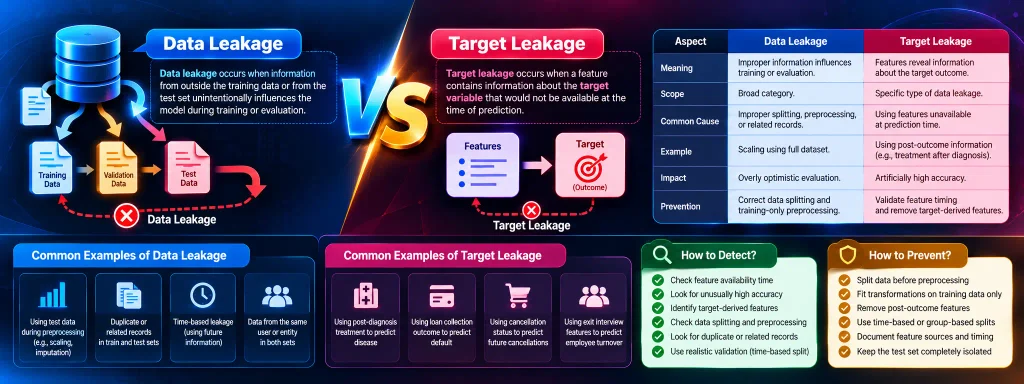
Data leakage is the broader concept, while target leakage is a specific type involving information that reveals the prediction target. Both can produce misleading evaluation results and reduce confidence in a machine learning model.
| Comparison | Data Leakage | Target Leakage |
|---|---|---|
| Meaning | Improper information influences training or evaluation. | Features reveal information about the target outcome. |
| Scope | Broad category of leakage problems. | Specific form of data leakage. |
| Common Cause | Improper splitting, preprocessing, or evaluation. | Using features unavailable at prediction time. |
| Example | Scaling data using training and test records together. | Using a post-diagnosis treatment to predict the diagnosis. |
| Impact | Overly optimistic evaluation or unreliable predictions. | Artificially high predictive performance. |
| Prevention | Use correct data splitting and training-only preprocessing. | Validate when each feature becomes available. |
What Are the Common Types of Data Leakage?
Data leakage can arise in several ways, depending on how the dataset is prepared and how the model is evaluated.
1. Train-Test Contamination
This occurs when information from the test dataset influences model training or preprocessing. For example, calculating a feature scaler using all records before splitting the data can expose information about the test distribution.
2. Preprocessing Leakage
Preprocessing leakage occurs when transformations are fitted using information that should remain outside the training process. Imputation, feature selection, and normalization should generally be fitted on training data only.
3. Duplicate or Related Records
When duplicate records or observations from the same person appear in both training and test sets, the evaluation may overestimate how well the model generalizes to new people.
What Are the Common Examples of Target Leakage?
Target leakage often happens when a dataset contains variables recorded after the outcome or variables derived directly from the target.
- Healthcare: Using a treatment administered after a diagnosis to predict that diagnosis.
- Finance: Using a collection outcome recorded after a loan defaults to predict whether the loan will default.
- Retail: Using a cancellation status recorded after an order is cancelled to predict future cancellations.
- Employee Analytics: Using an exit interview result to predict whether an employee will resign.
These features may be strongly associated with the target, but they are not appropriate if they become available only after the prediction must be made.
How Can You Detect Data Leakage and Target Leakage?
You can detect leakage by examining data preparation, feature availability, dataset splitting, and suspicious model performance. A model that achieves unexpectedly high accuracy deserves careful investigation.
- Check whether every feature would be available at the actual prediction time.
- Inspect features that are unusually strongly correlated with the target.
- Look for target-derived variables and post-outcome records.
- Check for duplicate users, transactions, or related observations across data splits.
- Confirm that preprocessing and feature selection are fitted only on training data.
- Evaluate the model on a realistic holdout dataset or time-based split when appropriate.
High accuracy alone does not prove leakage exists. The important step is to investigate whether the information used during development matches what will be available in production.
How Can You Prevent Data Leakage and Target Leakage?
The most effective prevention strategy is to reproduce the real prediction environment during model development. Every feature, transformation, and evaluation step should respect the information available at the intended prediction time.
- Split data first: Create training, validation, and test sets before fitting data-dependent preprocessing steps.
- Use pipelines: Fit scaling, imputation, and feature selection inside a training pipeline.
- Review feature timing: Remove variables recorded after the outcome when they would not be available during prediction.
- Use appropriate splitting: Apply time-based splits for forecasting and group-based splits when related records must stay together.
- Audit features: Document each feature’s meaning, source, and availability time.
- Keep the test set isolated: Avoid using test-set results to repeatedly tune the model.
Why Is Understanding Leakage Important in Machine Learning?
Understanding leakage helps prevent models from appearing successful during testing but failing when used with new data. It improves evaluation reliability, supports better feature selection, and reduces the risk of deploying misleading predictions.
For students and data scientists, learning to identify leakage is an essential part of building dependable machine learning workflows.
Final Thoughts
Data leakage and target leakage are closely related, but they are not identical. Data leakage covers improper information flow into model development or evaluation, whereas target leakage specifically involves features that reveal the outcome being predicted. Correct dataset splitting, careful feature timing, and training-only preprocessing help produce more trustworthy machine learning models.
Frequently Asked Questions
1. Is target leakage a type of data leakage?
Yes. Target leakage is a specific form of data leakage in which features reveal information about the target outcome that should not be available during prediction.
2. Can data leakage cause high model accuracy?
Yes. Leakage can produce overly optimistic evaluation results that do not reflect performance on genuinely unseen data.
3. How is target leakage different from overfitting?
Target leakage involves inappropriate information entering the model, while overfitting occurs when a model learns patterns that do not generalize well to new data. They can occur together but are different problems.
4. How can I prevent leakage during preprocessing?
Split the dataset first and fit preprocessing transformations only on training data. Use pipelines to apply the same fitted transformations to validation and test data.
5. How do I identify target leakage?
Check whether each feature would genuinely be available when the prediction is made, especially features recorded after the target event.
Keywords: Data Leakage vs Target Leakage, Data Leakage in Machine Learning, Target Leakage, Machine Learning Data Leakage, Data Science, Model Evaluation, Feature Engineering