
Introduction
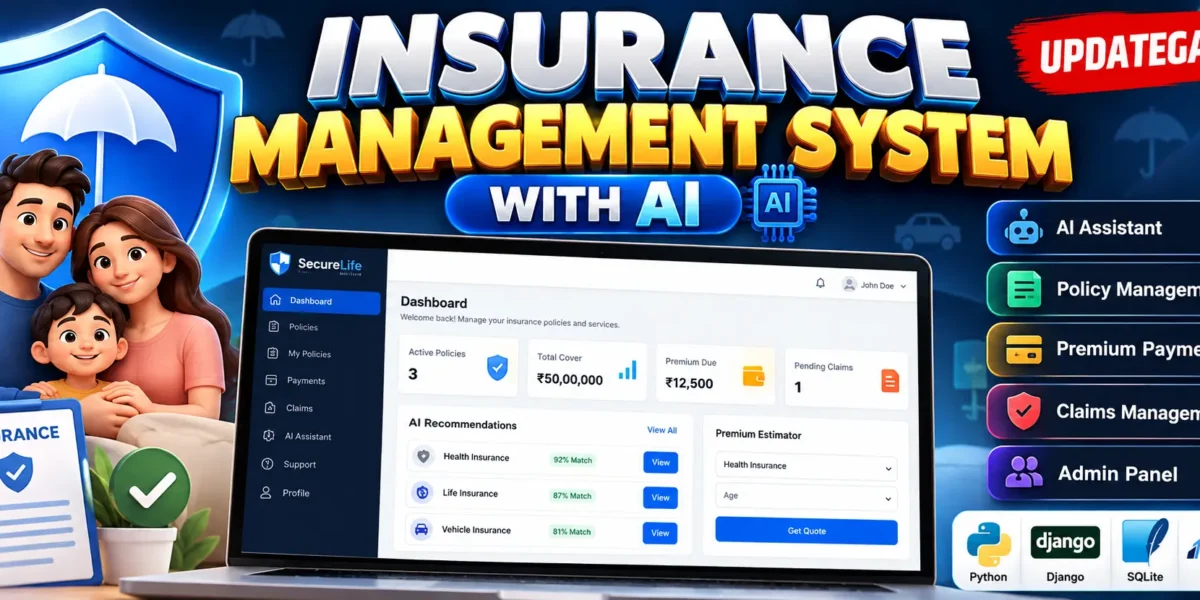
Insurance Management System with AI is a Django-based web application named SecureLife. The project combines insurance policy management with customer services, premium payments, claims handling, support questions, and a from-scratch Python machine-learning engine. The project uses Django for the web application, SQLite for data storage, and Razorpay integration for premium payments.
The AI part is implemented inside the project without NumPy or scikit-learn. It provides an assistant, policy recommendations, premium estimation, risk profiling, claim fraud screening, sentiment and urgency analysis, and customer segmentation. The project also includes separate customer and administrator areas for managing insurance operations.
Table of Contents
Complete Advance AI Topics: Click Here
Real Time Projects:- DecodeIT
Project Overview
| Project Name | Insurance Management System with AI |
|---|---|
| Project Type | Django Web Application |
| Framework | Django 5.1.15 |
| Database | SQLite |
| Payment Gateway | Razorpay |
| AI/ML | Custom Python implementation |
| Frontend | Django Templates, CSS, JavaScript |
| Developer | UPDATEGADH |
About the Project
The SecureLife system is designed around two main areas: the customer portal and the admin console. Customers can create their account, maintain their profile, browse insurance policies, apply for policies, make premium payments, view payment history, submit claims, track claim status, and use the AI assistant. Administrators can manage customers, categories, policies, applications, payments, claims, and support questions from the admin side.
The system also stores customer information used by the AI models. This includes date of birth, annual income, dependents, smoking status, pre-existing conditions, occupation risk, vehicle ownership, home ownership, and frequent travel information. These details are used by the recommendation, premium estimation, and risk-related AI functions.
AI and Machine Learning Features
The project contains a custom AI engine under the ai application. The project includes several models and their specific purposes.
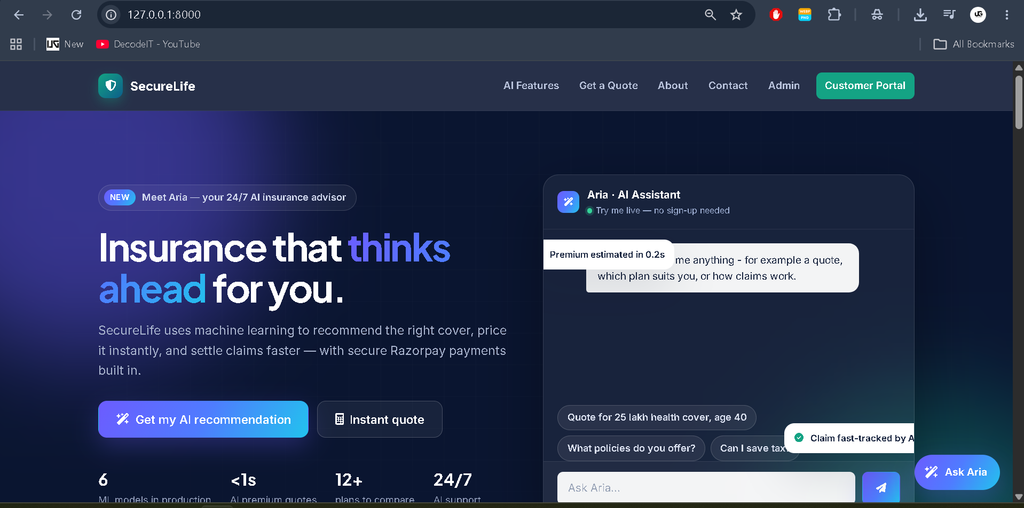
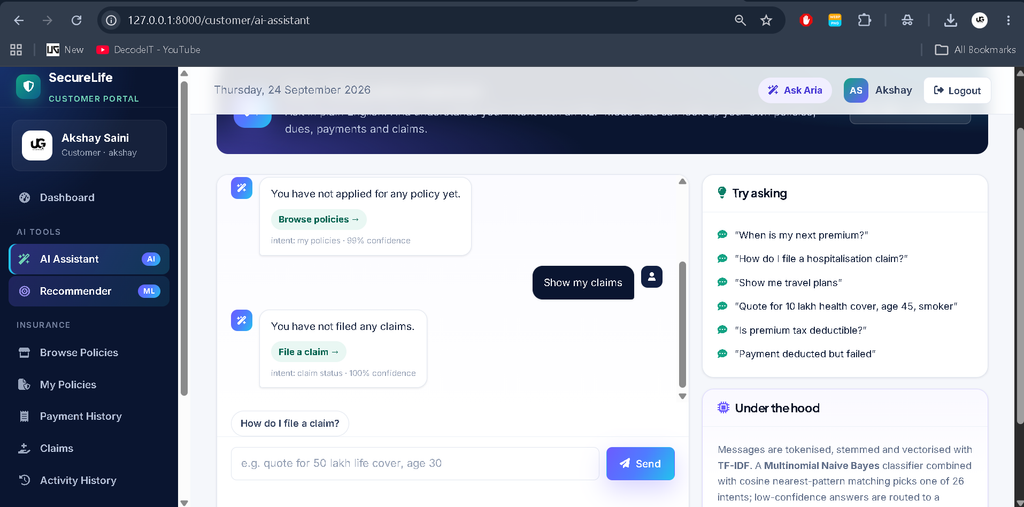
Aria Support Assistant: It uses TF-IDF, Multinomial Naive Bayes, and cosine nearest-pattern matching. It works as a support chatbot and can use a customer’s own policies, dues, payments, and claims when answering personal questions.
Sentiment and Urgency Analysis: It uses Multinomial Naive Bayes with keyword rules. It helps classify support questions and supports question triage and AI-drafted replies for administrators.
Policy Recommender: It uses Softmax multinomial logistic regression with SGD. It produces a personal match score for insurance plans and supports cross-sell suggestions.
Premium Estimator: It uses log-linear ridge regression with a closed-form approach. It provides a live premium quote on the homepage and a price check for policies.
Risk Profiler: It uses logistic regression to calculate a health and claim risk score from customer profile information.
Claim Fraud Screen: It uses logistic regression to calculate a risk score for submitted claims. Claims receive an AI risk score, label, and factors that can be reviewed by the administrator.
Customer Segments: It uses K-Means with k-means++ for the administrator’s AI Insights page.
The project keeps trained numeric models in ai/trained/models.json. The models can be retrained with the train_ai management command, while assistant training phrases are maintained in ai/knowledge.py.
Customer Portal
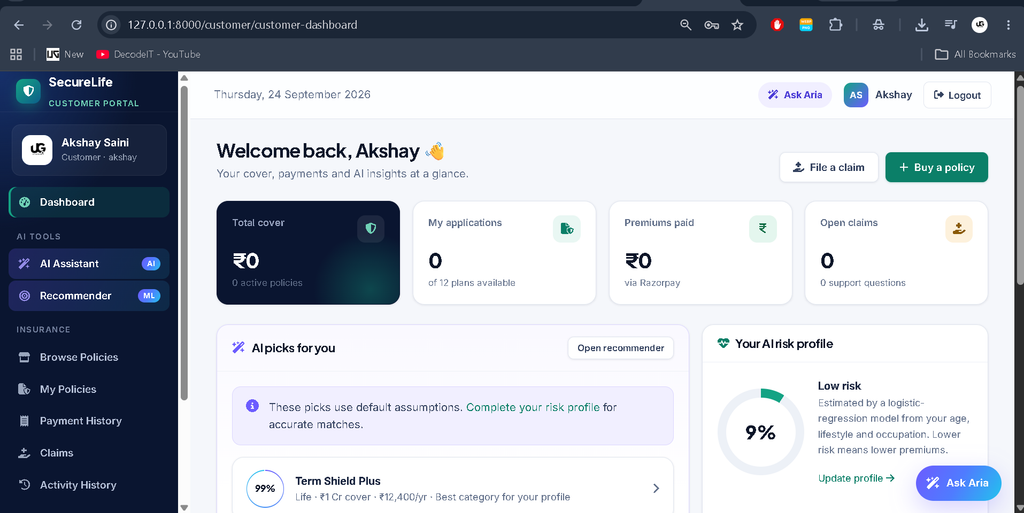
The customer portal provides the main insurance services for registered customers. The dashboard displays total cover, premiums due, AI recommendations, risk score, and recent activity.
Customers can browse policies using search and category filtering. Policies can also be ranked using AI match results, and individual policy pages provide an AI price check. Customers can apply for policies, while duplicate applications are blocked.
For approved policies, customers can pay premiums through Razorpay. The project supports UPI, cards, net banking, and wallets through the payment flow. Payment records contain the amount, currency, gateway, receipt number, Razorpay order information, payment information, status, and payment date. Printable receipts and payment history are also available.
The customer portal includes claims management. Customers can file claims for supported claim types, provide an incident date, claimed amount, and description, and then track the claim through its status. The project stores the AI risk score and related factors for each claim.
Customers can also manage their profile, edit profile information, change their password, view activity history, use the Aria AI assistant, receive AI recommendations, estimate premiums, and submit questions to the help desk.
Admin Console
The administrator area provides tools for managing the insurance system. The business dashboard contains revenue information, applications by category, AI alerts, and pending approvals.
Administrators can search customers and open a detailed customer view containing policy, payment, claim, and cross-sell information. Policy categories and insurance policies can be added, updated, viewed, and deleted.
Policy applications can be reviewed and approved or rejected. Separate views are available for approved, disapproved, and waiting policy holders.
The payment section provides a payment ledger with payment status and Razorpay identifiers. The claims queue shows claim information along with the AI fraud score and explanation factors. Administrators can approve, reject, or review claims and can also rescore a claim.
Support questions are tagged with topic, sentiment, and urgency information. The system can also prepare AI-drafted replies for administrators.
The AI Insights page contains the model registry and metrics, triage information, assistant analytics, demand forecast, and customer segments.
Database and Main Models
The application uses SQLite through Django’s database configuration. Important database models include Category, Policy, PolicyRecord, Payment, Claim, Question, Customer, and ChatLog.
Category stores insurance category information. Policy stores the policy name, description, sum assured, annual premium, tenure, and category. PolicyRecord connects a customer with a selected policy and tracks its application status.
Payment stores premium transaction information. Claim stores claim details, claim status, AI risk score, risk label, and AI factors. Question stores customer questions and administrator comments. Customer stores account and risk-profile information. ChatLog records assistant messages, replies, detected intent, confidence, and creation time.
Payment Processing
Razorpay is used for premium payment processing. The project can run with a clearly labelled demo checkout when Razorpay keys are not configured. For real payment processing, the project expects Razorpay key settings through environment variables.
The server creates a payment order and the payment flow verifies the Razorpay HMAC-SHA256 signature before marking the premium as paid. This keeps the payment status connected with server-side verification.
Technologies Used
Python is used for the application and AI logic. Django 5.1.15 provides the web framework. SQLite is used as the database. Django Templates, CSS, and JavaScript provide the application interface. django-widget-tweaks is included for template form handling, and Pillow is included for image handling. Razorpay is used for payment processing.
How to Download
The complete package is available so you can run, study, and submit it with confidence. It includes:
- Full Source Code
- Project Report
- Synopsis
- PPT Presentation
Screenshot and Demo Video
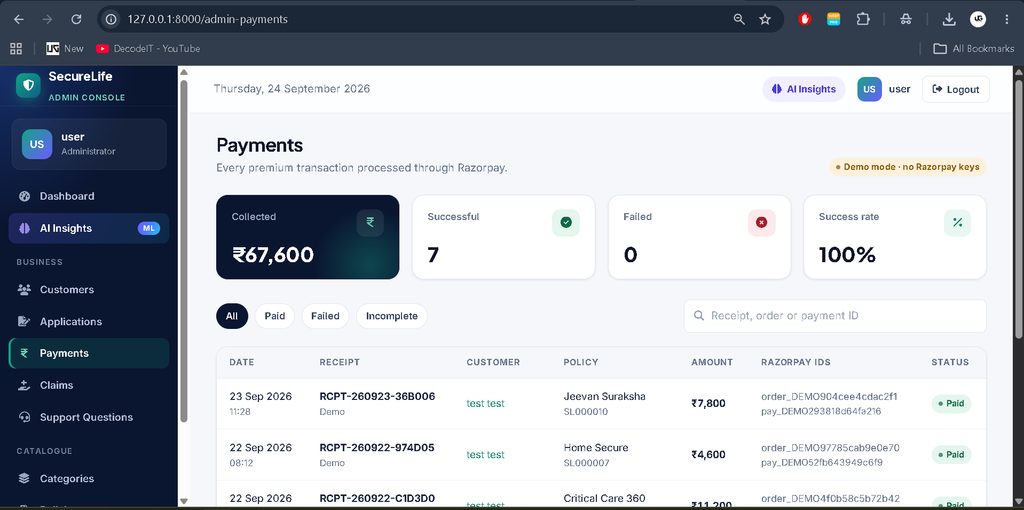
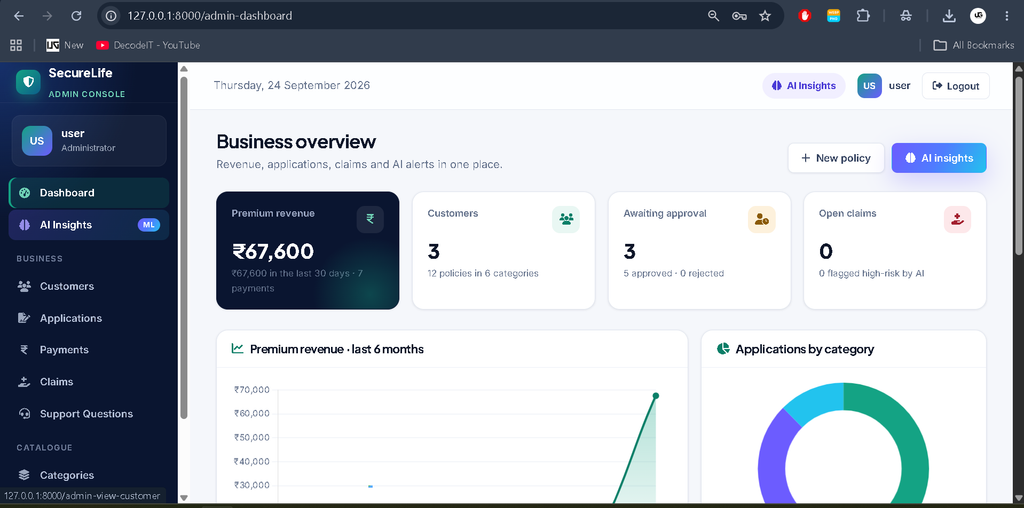
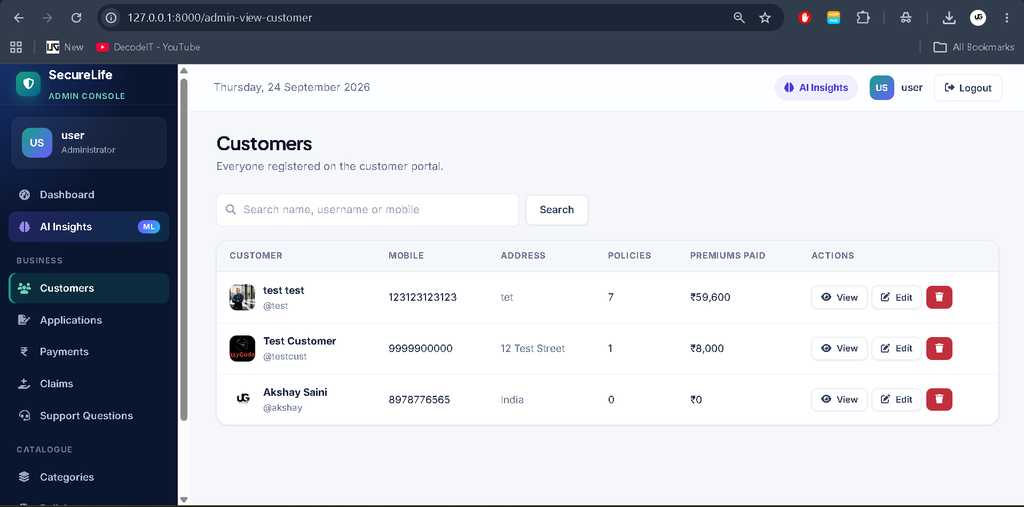
How to Install and Run the Project
1. Install Python 3.10 or newer and make sure Python is added to PATH.
2. Extract the project ZIP file and open a terminal in the project folder.
3. Create a virtual environment:
python -m venv .venv4. Activate the virtual environment on Windows:
.venv\Scripts\activateFor macOS or Linux:
source .venv/bin/activate5. Install the required packages:
python -m pip install -r requirements.txt6. Apply database migrations:
python manage.py migrate7. To add sample categories and policies, run:
python manage.py seed_demo8. Create an administrator account:
python manage.py createsuperuser9. Start the Django development server:
python manage.py runserver10. Open the application in a browser at:
http://127.0.0.1:8000/AI Model Training
The project includes a management command for training the numeric AI models. To retrain the models, run:
python manage.py train_aiThe trained models are cached in ai/trained/models.json. The assistant training phrases are stored in ai/knowledge.py.
Configuration
The project reads important settings from environment variables. DJANGO_SECRET_KEY is required with a unique value when DEBUG is disabled. DJANGO_DEBUG controls debug mode, and DJANGO_ALLOWED_HOSTS controls allowed host names.
For Razorpay, the project uses RAZORPAY_KEY_ID and RAZORPAY_KEY_SECRET. Without these keys, the project provides the demo checkout described in the project README.
The Contact Us page can use email credentials through EMAIL_HOST_USER, EMAIL_HOST_PASSWORD, and EMAIL_RECEIVING_USER. Without email credentials, submitted contact messages are printed to the console.
Testing
The project includes tests for the insurance application. The provided command for running them is:
python manage.py test insuranceFinal Thoughts
Insurance Management System with AI brings policy administration, customer services, payments, claims, support, and custom machine-learning functions into one Django project. Its customer portal focuses on policy applications, premium payments, claims, profile management, and AI assistance, while the admin console provides management and review tools.
The project is also useful for understanding how AI functions can be connected with a Django insurance application. The custom AI engine covers recommendation, premium estimation, risk scoring, fraud screening, support intent detection, sentiment analysis, and customer segmentation while keeping the implementation inside the project.
Keywords:-
Insurance Management System Insurance Management System – Google Search insurance management system project insurance management system project in java insurance management system githubinsurance management system er diagram insurance management system ims insurance management system project in python Insurance Management System with Al Using Django Insurance Management Insurance Management Insurance Management Services insurance management services provider phone number insurance management services provider portal insurance management administrators provider phone number insurance management system insurance management software Insurance Management System with Al Using Django

[…] If you want to take this Insurance Management System to the next level, you can explore an advanced version with AI-powered features, automated premium estimation, risk analysis, claim fraud detection, and improved customer management.Explore the advanced Insurance Management System with AI: https://updategadh.com/insurance-management-system-with-ai/ […]