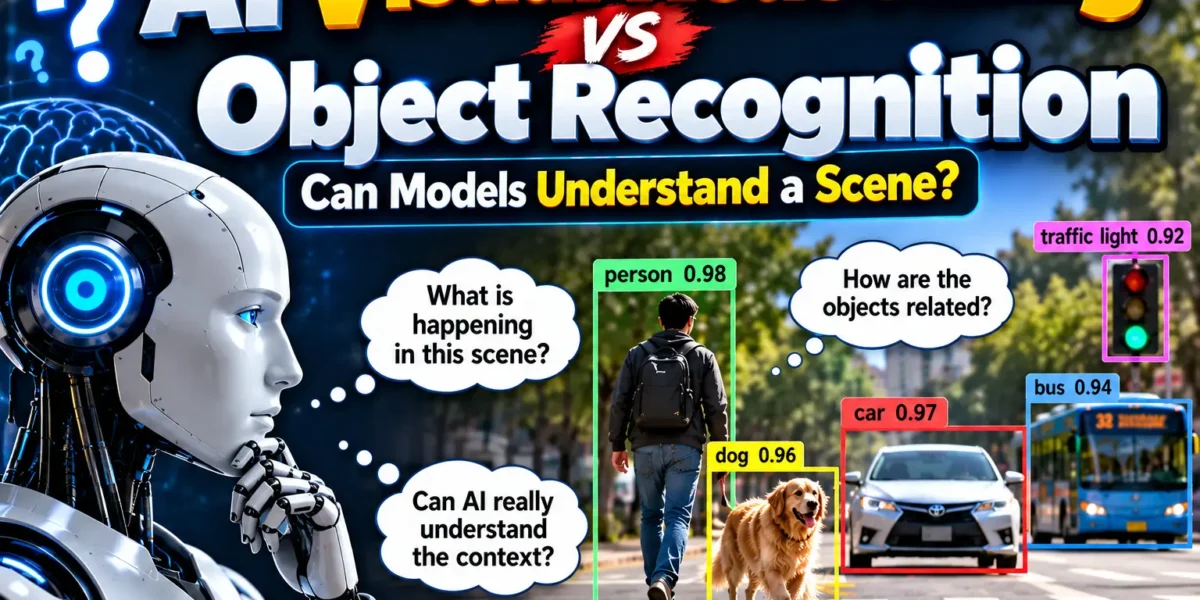
AI Visual Reasoning vs Object Recognition
Artificial intelligence has made significant progress in computer vision, enabling machines to identify objects, recognize people, detect vehicles, and analyze images. However, identifying individual objects is different from understanding what is happening in an entire scene. This difference introduces an important question: Can AI models understand a scene, or do they simply recognize the objects inside it?
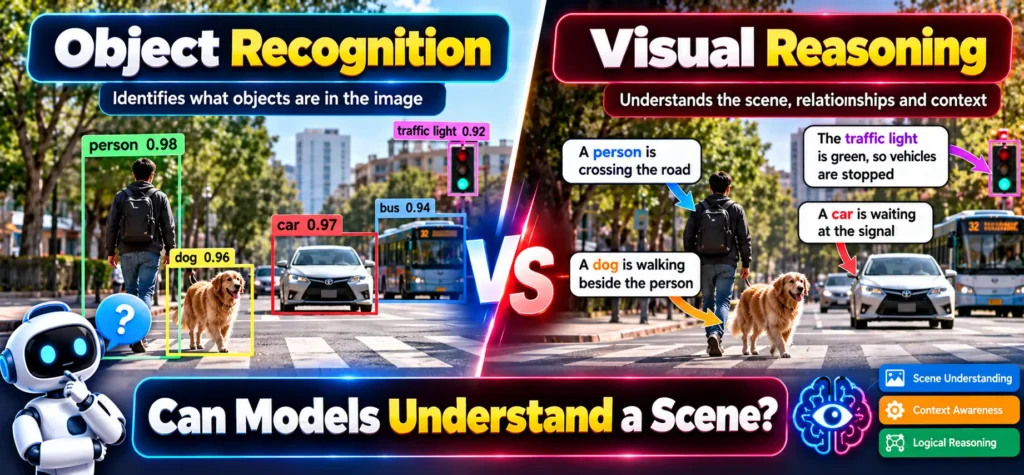
AI Visual Reasoning vs Object Recognition compares two important capabilities in computer vision. Object recognition identifies what appears in an image, while visual reasoning attempts to interpret relationships, actions, context, and possible outcomes. Understanding this distinction helps students and developers explore the next stage of AI-powered visual understanding.
Complete Advance AI Topics: Click Here
Real Time Projects on YouTube:- DecodeIT
What Is Object Recognition in AI?
Object recognition is a computer vision task that identifies objects present in an image or video. Depending on the system, it may classify an image, locate objects, or identify individual instances using bounding boxes or segmentation masks.
For example, when an AI system analyzes a photograph containing a dog, a person, and a bicycle, it may identify all three objects and locate their positions in the image.
Common computer vision tasks related to object recognition include:
- Image Classification: Assigns a category to an image, such as a car, dog, or tree.
- Object Detection: Identifies objects and estimates their locations using bounding boxes.
- Image Segmentation: Identifies the pixels belonging to objects or regions.
- Object Tracking: Follows objects across multiple video frames.
These tasks help machines identify visual elements, but object recognition alone does not necessarily explain how those elements interact or why an event is occurring.
What Is AI Visual Reasoning?
AI visual reasoning involves interpreting visual information and using it to answer questions, infer relationships, or draw conclusions about a scene. Instead of only identifying objects, a reasoning system attempts to connect the visible details and determine what they mean.
Consider an image showing a person holding an umbrella while standing on a wet road. An object recognition model might identify the person, umbrella, and road. A visual reasoning model may use the relationships between these elements to answer questions about the scene.
Visual reasoning can involve several capabilities:
- Spatial Reasoning: Understanding whether an object is above, below, behind, or beside another object.
- Relational Reasoning: Identifying how objects or people interact.
- Temporal Reasoning: Understanding changes and event sequences across video frames.
- Causal Reasoning: Evaluating possible causes and consequences using available evidence.
- Commonsense Reasoning: Applying general knowledge to interpret visual situations.
These capabilities are related but distinct. A model may correctly identify objects while still making mistakes about their positions, interactions, or the events they represent.
AI Visual Reasoning vs Object Recognition: Key Differences
| Comparison | Object Recognition | Visual Reasoning |
|---|---|---|
| Main Purpose | Identify objects in images or videos. | Interpret visual information and relationships. |
| Primary Question | What objects are present? | What is happening, and how are elements related? |
| Typical Output | Labels, object locations, or masks. | Answers, inferences, or scene interpretations. |
| Spatial Understanding | May locate objects without fully understanding their relationships. | Attempts to reason about relative positions and arrangements. |
| Temporal Understanding | Can detect or track objects across frames. | May interpret event sequences and changes over time. |
| Example | Identifies a person and a bicycle. | Attempts to determine whether the person is riding, pushing, or standing beside the bicycle. |
| Typical Applications | Image tagging, inventory inspection, and object detection. | Robotics, visual question answering, scene interpretation, and action planning. |
Object recognition and visual reasoning are not competing technologies. Recognition can provide important visual information that reasoning systems use to interpret more complex situations.
Can AI Models Really Understand a Scene?
AI models can perform many scene-understanding tasks, but their performance depends on the image, question, model architecture, training data, and complexity of the reasoning required. Correctly describing a scene does not automatically prove that a model understands every relationship within it.
For example, a model may recognize a cup and a table but incorrectly answer whether the cup is behind or in front of another object. It may also produce a plausible explanation that does not match the actual visual evidence.
Therefore, scene understanding should be evaluated through specific tasks rather than assumed from a model’s ability to produce fluent descriptions.
How Do Visual Reasoning Models Work?
Visual reasoning systems commonly combine image-processing capabilities with methods that interpret language, relationships, or structured information. The exact architecture varies across systems.
- Image Input: The system receives an image or video frame.
- Visual Feature Extraction: A vision model extracts features representing objects, shapes, textures, and other visual patterns.
- Object and Relationship Analysis: The system identifies relevant entities and, where supported, their spatial or semantic relationships.
- Question Interpretation: For visual question answering, the system processes the user’s question or instruction.
- Reasoning: The model combines relevant visual evidence and contextual information to produce an answer.
- Output Generation: The system returns a classification, explanation, answer, or other task-specific result.
Some systems use vision-language models, attention mechanisms, scene graphs, or additional tools to support these steps. No single architecture guarantees reliable reasoning for every image or task.
Real-World Applications of AI Visual Reasoning
1. Autonomous Vehicles
Vehicle perception systems identify roads, traffic signs, pedestrians, and other vehicles. Reasoning about movement and spatial relationships can help interpret traffic situations and support driving decisions.
2. Robotics
Robots need to identify objects and understand their positions relative to surrounding items. This information can support navigation, object manipulation, and task planning.
3. Medical Image Analysis
Computer vision can identify patterns in medical images. More advanced interpretation may help analyze relationships between visual findings, although clinical conclusions require appropriate validation and professional oversight.
4. Video Understanding
Video analysis can go beyond detecting objects in individual frames by examining motion, action sequences, and changes over time.
5. Visual Question Answering
Visual question-answering systems respond to questions about images, such as identifying an object, comparing positions, or describing visible interactions.
How Can Visual Reasoning Be Evaluated?
Evaluating visual reasoning requires more than measuring whether a model correctly identifies objects. Tests should examine whether it can use visual evidence to answer relational, compositional, and inference-based questions.
- Object Recognition Accuracy: Measures how reliably a system identifies objects.
- Spatial Relationship Tests: Evaluate positions such as left, right, above, and behind.
- Counting and Attribute Tests: Check object counts, colors, orientations, and other visible properties.
- Compositional Reasoning: Tests whether the model can combine multiple attributes or relationships.
- Robustness Tests: Examine performance when images contain blur, occlusion, rotation, or other changes.
- Video-Based Evaluation: Tests whether the system can interpret actions and temporal sequences.
Challenges and Limitations
Despite progress in computer vision, several challenges remain when building systems that interpret complete scenes.
- Visual Ambiguity: Images may not contain enough information to determine what happened.
- Occlusion: Objects can be partially hidden behind other objects.
- Spatial Errors: Models may confuse relative positions or distances.
- Contextual Bias: Models may rely on familiar patterns rather than the details of a particular image.
- Hallucinated Explanations: A system may provide a confident answer that is unsupported by the visual evidence.
- Generalization: Performance can decline when images differ from the training data or contain unfamiliar combinations.
These limitations make careful evaluation, diverse training data, and evidence-based testing important for reliable visual AI applications.
Frequently Asked Questions (FAQs)
1. What is the difference between visual reasoning and object recognition?
Object recognition identifies objects in an image, while visual reasoning attempts to interpret their relationships, actions, and context.
2. Can object recognition understand the meaning of a scene?
Object recognition can identify visual elements, but identifying those elements alone does not establish that the system understands the complete scene.
3. Which AI models are used for visual reasoning?
Approaches include vision-language models, multimodal models, scene-graph methods, and systems that combine visual features with structured reasoning. The appropriate approach depends on the task.
4. Where is AI visual reasoning used?
Applications include robotics, autonomous driving, video understanding, visual question answering, and selected medical image analysis tasks.
5. Is visual reasoning more advanced than object recognition?
Visual reasoning generally addresses more complex tasks involving relationships and inference. However, object recognition remains an essential capability, and different applications may require different combinations of both.
Conclusion
AI Visual Reasoning and Object Recognition represent two connected but different areas of computer vision. Object recognition helps machines identify what appears in an image, while visual reasoning attempts to explain relationships and interpret what those visual elements mean together.