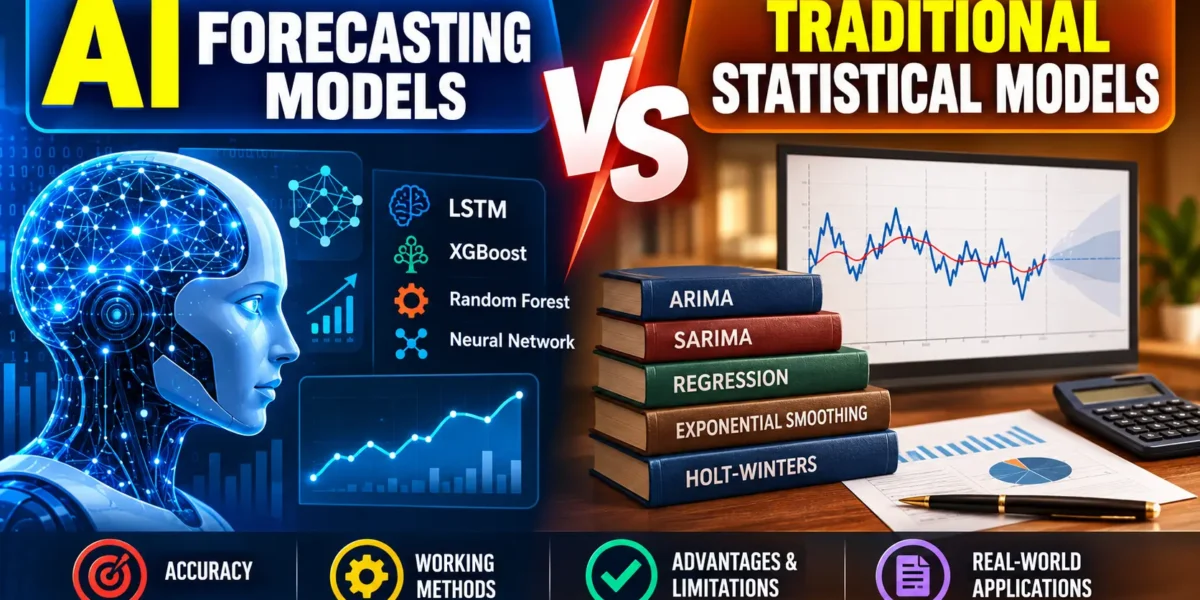
AI Forecasting vs Traditional Forecasting
Forecasting is an important technique used to predict future outcomes based on historical data. Businesses use forecasting to estimate sales, analyze customer demand, predict market trends, and improve decision-making. Traditional statistical models have been widely used for years, but Artificial Intelligence (AI) and Machine Learning (ML) are introducing new ways to make predictions.
Table of Contents
What Are AI Forecasting Models?
AI forecasting models use artificial intelligence and machine learning algorithms to identify patterns in historical data and predict future outcomes. These models can learn complex relationships between multiple variables and are particularly useful when data contains non-linear patterns.
AI forecasting is used in sales prediction, weather forecasting, inventory management, customer demand analysis, and predictive maintenance.
Popular AI Forecasting Models
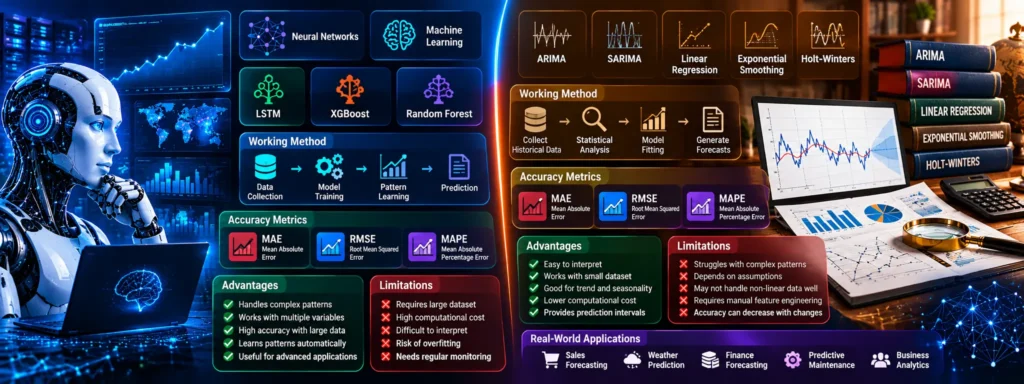
- Artificial Neural Networks (ANN): Learn complex relationships between input variables and predictions.
- Random Forest: Combines multiple decision trees to generate predictions.
- XGBoost: Uses gradient boosting for predictive modeling, particularly with structured datasets.
- LSTM Networks: Analyze sequential data and can learn long-term dependencies.
- Transformer Models: Learn relationships across sequences and can be applied to time-series forecasting.
What Are Traditional Statistical Models?
Traditional statistical forecasting models use mathematical equations and statistical techniques to analyze historical observations and estimate future values. These methods commonly focus on trends, seasonality, relationships between variables, and the statistical behavior of data.
They are widely used in economics, finance, business analytics, inventory planning, and sales forecasting because many statistical methods are relatively easy to interpret.
Complete Advance AI Topics: Click Here
Real Time Projects on YouTube:- DecodeIT
Popular Traditional Statistical Models
- ARIMA: Uses past observations, differencing, and past forecast errors to model time-series data.
- SARIMA: Extends ARIMA to handle seasonal patterns.
- Exponential Smoothing: Gives greater weight to recent observations.
- Linear Regression: Estimates relationships between dependent and independent variables.
- Holt-Winters Method: Models level, trend, and seasonality in time-series data.
AI Forecasting Models vs Traditional Statistical Models: Key Differences
| Comparison Factor | AI Forecasting Models | Traditional Statistical Models |
|---|---|---|
| Approach | Machine learning and pattern recognition | Mathematical equations and statistical principles |
| Data Requirements | Often benefit from large and diverse datasets | Can work well with smaller datasets |
| Complex Patterns | Can learn complex non-linear relationships | Depend on the selected model and assumptions |
| Interpretability | Can be difficult to explain | Often easier to interpret |
| Computational Cost | Can be high for complex models | Often lower for simpler models |
| Feature Engineering | Some models learn useful representations automatically | Often require carefully designed variables |
| Uncertainty Estimation | Depends on the selected technique | Many methods provide established prediction intervals |
| Best Applications | Complex patterns and multiple interacting variables | Trend analysis, seasonal forecasting, and interpretable predictions |
How Do AI Forecasting Models Work?
AI forecasting models follow a machine learning workflow to transform historical data into predictions.
- Data Collection: Collect historical sales, prices, demand, or other relevant information.
- Data Preprocessing: Handle missing values, inconsistent records, and outliers.
- Feature Selection: Identify useful variables such as previous sales, discounts, holidays, and advertising expenditure.
- Model Training: Train a suitable machine learning algorithm using historical observations.
- Model Evaluation: Measure performance using MAE, RMSE, or other appropriate metrics.
- Forecast Generation: Use the trained model to predict future outcomes.
How Do Traditional Statistical Models Work?
Traditional statistical forecasting follows a structured process based on mathematical modeling and statistical analysis.
- Collect Historical Data: Gather past observations relevant to the forecasting problem.
- Analyze Patterns: Examine trends, seasonality, and changes in the data.
- Select a Model: Choose an appropriate method, such as ARIMA or Exponential Smoothing.
- Estimate Parameters: Fit the model to historical observations.
- Validate the Model: Evaluate forecast errors and check whether the model assumptions are reasonable.
- Generate Predictions: Forecast future values using the fitted model.
Practical Example: Sales Forecasting
Imagine an online store that wants to predict its sales for the next month.
Using a traditional statistical model: The store can use SARIMA to analyze historical sales and recurring seasonal patterns. This method may work well when sales trends and seasonality remain relatively stable.
Using an AI forecasting model: The store can use XGBoost with historical sales, product prices, discounts, advertising expenditure, holidays, and customer activity. The model can learn relationships between these variables when sufficient representative data is available.
Advantages of AI Forecasting Models
- Can identify complex relationships in data.
- Support forecasting with multiple input variables.
- Can be useful for large-scale forecasting problems.
- Some models can adapt through retraining when new data becomes available.
- Can support advanced applications such as predictive maintenance and demand forecasting.
Limitations of AI Forecasting Models
- Complex models may require substantial training data and computing resources.
- Some models are difficult to interpret.
- Models can overfit historical data.
- Forecast quality may decline when real-world conditions change.
- Regular validation and monitoring may be necessary.
Advantages of Traditional Statistical Models
- Many methods are straightforward to understand and explain.
- Can work effectively with limited historical observations.
- Provide established techniques for analyzing trends and seasonality.
- Often require fewer computing resources.
- Many methods support prediction intervals for estimating uncertainty.
Limitations of Traditional Statistical Models
- Some models struggle with complex non-linear relationships.
- Their assumptions may not match real-world data.
- External factors may need to be included explicitly.
- Forecast accuracy can decrease when historical patterns change.
When Should You Choose Each Approach?
Choose AI forecasting models when you have sufficient representative data, multiple relevant variables, and potentially complex relationships to learn. These models can be useful for demand prediction, customer analytics, and large-scale business forecasting.
Choose traditional statistical models when the dataset is relatively small, trends and seasonal patterns are understandable, interpretability is important, or computational simplicity is preferred.
Consider a hybrid approach when statistical and machine learning techniques can complement each other. For example, a statistical model may capture seasonality while a machine learning model learns additional relationships. Use this approach only when testing demonstrates an improvement.
How to Evaluate Forecasting Accuracy
Forecasting models should be evaluated on data that was not used during training. Common evaluation metrics include:
- MAE (Mean Absolute Error): Measures the average absolute difference between actual and predicted values.
- RMSE (Root Mean Squared Error): Penalizes larger prediction errors more heavily.
- MAPE (Mean Absolute Percentage Error): Expresses errors as percentages but can be misleading when actual values are zero or close to zero.
For time-series forecasting, training and testing data should generally be divided chronologically. Future observations must not leak into the training dataset. Comparing advanced models with a simple baseline also helps determine whether the additional complexity is worthwhile.
Frequently Asked Questions (FAQs)
1. What is the main difference between AI forecasting and statistical forecasting?
AI forecasting often learns complex patterns from data, while traditional statistical forecasting uses mathematical models and assumptions to represent trends, seasonality, and relationships.
2. Are AI forecasting models more accurate than statistical models?
Not always. Accuracy depends on the dataset, forecasting horizon, model selection, and changing conditions. Both approaches must be evaluated using unseen data.
3. Which forecasting model is best for beginners?
Moving averages, Exponential Smoothing, and Linear Regression are useful starting points. Beginners can explore ARIMA and machine learning models after learning basic data analysis.
4. Can AI forecasting work with small datasets?
Some machine learning models can work with smaller datasets, but complex models generally benefit from sufficient representative data. Statistical models may be more suitable when observations are limited.
5. Can AI and statistical models be used together?
Yes. Hybrid forecasting systems combine statistical methods and machine learning when their strengths complement each other and testing confirms improved performance.
Conclusion
AI Forecasting Models vs Traditional Statistical Models is not simply a competition between old and new technologies. Both approaches have unique strengths, limitations, and applications. AI models can capture complex relationships, while traditional statistical methods often provide simplicity, interpretability, and effective performance on structured time-series data.