Is Python a Scripting Language?
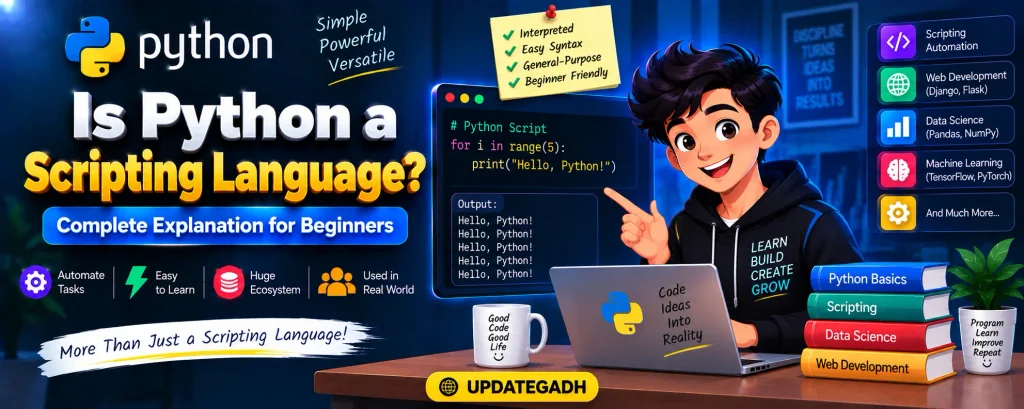
Yes, Python is a scripting language, but Python is not limited to scripting tasks. It is a high-level, general-purpose programming language that can be used for automation, web development, data science, machine learning, artificial intelligence, software development, and many other applications.
Python is often called a scripting language because Python programs can be used to automate repetitive tasks and can be executed through a Python interpreter. At the same time, Python provides features such as object-oriented programming, functions, modules, exception handling, and a large ecosystem of libraries.
In this article, we will understand why Python is considered a scripting language, what scripting languages are, how Python compares with compiled languages, and why Python is also considered a general-purpose programming language.
Complete Python Course: Click Here
Complete Advance AI Topics: Click Here
What is a Scripting Language?
A scripting language is a programming language commonly used to automate tasks and control the behavior of applications, systems, or other software. Scripts are often written to perform repetitive operations without requiring the programmer to manually perform each task.
Scripting languages are generally designed to make development convenient and productive. They are commonly associated with interpreted execution, although the exact execution model can vary between languages and implementations.
Some popular languages commonly used for scripting include:
- Python
- JavaScript
- Perl
- Bash or Shell scripting
- Ruby
- VBScript
Why is Python Called a Scripting Language?
Python is called a scripting language because it is widely used to write scripts that automate tasks. For example, you can create a Python script to rename files, process text, work with folders, collect data, or perform repetitive calculations.
A simple Python script can look like this:
print("Hello, Python!")You can save the code in a file with the .py extension and execute it using Python.
Python’s simple syntax also makes it convenient to write small scripts quickly. However, this does not mean Python can only be used for small programs.
Key Features of Scripting Languages
Scripting languages commonly provide several features that make automation and rapid development easier.
- Easy to write: Their syntax is often designed to be readable and productive.
- Automation-friendly: They are useful for repetitive tasks.
- Rapid development: Programs can often be created with relatively little code.
- Interactive execution: Many scripting languages provide convenient interpreter-based execution.
- Cross-platform support: Python programs can run on multiple operating systems when the required environment is available.
Python File Extensions
Python uses several file extensions for different purposes. The most commonly used one is .py.
| Extension | Purpose |
|---|---|
.py | Standard Python source file |
.pyw | Python source file commonly used for Windows GUI applications without a console window |
.pyc | Python bytecode file |
.pyd | Python extension module on Windows |
.pyz | Python zip application |
Python vs Compiled Languages
One reason people discuss Python as a scripting language is its execution model. Python source code is processed by the Python implementation rather than being directly compiled by the programmer into a native machine-code executable in the same way as traditional compiled languages such as C or C++.
Compiled languages generally translate source code into machine code or another executable form before the program runs. Python implementations commonly compile source code to bytecode and then execute it through a Python virtual machine.
This difference affects how programs are developed and executed, but it does not mean that Python is only suitable for simple scripts.
| Type | Examples | Common Characteristic |
|---|---|---|
| Scripting | Python, JavaScript, Ruby | Often used for automation and rapid development |
| Compiled | C, C++, Rust | Typically compiled before execution |
| Hybrid/VM-based | Java, C# | Compile to an intermediate representation and execute using a runtime |
Python is More Than a Scripting Language
Although Python is widely used for scripting, it is also a general-purpose programming language. This means it can be used to develop many different types of applications.
Object-Oriented Programming
Python supports object-oriented programming. You can create classes and objects and use concepts such as inheritance and polymorphism.
For example:
class Student:
    def __init__(self, name):
        self.name = name

student = Student("Peter")
print(student.name)
This demonstrates that Python can be used to build programs using structured programming concepts rather than only short automation scripts.
Large Library Ecosystem
Python has a large collection of libraries and frameworks. Developers use Python for web development, data analysis, machine learning, artificial intelligence, automation, scientific computing, and many other areas.
For example, Python is commonly used with technologies such as Django for web development, Pandas for data analysis, TensorFlow for machine learning, and PyTorch for machine learning and AI applications.
Web Development
Python can be used to create complete web applications. Frameworks such as Django and Flask provide tools for developing backend applications, APIs, and web services.
Data Science and Machine Learning
Python is also widely used in data science and machine learning. Developers can use Python libraries to process datasets, create visualizations, train machine learning models, and analyze results.
Examples of Python Scripting
Python can automate many everyday tasks. For example, a script can display a list of files:
import os

for file in os.listdir():
    print(file)
Another simple example is automating a calculation:
numbers = [10, 20, 30, 40]

total = sum(numbers)

print("Total:", total)
These examples show how Python can be used as a scripting language for small and practical tasks.
Is Python a Programming Language or Scripting Language?
Python is both a programming language and a scripting language. The term scripting language describes one way a language is commonly used, particularly for automation and interpreted execution. Python’s broader features allow it to be used for much larger programming tasks as well.
Therefore, calling Python a scripting language is correct, but describing Python only as a scripting language does not fully represent its capabilities.
Advantages of Using Python for Scripting
- Simple and readable syntax.
- Useful for automating repetitive tasks.
- Large collection of libraries.
- Works across major operating systems.
- Suitable for beginners and experienced developers.
- Can be used for both small scripts and larger applications.
YT:- DecodeIT
Conclusion
Python is a scripting language, but it is also much more than that. Its simple syntax and interpreter-based execution make it highly useful for writing scripts and automating repetitive tasks.
At the same time, Python supports object-oriented programming, functions, modules, libraries, frameworks, and large-scale application development. It is used across areas such as web development, data science, machine learning, artificial intelligence, and automation.
So, if someone asks “Is Python a scripting language?”, the answer is yes. However, Python is best understood as a general-purpose programming language that is also widely used as a scripting language.
Frequently Asked Questions (FAQ)
1. Is Python a scripting language?
Yes. Python is widely used as a scripting language for automation, task processing, and many other applications.
2. Is Python a programming language or scripting language?
Python is both. It is a general-purpose programming language that is also commonly used for scripting.
3. Why is Python called a scripting language?
Python is commonly called a scripting language because it is frequently used to write scripts for automation and task execution.
4. Is Python only used for scripting?
No. Python is also used for web development, data science, machine learning, artificial intelligence, scientific computing, and software development.
5. Is Python object-oriented or a scripting language?
These descriptions refer to different aspects of Python. Python supports object-oriented programming and is also widely used as a scripting language.
6. What are examples of Python scripting?
Python scripts can automate file operations, process data, perform calculations, manage folders, and complete other repetitive tasks.
Keywords
python scripting language is python a programming language or scripting language scripting language python scripting language python python is a scripting language what is a scripting language scripting language vs programming language python scripting language examples is python object oriented scripting language python or scripting python programming language python scripting scripting in python python automation scripting python script python programming advantages of python scripting python general purpose programming language python interpreted language python vs scripting language scripting languages examples why python is called a scripting language python programming language features