100 + Core Java Interview Questions For Freshers: Empower Your Knowledge
Core Java Interview Questions Categories
| Category | Questions |
|---|---|
| Basic Java Concepts | What is Java? Explain the difference between JDK, JRE, and JVM. How does Java achieve platform independence? What are the key features of Java? |
| Variables and Data Types | What are the different data types in Java? How are local variables and instance variables different? Explain the significance of the ‘final’ keyword in Java. |
| Operators and Expressions | What is the ternary operator in Java? Describe the ‘&&’ and ‘ |
| Control Statements | Differentiate between ‘if-else’ and ‘switch’ statements. What is the purpose of ‘break’ and ‘continue’ statements? Explain the ‘for-each’ loop in Java. |
| Classes and Objects | Define a class and an object. What is encapsulation, and how does Java achieve it? Discuss the ‘this’ keyword in Java. |
| Inheritance and Polymorphism | What is inheritance, and why is it important? Describe method overriding and method overloading. How does Java support multiple inheritance through interfaces? |
| Exception Handling | What is an exception in Java? Explain the ‘try-catch-finally’ block. What is the purpose of custom exceptions? |
| Multithreading | Define multithreading and its advantages. How do you create a thread in Java? What is the ‘synchronized’ keyword used for? |
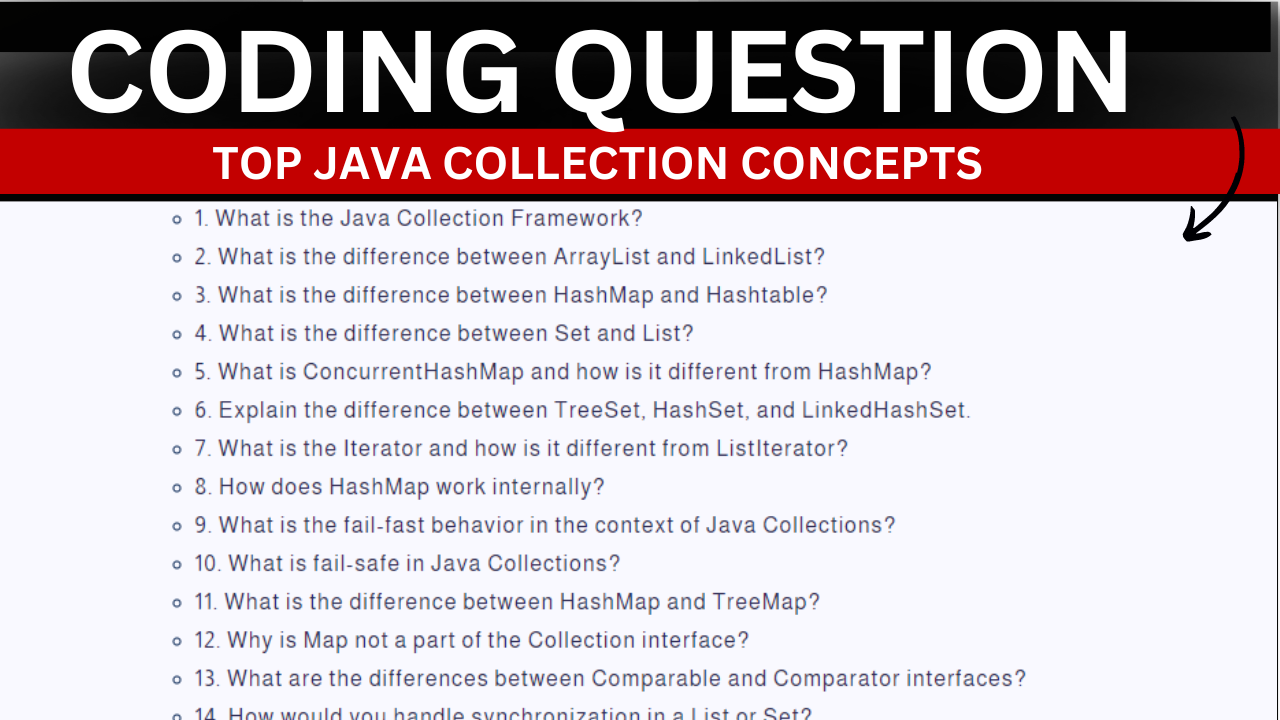
| Collections Framework | What is the Collections Framework in Java? Discuss the differences between List, Set, and Map. How do you sort elements in a List? |
| File Handling | How do you read and write files in Java? Explain the use of ‘File’ and ‘FileReader’ classes. What are the differences between ‘FileInputStream’ and ‘FileOutputStream’? |
| Networking and Sockets | What is networking in Java? Describe the client-server model. How do you create a simple client-server application? |
| Design Patterns | Discuss the Singleton, Factory, and Observer patterns. Explain the Model-View-Controller (MVC) pattern. How do design patterns improve code quality? |
| Garbage Collection | What is garbage collection in Java? How does the JVM manage memory? Explain the ‘finalize’ method. |
Topic: Basic Java Concepts, Variables and Data Types, Operators and Expressions, Garbage Collection, Design Patterns, File Handling.
Theoretical Questions:
- What is Java, and why is it considered a platform-independent language?
- Explain the differences between JDK, JRE, and JVM.
- What are the key features of Java that make it popular?
- Define variables in Java. What are the different data types?
- Discuss the difference between primitive and reference data types.
- Explain the purpose and usage of the ‘final’ keyword in Java.
- What is type casting, and when is it necessary in Java?
- Describe the order of precedence of operators in Java.
- How do you use the conditional (ternary) operator in Java?
- Write Java code to swap two numbers without using a temporary variable.
- Differentiate between ‘if-else’ and ‘switch’ statements in Java.
- How do ‘break’ and ‘continue’ statements work in Java?
- Explain the ‘for-each’ loop in Java with an example.
- What is the concept of nested loops in Java, and when is it useful?
- Write a Java program to find the factorial of a number using a while loop.
- Define a class and an object in Java.
- Explain the concept of constructors and their types.
- How does encapsulation work in Java, and why is it important?
- Discuss the ‘this’ keyword in Java and its uses.
- Create a simple Java class with methods to add and subtract two numbers.
- What is inheritance in Java, and how is it implemented?
- Describe method overriding and method overloading.
- Explain the concept of abstract classes and methods in Java.
- How does Java support multiple inheritance through interfaces?
- Write a Java program that demonstrates polymorphism using method overriding.
- What are exceptions in Java, and how are they handled?
- Explain the ‘try-catch-finally’ block in exception handling.
- What are checked and unchecked exceptions in Java?
- How do you create custom exceptions in Java?
- Write a Java program that demonstrates exception handling for divide-by-zero.
- Define multithreading and its advantages in Java.
- How do you create a thread in Java, using both Thread and Runnable?
- Explain the concept of thread synchronization and the ‘synchronized’ keyword.
- Discuss the difference between wait(), notify(), and notifyAll() in Java.
- Write a Java program with multiple threads to demonstrate thread synchronization.
- What is the Collections Framework in Java, and why is it important?
- Differentiate between List, Set, and Map interfaces.
- How do you sort elements in a List using the Collections framework?
- Explain the concept of generics in Java collections.
- Write a Java program that demonstrates the use of ArrayList and HashMap.
- How do you read and write files in Java using FileReader and FileWriter?
- Explain the purpose of the ‘File’ class in Java file handling.
- What are the differences between ‘FileInputStream’ and ‘FileOutputStream’?
- Write a Java program to copy the contents of one file to another.
- How do you handle exceptions while working with files in Java?
- What is networking in Java, and how is it achieved?
- Describe the client-server model and its components.
- How do you create a simple client-server application in Java?
- Explain the purpose of sockets in Java networking.
- Write a Java program to establish a client-server connection.
Coding Questions And Solution :
- Write a Java program to find the sum of two numbers.
- Calculate the area of a circle in Java given its radius.
- Implement a program to convert temperature from Fahrenheit to Celsius.
- Create a Java program to check whether a given number is prime or not.
- Write code to reverse a string in Java.
- Implement a program to find the factorial of a number using recursion.
- Calculate the sum of natural numbers up to a given limit using a loop.
- Create a Java program to find the largest among three numbers.
- Write code to check if a given string is a palindrome or not.
- Implement a Java program to count the number of vowels in a string.
- Find the factorial of a number without using recursion.
- Calculate the average of an array of integers in Java.
- Write code to find the maximum and minimum elements in an array.
- Implement a Java program to check if a number is even or odd.
- Create a program to print the Fibonacci series up to a given limit.
- Calculate the sum of all even numbers up to a given limit using a loop.
- Write code to find the GCD (Greatest Common Divisor) of two numbers.
- Implement a Java program to reverse a linked list.
- Create code to find the first ‘n’ prime numbers.
- Write a program to check if a given year is a leap year or not.
- Implement a program to find the sum of digits of a number.
- Create code to calculate the power of a number using recursion.
- Write a Java program to find the intersection of two arrays.
- Implement a program to find the LCM (Least Common Multiple) of two numbers.
- Create code to find the second largest element in an array.
- Write a program to rotate an array to the right by ‘k’ steps.
- Implement a Java program to check if a string contains all unique characters.
- Calculate the sum of all elements in a 2D array.
- Write code to sort an array of integers in ascending order.
- Create a program to find the number of words in a string.
- Implement a Java program to find the missing number in an array of integers.
- Calculate the square root of a number using the Newton-Raphson method.
- Write code to merge two sorted arrays into a single sorted array.
- Create a program to find the longest substring without repeating characters.
- Implement a Java program to check if a number is a perfect number or not.
- Write a program to find the common elements between two arrays.
- Calculate the factorial of a number without using recursion.
- Create code to find the majority element in an array.
- Implement a Java program to perform matrix multiplication.
- Write code to count the number of occurrences of a character in a string.
https://updategadh.com/category/interview-question
Solution
Check Solution :- https://www.youtube.com/watch?v=bW8qG1MX7jQ
   int a = 5, b = 10;
   a = a + b;
   b = a - b;
   a = a - b;
public class SwapNumbersWithoutTempVariable {
public static void main(String[] args) {
int a = 5;
int b = 10;
System.out.println("Before swapping: a = " + a + ", b = " + b);
a = a ^ b;
b = a ^ b;
a = a ^ b;
System.out.println("After swapping: a = " + a + ", b = " + b);
}
}
Differentiate between ‘if-else’ and ‘switch’ statements in Java.
Answer: ‘if-else’ statements are used for conditional branching based on boolean expressions. ‘switch’ statements provide a way to select among multiple code blocks based on the value of an expression. Question: When is it more appropriate to use a ‘switch’ statement instead of multiple ‘if-else’ statements, and vice versa?
Core Java Interview Questions For Freshers :
How do ‘break’ and ‘continue’ statements work in Java?
Answer: The ‘break’ statement is used to exit a loop or switch statement prematurely, while the ‘continue’ statement is used to skip the current iteration of a loop and proceed to the next one. Question: Can you provide an example of how ‘break’ and ‘continue’ statements are used in practice, such as in a loop?
Explain the ‘for-each’ loop in Java with an example.
Answer: The ‘for-each’ loop (enhanced for loop) simplifies iteration through collections and arrays. It automatically iterates through elements without the need for explicit index management. Question: In what situations is the ‘for-each’ loop more convenient than a traditional ‘for’ loop, and can you provide an example of its use?
What is the concept of nested loops in Java, and when is it useful?
Answer: Nested loops are loops inside other loops. They are useful when you need to perform repetitive tasks within repetitive tasks, such as iterating through a 2D array or generating patterns. Question: Can you give an example of a real-world problem that can be solved using nested loops, and how do you implement it?
Write a Java program to find the factorial of a number using a while loop.
Answer: Here’s a Java program to find the factorial of a number using a while loop:
   int number = 5;
   int factorial = 1;
   int i = 1;
   while (i <= number) {
       factorial *= i;
       i++;
   }
System.out.println("Factorial of " + number + " is " + factorial);Question: How can you modify this code to calculate the factorial using a ‘for’ loop instead of a ‘while’ loop?
Define a class and an object in Java.
Answer: A class is a blueprint or template for creating objects. An object is an instance of a class, representing a real-world entity with its data and behaviors. Question: Can you provide an example of a class definition and how to create objects from it?
Explain the concept of constructors and their types.
Answer: Constructors are special methods used to initialize objects. They have the same name as the class and can be parameterized or no-argument. There are default (no-argument) constructors and user-defined constructors. Question: How do constructors differ from regular methods, and when would you use a parameterized constructor?
How does encapsulation work in Java, and why is it important?
Answer: Encapsulation is the concept of bundling data (attributes) and methods (functions) that operate on that data into a single unit called a class. It’s important for data hiding, maintaining data integrity, and promoting modular and organized code. Question: How does encapsulation enhance code security and maintainability, and can you provide an example of encapsulation in Java?
Discuss the ‘this’ keyword in Java and its uses.
Answer: ‘this’ is a reference to the current instance of the class. It is used to distinguish between instance variables and parameters in constructors and methods and for invoking one constructor from another. Question: How does using the ‘this’ keyword improve code readability and prevent naming conflicts in Java?
Create a simple Java class with methods to add and subtract two numbers.
Answer: Here’s an example of a Java class with ‘add’ and ‘subtract’ methods:
   public class Calculator {
       public int add(int a, int b) {
           return a + b;
       }
       public int subtract(int a, int b) {
           return a - b;
       }
   }
What is inheritance in Java, and how is it implemented?
Answer: Inheritance is a fundamental concept in object-oriented programming where a new class (subclass or derived class) is created by inheriting properties and behaviors from an existing class (superclass or base class). It’s implemented using the ‘extends’ keyword in Java. Question: Explain the difference between single inheritance and multiple inheritance in Java and when you would use one over the other.
Describe method overriding and method overloading.
Answer: Method overriding occurs when a subclass provides a specific implementation of a method inherited from its superclass. Method overloading happens when multiple methods in the same class have the same name but different parameters. Question: Provide an example of method overriding and method overloading in Java and explain the differences.
Explain the concept of abstract classes and methods in Java.
Answer: Abstract classes are classes that cannot be instantiated and are meant to be subclassed. They often contain abstract methods (methods without a body) that must be implemented by concrete subclasses. Question: In what scenarios would you use abstract classes and methods in Java, and can you provide an example?
How does Java support multiple inheritance through interfaces?
Answer: Java supports multiple inheritance through interfaces by allowing a class to implement multiple interfaces. This means a class can inherit the method signatures from multiple sources. Question: Provide an example of a Java class that implements multiple interfaces and explain how it benefits from this feature.
Write a Java program that demonstrates polymorphism using method overriding.
Answer: Here’s a Java program that demonstrates polymorphism through method overriding:
   class Animal {
       void sound() {
           System.out.println("Animal makes a sound");
       }
   }
   class Dog extends Animal {
       @Override
       void sound() {
           System.out.println("Dog barks");
       }
   }
   public class PolymorphismExample {
       public static void main(String[] args) {
           Animal myPet = new Dog();
           myPet.sound(); // Output: Dog barks
       }
   }
What are exceptions in Java, and how are they handled?
Answer: Exceptions are events that occur during the execution of a program that disrupt the normal flow of instructions. Java handles exceptions using try-catch blocks where exceptions are caught and handled gracefully. Question: Describe the types of exceptions in Java and provide an example of how to use a try-catch block to handle exceptions.
Explain the ‘try-catch-finally’ block in exception handling.
Answer: The ‘try-catch-finally’ block is used to handle exceptions. Code inside the ‘try’ block is executed, and if an exception occurs, it’s caught in the ‘catch’ block. The ‘finally’ block is always executed, whether an exception occurred or not. Question: How does the ‘finally’ block in exception handling ensure resource cleanup and why is it important?
What are checked and unchecked exceptions in Java?
Answer: Checked exceptions are exceptions that must be either caught or declared using the ‘throws’ keyword. Unchecked exceptions (Runtimes exceptions) are exceptions that do not need to be declared or caught explicitly. Question: Can you provide examples of both checked and unchecked exceptions in Java and explain when to use them?
How do you create custom exceptions in Java?
Answer: Custom exceptions are created by extending the ‘Exception’ class (for checked exceptions) or ‘RuntimeException’ class (for unchecked exceptions). You can add custom constructors and methods as needed. Question: When and why would you create a custom exception in Java, and how would you use it in your code?
Write a Java program that demonstrates exception handling for divide-by-zero.
Answer: Here’s a Java program that demonstrates exception handling for divide-by-zero:
   public class DivideByZeroExample {
       public static void main(String[] args) {
           try {
               int result = divide(10, 0);
               System.out.println("Result: " + result);
           } catch (ArithmeticException e) {
               System.out.println("Exception: " + e.getMessage());
           }
       }
       static int divide(int a, int b) {
           return a / b;
       }
   }