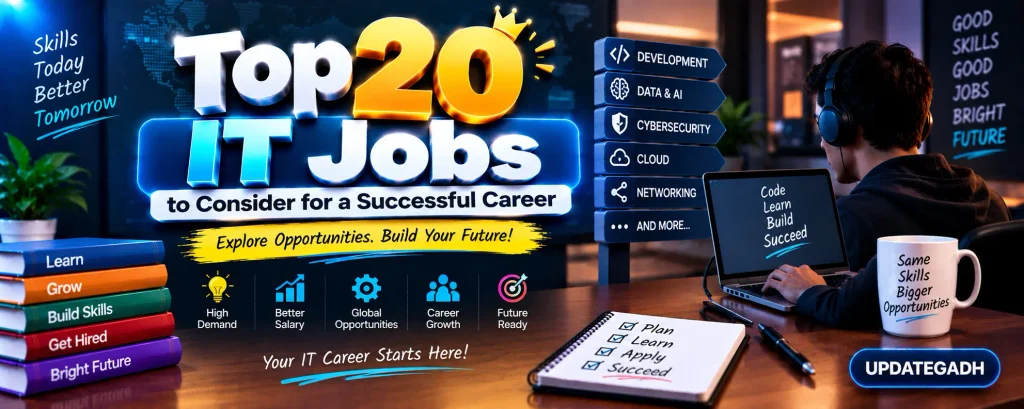
Top 20 IT Jobs to Consider for a Successful Career
The IT industry is changing quickly as artificial intelligence, cloud computing, cybersecurity, automation, data analytics, and software platforms become part of everyday business. For students, freshers, and experienced professionals, choosing a technology career now means looking beyond traditional programming and understanding the skills that are becoming more valuable.
Current workforce research points to strong growth around AI, big data, cybersecurity, technological literacy, and software development through the end of the decade. The World Economic Forum identifies AI and big data, networks and cybersecurity, and technological literacy among the fastest-growing skill areas, while its 2025 report lists AI/ML specialists, big data specialists, and software and application developers among the fastest-growing technology roles.
Complete Advance AI Topics: Click Here
SQL Tutorial: Click Here
YT:- DecodeIT
Top 20 IT Jobs at a Glance
| # | IT Job | Important Skills |
|---|---|---|
| 1 | Software Developer | Python, Java, C++, Git |
| 2 | Data Scientist | Python, SQL, Statistics, ML |
| 3 | Cybersecurity Analyst | Threat detection, Security tools |
| 4 | Cloud Engineer | AWS, Azure, Google Cloud |
| 5 | DevOps Engineer | CI/CD, Automation, Monitoring |
| 6 | AI/ML Engineer | Python, ML, Deep Learning |
| 7 | Network Administrator | Networking, Security, Troubleshooting |
| 8 | Systems Analyst | Business analysis, IT systems |
| 9 | Database Administrator | SQL, Backup, Performance tuning |
| 10 | Web Developer | HTML, CSS, JavaScript, React |
| 11 | IT Project Manager | Agile, Planning, Leadership |
| 12 | UX/UI Designer | UI design, UX research, Prototyping |
| 13 | Business Intelligence Analyst | SQL, Power BI, Tableau |
| 14 | Mobile App Developer | Kotlin, Swift, Flutter |
| 15 | IT Support Specialist | Troubleshooting, Hardware, Networking |
| 16 | Blockchain Developer | Solidity, Smart contracts |
| 17 | QA Engineer | Testing, Automation, Debugging |
| 18 | IT Consultant | Technology strategy, Analysis |
| 19 | Penetration Tester | Ethical hacking, Security testing |
| 20 | Full Stack Developer | Frontend, Backend, Databases |
1. Software Developer
Software developers create and maintain applications, platforms, APIs, and other digital products. Programming knowledge remains central to the role, with Python, Java, C++, JavaScript, and other languages used across different development environments. Software development is also being influenced by AI, automation, cloud services, and connected devices. U.S. projections currently show strong growth for software developers through 2034.
2. Data Scientist
Data scientists work with large datasets to discover patterns, generate insights, and support business decisions. Their work combines programming, statistics, data analysis, and machine learning. Python, SQL, statistics, and machine learning are useful foundations for entering this field. Current BLS projections show data scientists among the fastest-growing occupations in its 2024–2034 outlook.
3. Cybersecurity Analyst
Cybersecurity analysts help organizations identify threats, monitor systems, investigate suspicious activity, and strengthen security controls. Knowledge of networks, operating systems, security tools, and threat analysis can help build a career in this area. Cybersecurity is also highlighted as a rapidly growing technology skill area by the World Economic Forum.
4. Cloud Engineer
Cloud engineers design, configure, monitor, and maintain cloud-based infrastructure. AWS, Microsoft Azure, and Google Cloud are widely used platforms, while networking, Linux, security, containers, and automation are valuable supporting skills.
5. DevOps Engineer
DevOps engineers connect software development with infrastructure and operations. They work with CI/CD pipelines, automation, monitoring, containers, infrastructure tools, and deployment processes to make software delivery more consistent and efficient.
6. AI/ML Engineer
AI and machine learning engineers develop systems that use data and models to perform tasks such as prediction, classification, recommendation, automation, and language processing. Python, machine learning, deep learning, model deployment, and data handling are important skills. AI and machine learning specialists are among the technology roles expected to grow strongly through 2030.
7. Network Administrator
Network administrators manage and troubleshoot the infrastructure that allows computers, servers, applications, and users to communicate. Networking fundamentals, security practices, monitoring, and problem-solving are important for this career.
8. Systems Analyst
Systems analysts examine how organizations use technology and identify ways to improve processes and systems. They often work between business stakeholders and technical teams, so analytical thinking, communication, documentation, and IT knowledge are particularly useful.
9. Database Administrator (DBA)
Database administrators manage the availability, security, performance, and reliability of databases. SQL, backup and recovery, database security, monitoring, and performance optimization are common areas of responsibility.
10. Web Developer
Web developers create, update, and manage websites and web-based applications. Front-end development focuses on technologies such as HTML, CSS, and JavaScript, with frameworks like React helping developers build interactive user interfaces. Back-end development handles server-side functionality through programming languages, APIs, databases, and other server technologies.
11. IT Project Manager
IT project managers coordinate technology projects from planning through delivery. Their responsibilities can include scheduling, resource management, communication, risk tracking, documentation, and stakeholder coordination. Agile and project management knowledge can be valuable.
12. UX/UI Designer
UX/UI designers focus on how users interact with digital products. UX involves understanding user needs and designing useful experiences, while UI focuses on visual interfaces and interaction details. Research, wireframing, prototyping, usability testing, and design tools are common parts of the work.
13. Business Intelligence Analyst
Business intelligence analysts transform business data into reports, dashboards, and useful insights. SQL, spreadsheets, Power BI, Tableau, data visualization, and analytical thinking can help professionals work effectively in this area.
14. Mobile App Developer
Mobile developers create applications for smartphones and tablets. Kotlin is widely associated with Android development, Swift with Apple platforms, and Flutter can be used for cross-platform development. Understanding APIs, databases, UI design, and mobile performance is also useful.
15. IT Support Specialist
IT support specialists help users solve hardware, software, networking, and account-related problems. Strong troubleshooting ability and communication skills make this role a practical entry point for people beginning an IT career.
16. Blockchain Developer
Blockchain developers work with distributed-ledger technologies and decentralized applications. Depending on the project, useful skills can include blockchain concepts, smart contracts, Solidity, cryptography, and application development.
17. QA Engineer
Quality assurance engineers test software to identify defects and verify that applications meet expected requirements. Modern QA work can include manual testing, automated testing, API testing, regression testing, and continuous testing within development pipelines.
18. IT Consultant
IT consultants help organizations evaluate technology systems and plan improvements. The role can involve technology strategy, process analysis, system evaluation, implementation planning, and communication with business teams.
19. Penetration Tester
Penetration testers legally examine computer systems, networks, and applications to discover security weaknesses before they can be abused by attackers. A strong understanding of networking, Linux, web security, vulnerability testing, scripting, and ethical hacking techniques provides a useful foundation for this career.
20. Full Stack Developer
Full stack developers work across the front end and back end of web applications. They may handle interfaces, server-side logic, APIs, databases, authentication, and deployment. This broad skill set can be particularly useful for developers working on complete applications or smaller product teams.
Which IT Career Should You Choose for 2027?
There is no single career path that fits every student or professional. Your choice should depend on your interests, existing skills, preferred type of work, and the technologies you are willing to learn.
If you enjoy programming, software development and full stack development may be natural areas to explore. People interested in mathematics and data can investigate data science and AI/ML. Cybersecurity and penetration testing suit learners interested in digital security, while cloud and DevOps can appeal to those who enjoy infrastructure and automation.
Whatever path you select, building practical projects and continuously improving your technical and communication skills will remain important. The World Economic Forum expects technological skills to grow rapidly while also emphasizing creative thinking, analytical thinking, resilience, flexibility, and lifelong learning.
Frequently Asked Questions
Which IT jobs are expected to grow toward 2027?
Current global research highlights AI and machine learning, big data, software development, and cybersecurity-related roles among areas with strong growth expectations toward 2030. Exact hiring conditions in 2027 will vary by country, industry, employer, and economic conditions.
Which IT jobs can freshers consider?
Software development, web development, QA testing, IT support, and junior data-related roles can provide starting points for freshers. Building projects and demonstrating practical skills can strengthen an entry-level profile.
Do I need a degree for an IT career?
Requirements differ between employers and roles. A degree can be useful for many positions, while practical skills, certifications, projects, internships, and demonstrable technical ability may also contribute to employability.
What skills should IT students learn for 2027?
Programming, AI and data skills, cybersecurity, cloud technologies, automation, databases, and technological literacy are useful areas to explore. Human skills such as analytical thinking, creativity, communication, adaptability, and continuous learning are also expected to remain important.
Final Thoughts
The IT job market heading toward 2027 is being shaped by AI, cloud computing, cybersecurity, data, automation, and software development. Rather than focusing only on a job title, students should build a strong foundation and then specialize in an area that matches their interests.
Technology will continue to change, so the ability to learn new tools may be just as important as knowing today’s technologies. Start with one career path, build real projects, strengthen your fundamentals, and keep updating your skills as the industry evolves.
SEO Details
SEO Title: Top 20 IT Jobs to Consider for a Successful Career in 2027
Meta Description: Explore 20 IT jobs to consider for 2027, including AI/ML, software development, cybersecurity, cloud, DevOps, data science, web development, and more.
Primary Keyword: Top 20 IT Jobs to Consider for a Successful Career in 2027
Keywords: top 20 IT jobs 2027, IT jobs in demand 2027, future IT jobs, best IT careers for freshers, IT jobs in India, high demand technology jobs, AI jobs, machine learning jobs, software developer jobs, data scientist jobs, cybersecurity jobs, cloud engineer jobs, DevOps jobs, web developer jobs, full stack developer jobs, IT career options, future technology careers,Top 20 IT Jobs to Consider for a Successful Career ,Top 20 IT Jobs to Consider for a Successful Career