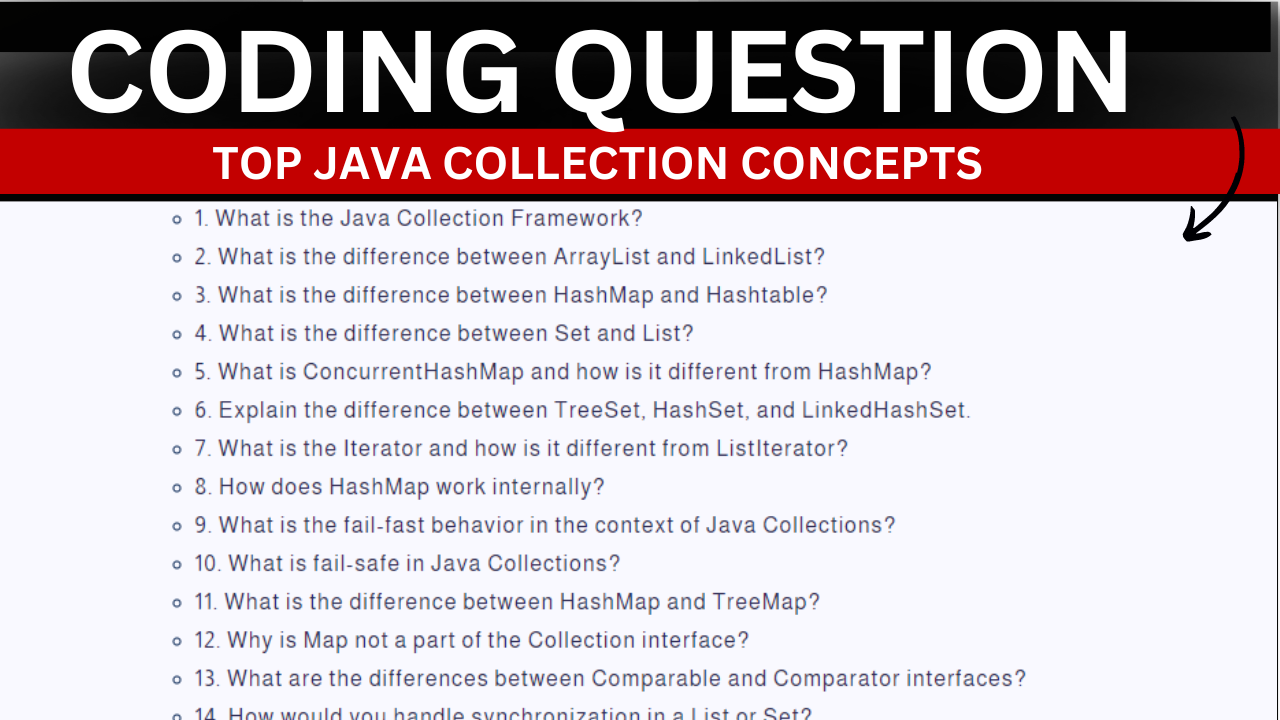
Top Java Collection Framework Interview Questions for Automation Testers
Java Collections are an important part of automation testing because test frameworks frequently need to store, search, organize, compare, and process groups of data. Understanding interfaces such as List, Set, Map, Queue, and Deque can help automation testers write cleaner and more efficient test code.
Interviewers often ask questions about collection implementations, ordering, duplicate values, thread safety, iteration, and internal behavior. The following questions cover important Java Collection concepts that automation testers should prepare before an interview.

Complete Advance AI Topics: Click Here
SQL Tutorial: Click Here
Top 15 Java Collection Interview Questions and Answers
1. What is the Java Collection Framework?
Answer: The Java Collection Framework provides a standard set of interfaces and classes for working with groups of objects. It includes functionality for storing, retrieving, searching, sorting, inserting, and removing data. Common collection interfaces include List, Set, Map, Queue, and Deque.
2. How are ArrayList and LinkedList different?
Answer: ArrayList uses a dynamically sized array and is generally convenient when elements need to be accessed by index. Inserting or removing elements from the middle can require shifting other elements.
LinkedList uses a doubly linked structure. It can be useful for insertion and removal operations when the required node position is already known, but accessing an element by index requires traversal through the list.
3. What is the difference between HashMap and Hashtable?
Answer: HashMap is not synchronized and permits null keys and values. Hashtable provides synchronization and does not permit null keys or values. Because synchronization adds overhead, HashMap is generally preferred when built-in thread safety is not required.
4. How does Set differ from List?
Answer: A List can contain duplicate elements and normally preserves insertion order. A Set is designed to store unique elements. The ordering behavior depends on the implementation; for example, LinkedHashSet maintains insertion order.
5. What is ConcurrentHashMap?
Answer: ConcurrentHashMap is a collection designed for concurrent access by multiple threads. It supports thread-safe operations without requiring the entire map to be locked for every operation. In contrast, a regular HashMap is not designed for concurrent modification by multiple threads.
6. Compare TreeSet, HashSet, and LinkedHashSet.
Answer:
HashSetstores unique elements without guaranteeing a particular iteration order.LinkedHashSetstores unique elements while preserving insertion order.TreeSetstores unique elements according to their natural ordering or a supplied comparator.
The appropriate implementation depends on whether your test data requires uniqueness, insertion order, or sorted order.
7. What is the difference between Iterator and ListIterator?
Answer: Iterator provides forward traversal through a collection. ListIterator is specifically designed for lists and supports movement in both forward and backward directions. It also provides additional operations for modifying list elements during traversal.
8. How does HashMap work internally?
Answer: A HashMap uses the hash value of a key to determine where an entry should be stored within its internal bucket structure. If multiple keys map to the same bucket, a collision occurs and the entries must be handled together.
In Java 8 and later, heavily populated collision buckets can be converted from a linked structure into a balanced tree structure when certain conditions are met, improving lookup performance in those cases.
9. What does fail-fast mean in Java Collections?
Answer: A fail-fast iterator detects certain structural changes made to a collection while it is being traversed and may throw a ConcurrentModificationException. Collections such as ArrayList and HashMap commonly demonstrate this behavior when modified incorrectly during iteration.
10. What is fail-safe behavior in Java Collections?
Answer: The term fail-safe is commonly used for collection iteration approaches that allow certain modifications without producing the same concurrent-modification behavior as ordinary fail-fast iterators. Examples often discussed include ConcurrentHashMap and CopyOnWriteArrayList.
11. What is the difference between HashMap and TreeMap?
Answer: HashMap stores key-value mappings without guaranteeing a sorted order and permits a null key. TreeMap maintains its entries according to natural key ordering or a comparator and is designed for ordered map operations.
12. Why is Map separate from the Collection interface?
Answer: A Collection represents a group of individual elements, whereas a Map represents relationships between keys and values. Since these structures serve different purposes, Map exists separately rather than extending the Collection interface.
13. What is the difference between Comparable and Comparator?
Answer: Comparable is used when a class defines its natural ordering through the compareTo() method. Comparator provides an external way to define a particular ordering using the compare() method.
For automation testing, Comparator can be especially useful when test data needs to be sorted according to different criteria.
14. How can a List or Set be synchronized?
Answer: Java provides utility methods such as Collections.synchronizedList() and Collections.synchronizedSet() for creating synchronized collection wrappers.
For scenarios involving concurrent access, specialized collections such as CopyOnWriteArrayList and ConcurrentSkipListSet can also be considered depending on the application’s requirements.
15. What are good practices for using Collections in automation testing?
Answer: The collection should be selected according to the operation your automation code performs most frequently.
- Use
ArrayListwhen convenient indexed access is important. - Consider
LinkedListfor use cases involving frequent insertion or removal operations. - Use concurrent collections when test execution involves multiple threads and shared collection data.
- Use
Comparatorwhen test data needs to be sorted according to custom rules. - Choose collections based on data uniqueness, ordering, access patterns, and thread-safety requirements.
YT:- DecodeIT
Why Java Collections Matter in Automation Testing
Automation scripts frequently process test data such as user records, browser elements, API responses, configuration values, expected results, and execution reports. Choosing an appropriate collection can make these operations easier to manage and can improve the readability of test code.
For automation testers, collection knowledge is therefore useful not only for interviews but also for writing practical Java-based test automation programs.
Final Thoughts
Java Collection Framework questions are common in technical discussions because they test both basic Java knowledge and practical understanding of data handling. Automation testers should be comfortable explaining the behavior of List, Set, Map, iteration mechanisms, sorting interfaces, and concurrent collections.
Along with memorizing definitions, practice these concepts through small Java programs. Working with real test data will make it easier to understand which collection is appropriate for a particular automation scenario.
Frequently Asked Questions
1. Which Java collections should automation testers learn first?
Start with ArrayList, LinkedList, HashSet, LinkedHashSet, TreeSet, HashMap, and TreeMap. Then move toward concurrent collections and iterator behavior.
2. Why are collections useful in automation testing?
They help testers store and process groups of test data, application elements, API results, expected values, and other information required during automated execution.
3. Which collection allows duplicate values?
List implementations such as ArrayList and LinkedList allow duplicate elements. Set implementations are designed to maintain unique elements.
4. What is commonly used for key-value data in Java?
The Map family is designed for key-value relationships. HashMap and TreeMap are two commonly discussed implementations.
5. Why should automation testers understand thread-safe collections?
Automation frameworks may execute tests concurrently. Understanding thread-safe collections can help when multiple test threads need to work with shared data.
Keywords: Java Collection interview questions, Java collections interview questions for automation testers, Java Collection Framework questions, Java automation interview questions, ArrayList vs LinkedList, HashMap vs Hashtable, HashMap vs TreeMap, List vs Set, ConcurrentHashMap, Java Iterator interview questions