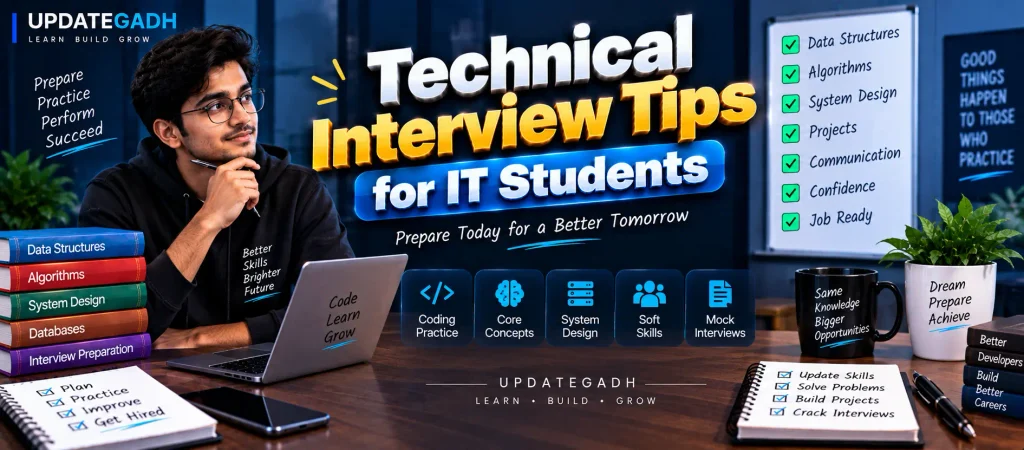
Technical Interview Tips
Getting ready for an IT interview involves more than studying programming languages or memorizing technical definitions. Interviewers often want to understand how you solve problems, explain your ideas, work with others, and apply your knowledge to practical situations.
For students preparing for their first technical interview, the process can seem challenging. A structured preparation strategy can make it easier to identify weak areas and build confidence. Here are seven practical areas that IT students should focus on before attending a technical interview.
YT:- DecodeIT
1. Strengthen Your Technical Fundamentals
A strong foundation in computer science concepts can help you approach a wide range of technical questions. Pay particular attention to data structures, algorithms, operating systems, and databases.
Important areas include arrays, linked lists, trees, graphs, sorting, searching, process synchronization, and database normalization.
Examples of questions you may encounter:
- How can a stack be implemented using a linked list?
- What are the main differences between merge sort and quick sort?
- What is a semaphore, and why is it useful in process synchronization?
- What problem does database normalization solve?
Tip: Practice explaining concepts without depending completely on an IDE. Focus on understanding the logic, expected output, and time and space complexity of your solutions.
2. Solve Coding Problems Regularly
Programming practice helps improve both problem-solving ability and coding speed. Platforms such as LeetCode, HackerRank, and Codeforces provide problems ranging from beginner-level exercises to more advanced challenges.
Try practicing different categories instead of repeatedly solving the same type of problem.
Example problems include:
- Find the maximum product of two numbers in an array.
- Solve the 0/1 knapsack problem using dynamic programming.
- Determine whether a string is a palindrome.
Tip: Set a time limit for practice sessions. After solving a problem, review whether your solution can be made simpler or more efficient.
3. Understand Different Interview Formats
Technical interviews can contain several types of assessments. Preparing for only coding questions may leave you unprepared for other parts of the process.
- Behavioral Questions: Explore teamwork, communication, and workplace situations.
- Coding Questions: Test your ability to develop solutions under time constraints.
- System Design: Examines how you approach the architecture and scalability of larger applications.
For example, you may be asked to write a program for calculating the nth Fibonacci number using different approaches, or design a URL-shortening service capable of handling a large number of requests.
Tip: Practice explaining your reasoning while solving a problem. Interviewers may evaluate your approach, not just the final code.
4. Know Your Projects Thoroughly
Your academic, personal, or internship projects can become an important part of a technical interview. Be prepared to explain what you built, why you selected particular technologies, what problems you encountered, and what you personally contributed.
Interviewers may ask questions such as:
- What was the most difficult part of your project?
- Why did you select a particular technology?
- How did you identify and fix a difficult bug?
- How did your team divide responsibilities?
- What would you improve if you developed the project again?
Tip: Prepare a few project stories in advance, but do not memorize them word for word. Clearly distinguish your own contribution from the work completed by other team members.
5. Prepare for System Design Topics
Students applying for some software engineering positions may encounter basic system-design discussions, while more experienced roles generally require deeper knowledge. Start by understanding concepts such as scalability, load balancing, caching, databases, and microservices.
Practice designing familiar applications such as a chat platform, e-commerce website, or social media service. Think about how users interact with the system, where information is stored, how requests are distributed, and how the application could handle increasing traffic.
Example questions:
- How would you design a chat application for a large number of users?
- What role does a load balancer play in a web application?
- What are the advantages and disadvantages of microservices?
Tip: Do not focus only on drawing architecture diagrams. Explain why you selected each component and discuss the trade-offs involved.
6. Improve Communication and Other Soft Skills
Technical knowledge is much more useful when you can explain it clearly. During an interview, you may need to communicate with people who have different levels of technical knowledge.
Work on skills such as:
- Clear communication
- Team collaboration
- Active listening
- Logical problem-solving
- Receiving and applying feedback
You may be asked how you explained a technical issue to a non-technical person, handled a disagreement with a teammate, or approached a problem without an obvious solution.
Tip: During practice interviews, concentrate on explaining your reasoning in a simple and organized manner rather than trying to sound overly technical.
Complete Advance AI Topics: Click Here
SQL Tutorial: Click Here
7. Use Mock Interviews and Peer Reviews
Mock interviews provide an opportunity to practice under conditions similar to an actual interview. You can ask a classmate, mentor, teacher, or experienced developer to conduct a practice session.
Peer code reviews are also useful because another person may identify issues related to readability, efficiency, structure, or coding practices that you overlooked.
Group discussions can provide additional practice for explaining technical decisions and considering alternative approaches.
Tip: After every mock interview, write down the questions you struggled with and review those topics before your next session.
Technical Interview Preparation Checklist
- Review core computer science concepts.
- Practice coding problems consistently.
- Study basic system-design principles.
- Prepare detailed explanations of your projects.
- Practice behavioral and technical questions.
- Improve your communication skills.
- Take regular mock interviews.
- Review mistakes instead of simply moving to the next problem.
Final Thoughts
Technical interview preparation becomes much more manageable when you approach it as a combination of technical learning, coding practice, project knowledge, communication, and interview simulation.
IT students should focus on understanding concepts rather than memorizing answers. Practice solving problems independently, explain your approach clearly, and become comfortable discussing your own projects. Consistent preparation can help you enter technical interviews with a better understanding of what to expect and how to present your skills.
Frequently Asked Questions
1. What should IT students study for technical interviews?
Focus on data structures, algorithms, databases, operating systems, programming fundamentals, project knowledge, and basic system-design concepts relevant to the position.
2. Are coding platforms useful for interview preparation?
Yes. Platforms such as LeetCode, HackerRank, and Codeforces provide problems that can help you practice algorithmic thinking and coding under time constraints.
3. Should freshers prepare system design?
Basic system-design knowledge can be useful, but the required depth depends on the position and interview process. Start with fundamental concepts before moving toward complex architectures.
4. How should I prepare to discuss my projects?
Understand every important part of your project, including its purpose, technologies, database, major features, challenges, your contribution, and possible improvements.
5. Why are mock interviews important?
They help you practice communicating your thoughts, managing interview time, responding to unexpected questions, and identifying areas that need more preparation.
Keywords: technical interview tips, technical interview tips for IT students, technical interview preparation, coding interview tips, technical interview questions and answers, interview tips for freshers, IT interview preparation, software developer interview tips, system design interview tips, coding interview preparation, technical interview tips and tricks