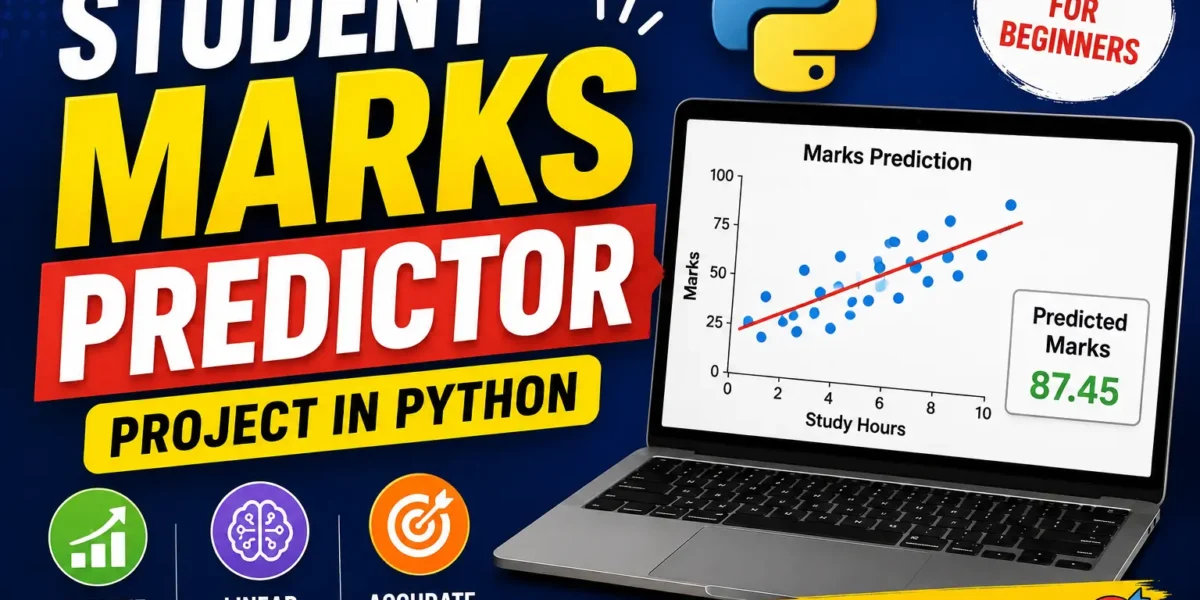
The Student Marks Predictor project in Python is the single best starting point for any student who wants to genuinely understand machine learning instead of merely calling library functions. Most tutorials hand you three lines of scikit-learn code and call it artificial intelligence. This project takes the opposite approach: every part of the learning algorithm is written by hand, using nothing but Python and NumPy arrays.
Table of Contents
By the end of this project, you will have built a working predictive model that estimates a student’s examination marks from their study hours and attendance percentage. More importantly, you will understand gradient descent, loss functions, feature scaling, and train-test splitting well enough to defend every line in a viva. This post walks through the complete project, explains how it works internally, and shows you exactly how to run it on your own machine.
| Attribute | Details |
|---|---|
| Project Name | Student Marks Predictor |
| Language | Python 3.8+ |
| Framework | NumPy |
| Database | CSV file storage |
| Project Type | Machine Learning / Predictive Analytics |
| Algorithm | Linear Regression with Gradient Descent |
| Difficulty | Beginner to Intermediate |
| Best For | BCA, MCA, B.Tech CS/IT, M.Tech |
| Category | Artificial Intelligence and Machine Learning |
| Platform | Windows, Linux, macOS |
| Developer | Updategadh |
About the Student Marks Predictor Project
Educational institutions collect enormous amounts of student data every semester: attendance registers, study logs, internal assessment scores, and final results. Yet most of this data is filed away and never used. Faculty rarely have a systematic way to identify which students are drifting towards failure until the results are already published, at which point intervention is too late to help anyone. The underlying question is simple but rarely answered with evidence: which measurable behaviours actually influence academic performance, and by how much?
This project answers that question with a predictive model built from first principles. Given historical records of study hours, attendance percentages, and resulting marks, the model discovers the mathematical relationship hidden inside that data entirely on its own. Nobody supplies the formula. The algorithm begins with a deliberately terrible guess, measures how wrong it is, adjusts slightly in the direction that reduces error, and repeats that cycle a thousand times until the wrongness stops shrinking. What emerges is an interpretable equation stating precisely how many marks each additional study hour is worth, and how much each percentage point of attendance contributes.
Key Features of the Marks Predictor Project
Core Machine Learning Features
- Hand-Written Gradient Descent: The optimisation loop is implemented from scratch, with no reliance on scikit-learn, TensorFlow, or PyTorch. Every weight update is visible and explainable.
- Multi-Feature Linear Regression: The model learns from two independent variables simultaneously, study hours and attendance, each with its own learned weight.
- Mean Squared Error Loss: A custom loss function that squares each prediction error, preventing positive and negative mistakes from cancelling each other out.
- Analytical Gradient Computation: Partial derivatives with respect to every weight and the bias term are derived and coded manually rather than obtained through automatic differentiation.
Data Handling Features
- Train-Test Splitting: Twenty percent of records are withheld during training and revealed only at evaluation time, producing an honest accuracy estimate rather than a memorised one.
- Feature Standardisation: Input columns are rescaled to zero mean and unit variance so that a large-magnitude feature such as attendance cannot dominate the gradient signal.
- Data Leakage Prevention: Scaling statistics are computed exclusively on the training partition and then applied to the test partition, a discipline most beginner projects violate silently.
Evaluation and Interpretation Features
- Multiple Evaluation Metrics: Root Mean Squared Error, Mean Absolute Error, and R-squared are all computed independently and reported side by side for training and test sets.
- Weight Un-Scaling: Learned coefficients are converted back from standardised units into real-world units, so the final equation can be read and understood by a non-technical examiner.
- Model Persistence: Trained weights and scaling parameters are saved to disk so the model can make predictions later without retraining.
- New Student Prediction: The trained model accepts fresh input values and returns an estimated mark instantly.
Technologies Used in This Python Machine Learning Project
| Layer | Technology | Purpose |
|---|---|---|
| Programming Language | Python 3.8 or above | Core implementation of all logic |
| Numerical Computing | NumPy | Vector and matrix operations for predictions and gradients |
| Data Input | Python csv module | Reading the student dataset from disk |
| Machine Learning | Custom implementation | Gradient descent, loss, and metrics written manually |
| Model Storage | NumPy npz format | Persisting trained weights and scaler statistics |
| Development Environment | VS Code, PyCharm, or Jupyter Notebook | Writing and executing the project code |
| Runtime | Standard CPU | No GPU required at any stage |
How the Student Marks Predictor Works
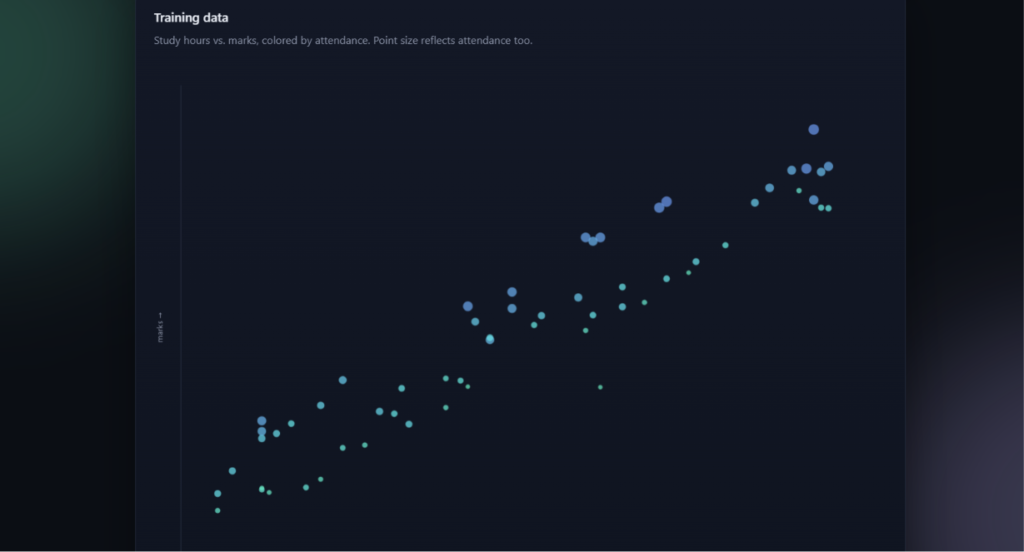
- Load the dataset. Sixty student records are read from a CSV file. Each record contains study hours, attendance percentage, and the marks eventually obtained.
- Split the data. Records are shuffled and divided. Forty-eight students form the training set. Twelve are hidden away entirely and used only for the final honest evaluation.
- Scale the features. The mean and standard deviation of the training columns are computed, then both columns are standardised. Attendance values near one hundred and study hours near ten are brought onto a common scale.
- Initialise the model. Both weights and the bias term begin at zero, meaning the untrained model predicts zero marks for every single student. It is maximally wrong, and that wrongness is precisely the signal it learns from.
- Predict. Each student’s scaled features are multiplied by the current weights and summed with the bias to produce a predicted mark.
- Measure the loss. Every prediction is compared against the true mark. Differences are squared and averaged into a single number describing total wrongness.
- Compute the gradients. For each weight, a partial derivative is calculated. A negative gradient means the weight is too small and must be increased. A positive gradient means the opposite.
- Update the weights. Each parameter moves a small step in the direction opposite to its gradient. The size of that step is controlled by the learning rate.
- Repeat. Steps five through eight run one thousand times. Loss falls steeply at first, then plateaus once the model has extracted every learnable pattern from the data.
- Evaluate and interpret. The twelve hidden students are finally revealed. Metrics are computed, weights are converted back to real-world units, and the model outputs a readable equation describing what it discovered.
Medicine Recommendation System using ML
How to Run This Machine Learning Project
Step 1: Prerequisites
You need Python 3.8 or higher installed on your system. No GPU, no cloud account, and no paid services are required. Verify your installation before proceeding.
python --versionStep 2: Download the Project
Download the complete project package from Updategadh and extract it to a working folder on your machine.
cd student-marks-predictorStep 3: Install Dependencies
Only one external library is needed. Installing it inside a virtual environment is recommended but optional.
python -m venv venv
source venv/bin/activate
pip install numpy
Windows users should activate the environment with the following command instead.
venv\Scripts\activateStep 4: Verify the Dataset
Confirm that the dataset file sits in the same directory as the Python script. It should contain three columns and sixty rows of student records.
hours,attendance,marks
3.6,53.3,29.4
5.6,65.1,46.2
1.1,72.9,23.8
Step 5: Train the Model
Execute the main script. Training completes in under a second on any modern processor.
python marks_predictor.pyStep 6: Read the Output
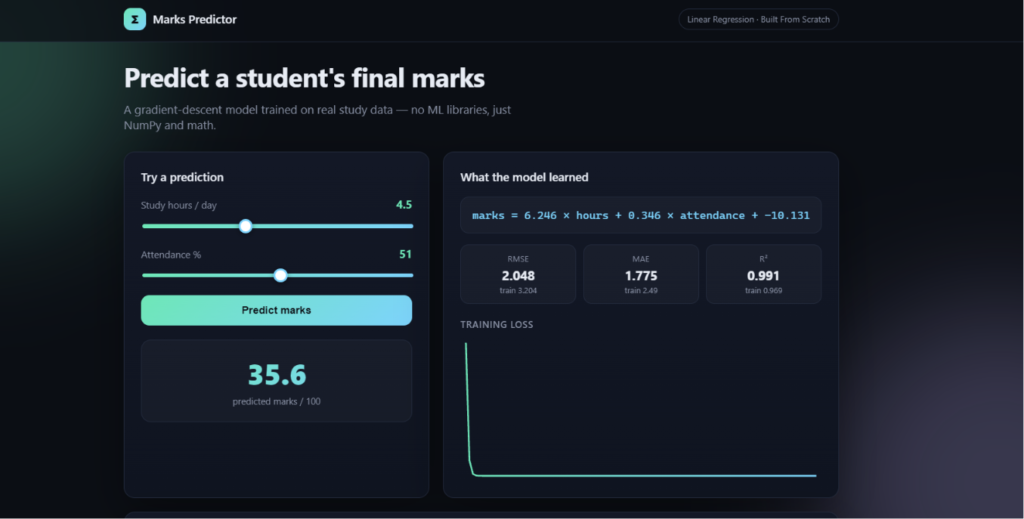
The script prints the loss at regular intervals, the final evaluation metrics for both training and test sets, the learned equation in real-world units, and sample predictions for new students. A trained model file is written to disk automatically.
Project Screenshots
Why This Is a Great Final Year Project
- Viva-Ready Depth Examiners routinely ask candidates to explain what gradient descent actually does. Students who imported a library cannot answer. Students who wrote the update rule themselves can explain it at the whiteboard without hesitation.
- Genuinely Original Work Because no machine learning library is used, this project cannot be dismissed as copy-pasted tutorial code. The core algorithm is yours.
- Placement-Relevant Fundamentals Loss functions, overfitting, train-test splitting, and feature scaling appear in almost every data science and machine learning interview conducted today.
- Resume-Worthy Framing Describing yourself as someone who implemented linear regression and gradient descent from scratch carries considerably more weight than listing scikit-learn as a skill.
- Zero Hardware Cost No GPU, no cloud credits, and no paid subscriptions. The entire project trains in under a second on a basic laptop.
- A Natural Foundation Logistic regression, neural networks, and deep learning all reuse the identical training loop. This project makes every subsequent machine learning topic dramatically easier to learn.
- Complete Documentation Included The package ships with a report, synopsis, and presentation, leaving you free to concentrate on understanding the code.
How to Download This Project
The complete Student Marks Predictor package is available from Updategadh and includes everything required for submission:
For customisation requests, additional features, or any assistance with setup, reach out directly.
WhatsApp: +91 79834 34684
Possible Extensions and Future Enhancements
- Add further input features such as previous semester marks, assignment submission rate, or number of backlogs, and observe how each affects predictive accuracy
- Implement polynomial regression to capture the realistic possibility that returns on study hours diminish beyond a certain point
- Add L2 regularisation, commonly called ridge regression, to prevent any single weight from growing disproportionately large
- Replace full-batch gradient descent with mini-batch or stochastic gradient descent so the model can train on datasets too large to fit in memory
- Implement k-fold cross validation to replace the single train-test split, producing a far more reliable accuracy estimate on small datasets
- Build a Flask or Streamlit web interface allowing faculty to enter student details and receive an instant predicted mark
- Add early stopping so training halts automatically once the loss ceases improving, rather than running a fixed number of epochs
- Extend the model into logistic regression to classify students as pass or fail rather than predicting an exact numeric mark
Watch the Project Tutorial
A full walkthrough covering the mathematics, the code, and the common mistakes that silently break machine learning projects is available on our YouTube channel, alongside dozens of other final year project tutorials.
Subscribe to DecodeIT2 on YouTube
Frequently Asked Questions
Do I need to know advanced mathematics to understand this project?
Basic algebra is sufficient to follow the entire project. Calculus helps you understand where the gradient formulas originate, but the code and the accompanying explanation state clearly what each derivative does in practical terms. Thousands of students complete this project without any calculus background whatsoever.
Is this suitable for BCA, MCA, or B.Tech final year submission?
Yes. The Student Marks Predictor project in Python is appropriate for BCA, MCA, B.Tech CS/IT, and M.Tech submissions. Because the algorithm is implemented from scratch rather than imported, it demonstrates genuine understanding and stands up to detailed examiner questioning far better than a library-based project.
Why does this project avoid scikit-learn entirely?
Calling a library function teaches you the name of an algorithm, not the algorithm. Writing the gradient descent loop by hand means you can explain exactly why the loss decreases, what the learning rate controls, and what happens when training diverges. That understanding transfers directly to every neural network you will build afterwards.
Can I use my own college dataset instead of the provided one?
Absolutely, and doing so significantly strengthens your submission. Provided your CSV contains numeric feature columns and a numeric target column, the code requires only minimal modification. Collecting genuine data from your own institution transforms this into original research rather than a reproduction.
Does the download package include a report, synopsis, and presentation?
Yes. Every project package from Updategadh includes the complete source code, the sample dataset, a full project report, a synopsis document, and a ready-to-present PowerPoint deck.
- student marks prediction project report
- student marks prediction using machine learning github
- student marks prediction dataset
- student marks prediction model
- student marks dataset csv
- student performance prediction project github
- student marks dataset excel download
- student marks predictor csv