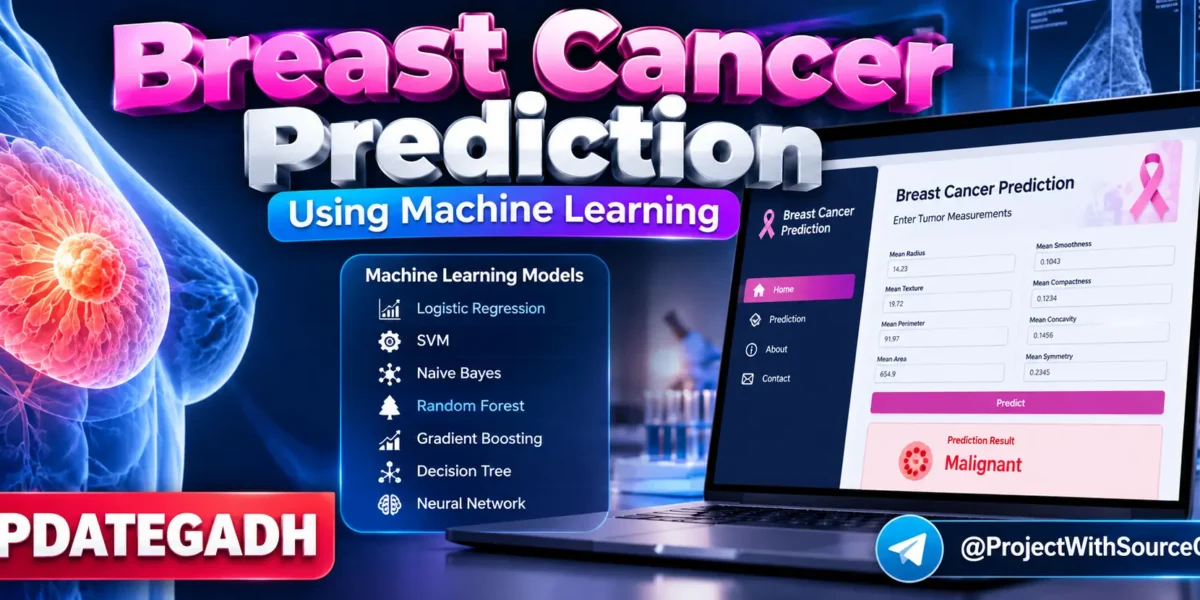
Breast Cancer Prediction Using Machine Learning
Breast cancer is one of the most common health conditions affecting women worldwide. Early identification of breast tumors can play an important role in improving treatment planning and patient outcomes. With the growth of machine learning, healthcare datasets can be analyzed to identify patterns that may help classify medical conditions.
The Breast Cancer Prediction Project, developed by UPDATEGADH, is a machine learning-based application designed to classify breast tumors as benign or malignant. The project uses medical measurements from the Breast Cancer Wisconsin Diagnostic Dataset and applies multiple classification algorithms to determine which model performs best.
This project is useful for students who want to understand how machine learning can be implemented in a practical healthcare-related application. It covers important concepts such as data preprocessing, feature transformation, model training, model evaluation, prediction pipelines, and Flask-based deployment.
Fake Currency Detection Using AI and Python :-Click Here
Complete Advance AI Topics: Click Here
Real Time Projects on YouTube:- DecodeIT
Project Overview
| Project Name | Breast Cancer Prediction Using Machine Learning |
|---|---|
| Language/s Used | Python |
| Machine Learning | Scikit-learn |
| Framework | Flask |
| Database | Not Required |
| Dataset | Breast Cancer Wisconsin Diagnostic Dataset |
| Project Type | Machine Learning Web Application |
Dataset Information
The project uses the Breast Cancer Wisconsin Diagnostic Dataset, a commonly used dataset for binary classification problems in machine learning. The dataset contains measurements extracted from breast tumor samples.
- Number of Features: 30
- Problem Type: Binary Classification
- Prediction Classes: Benign and Malignant
- Dataset Library: Scikit-learn
Important Features
The dataset contains measurements related to different characteristics of the tumor, including:
- Mean radius
- Mean texture
- Mean perimeter
- Mean area
- Mean smoothness
- Mean compactness
- Mean symmetry
- Mean fractal dimension
- Standard error measurements
- Worst-case measurements
Car Price Prediction System Using Machine Learning :- Click Here
Machine Learning Algorithms Used
Multiple machine learning classification algorithms are trained and evaluated in the project. Their performance is compared using different evaluation metrics before selecting the model for prediction.
- Logistic Regression
- Support Vector Machine (SVM)
- Gaussian Naive Bayes
- Random Forest
- Gradient Boosting
- Decision Tree
- Neural Network using MLP Classifier
The models are evaluated using metrics such as accuracy, precision, recall, and F1-score. The better-performing model is selected for the prediction process.
Available Features
- Breast tumor classification
- Benign and malignant prediction
- Multiple machine learning algorithms
- Dataset preprocessing
- Feature transformation
- Model training and evaluation
- Prediction pipeline
- Flask-based web interface
- Real-time prediction through user input
- Logging and exception handling
- Saved trained machine learning model
- Jupyter Notebook support for data analysis
Project Structure
The project follows a modular structure that separates data processing, model training, prediction, and web application components.
Important Files and Directories
- requirements.txt: Contains the Python libraries required to run the project.
- application.py: Main Flask application responsible for the web interface and prediction functionality.
- notebooks/: Contains Jupyter Notebooks used for data exploration, visualization, and model development.
- setup.py: Provides project configuration settings.
- src/: Contains the main source code.
- artifacts/: Stores processed datasets and the trained model.
- templates/: Contains HTML templates used by the Flask application.
ML Components
- data_ingestion.py: Loads and prepares the dataset.
- data_transformation.py: Handles preprocessing and transformation of the input data.
- model_trainer.py: Trains and evaluates the machine learning models.
- training_pipeline.py: Controls the model training workflow.
- prediction_pipeline.py: Handles predictions using the trained model.
- exception.py: Provides custom exception handling.
- logger.py: Maintains application and execution logs.
- utils.py: Contains reusable utility functions.
How to Download
The complete package is available so you can run, study, and submit it with confidence.
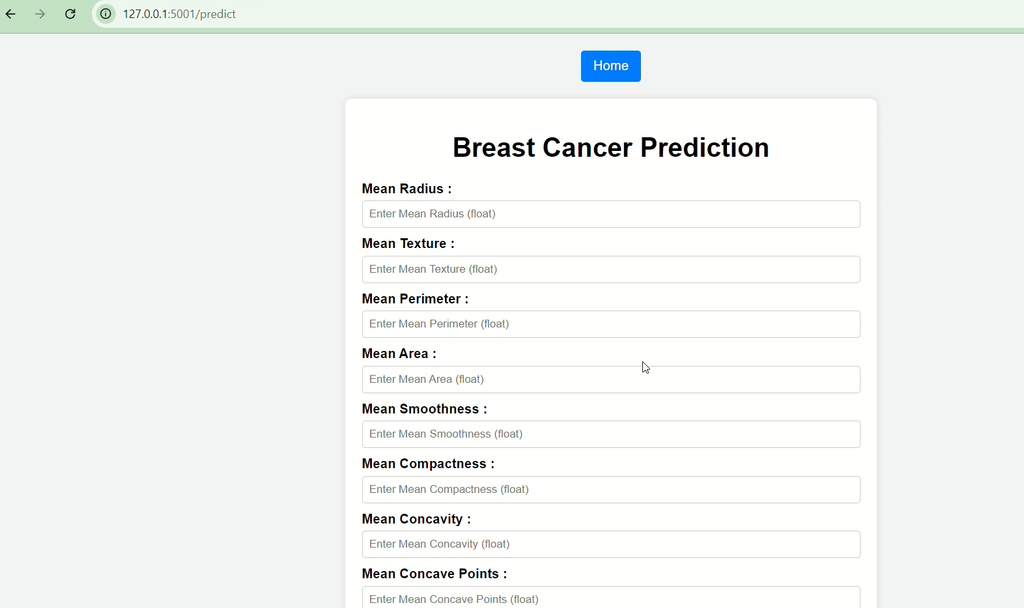
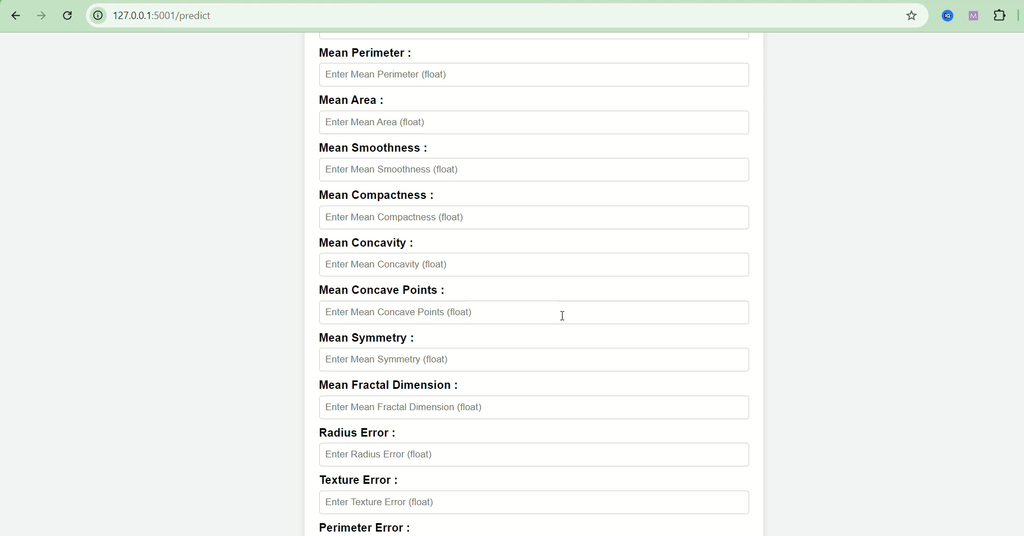
Screenshot
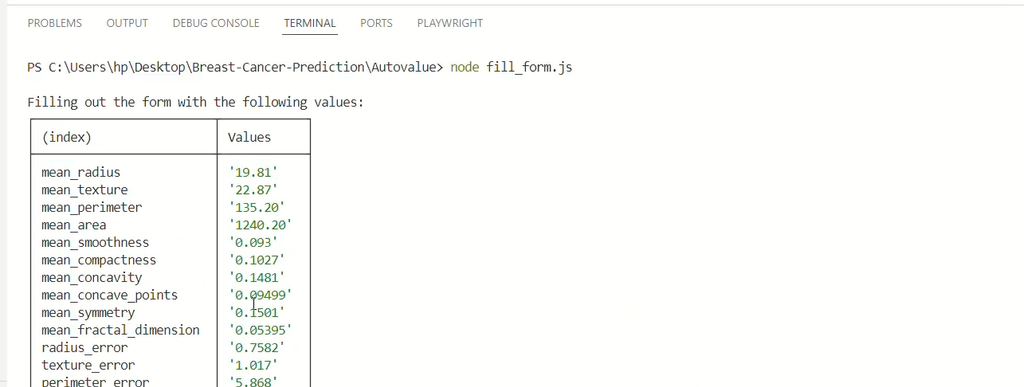
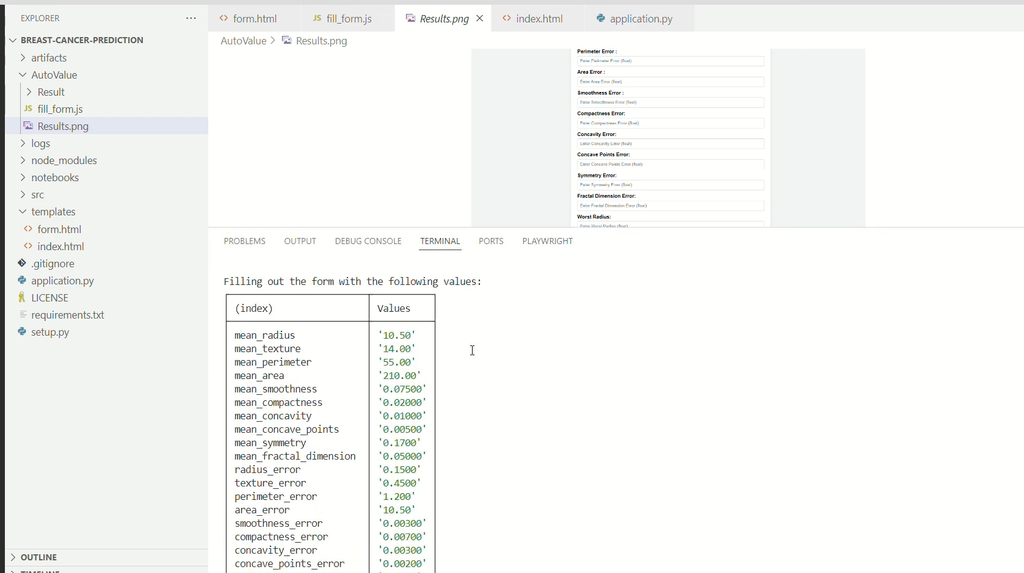
How the Project Works
1. Data Preprocessing
The dataset is loaded and prepared before it is provided to the machine learning algorithms. The preprocessing stage handles the required transformations and prepares the medical features for model training.
2. Model Training
Multiple classification algorithms are trained using the prepared dataset. Each model is evaluated to understand its prediction performance.
3. Model Evaluation
The trained models are compared using evaluation metrics such as accuracy, precision, recall, and F1-score. Based on the evaluation results, the better-performing model is selected for the prediction process.
4. Flask Web Application
The trained model is integrated with a Flask application. Users can enter the required medical parameters through the web interface, after which the application processes the input and generates a tumor classification prediction.
5. Prediction
The prediction pipeline loads the trained model and applies the same required transformations to the user-provided input. The system then returns the predicted classification as benign or malignant.
Software and Tools Required
- Python
- VS Code or another Python-compatible IDE
- Flask
- Scikit-learn
- NumPy
- Pandas
- Jupyter Notebook
- Web Browser
Installation Guide
Follow these steps to run the project in VS Code.
Step 1: Open the Project
Open the project folder in VS Code.
Step 2: Create a Virtual Environment
python -m venv venvStep 3: Activate the Virtual Environment
For Windows:
venv\Scripts\activateStep 4: Install Dependencies
pip install -r requirements.txtStep 5: Run the Flask Application
python application.pyAfter starting the application, open the local Flask address shown in the terminal in your web browser.
Usage
Once the application is running, users can access the prediction interface through their browser. The required tumor-related parameters can be entered into the provided form. After submitting the information, the trained machine learning model processes the input and displays the predicted tumor classification.
This workflow allows students to understand how a trained machine learning model can be connected to a web application and used for interactive predictions.
Project Benefits
- Helps students understand machine learning classification.
- Demonstrates practical use of healthcare-related datasets.
- Provides experience with multiple ML algorithms.
- Explains the complete workflow from data preprocessing to prediction.
- Demonstrates Flask-based machine learning deployment.
- Provides a modular project structure for easier maintenance.
Future Enhancements
The project can be further improved by using larger and more diverse datasets, deploying the prediction system through a cloud-based API, and experimenting with advanced deep learning approaches where appropriate.
Additional improvements can also focus on improving the web interface, adding better model monitoring, and providing more detailed prediction reports.
Final Thoughts
From a student’s perspective, the Breast Cancer Prediction Using Machine Learning project is a practical way to understand how machine learning concepts can be applied to a real-world classification problem. Instead of focusing only on model training, the project demonstrates the complete workflow, including preprocessing, multiple algorithm comparison, evaluation, prediction pipelines, and Flask deployment.
Breast Cancer Prediction Using Machine Learning,Breast Cancer Prediction, Breast Cancer Prediction Using Breast Cancer Prediction Using – Google Search breast cancer prediction using machine learning breast cancer prediction using machine learning project breast cancer prediction using machine learning research paper breast cancer prediction using machine learning github breast cancer prediction using deep learning breast cancer prediction using machine learning project report pdf breast cancer prediction using machine learning python code breast cancer prediction using machine learning classification algorithms breast cancer prediction using machine learning project ppt