AI-Based Smart Energy Consumption Analyzer and Optimization System — Final Year Project Guide
Are you looking for a final year project on Artificial Intelligence and Machine Learning that is practical, impressive, and easy to explain in your university viva? The AI-Based Smart Energy Consumption Analyzer and Optimization System is one of the best choices available for B.Tech, MCA, and BCA students.
This project uses Python, XGBoost, Flask, and Groq AI API to monitor electricity usage, predict future consumption, estimate electricity bills, and give smart energy-saving recommendations — all through a secure web application.
In this post, you will get a complete breakdown of the project — abstract, objectives, technology stack, how it works, and why it is perfect for your final year submission.
More Video:- https://www.youtube.com/c/DecodeIT2
What is This Project About?
Rising electricity costs and energy wastage are growing problems in modern homes, offices, and industries. Traditional energy meters only show past usage — they cannot predict what is coming next or suggest ways to save money.
This project solves that problem. The AI-Based Smart Energy Consumption Analyzer is an intelligent web system that:
- Monitors electricity usage in real time
- Predicts future energy consumption using Machine Learning
- Estimates your upcoming electricity bill
- Gives AI-powered recommendations to reduce waste
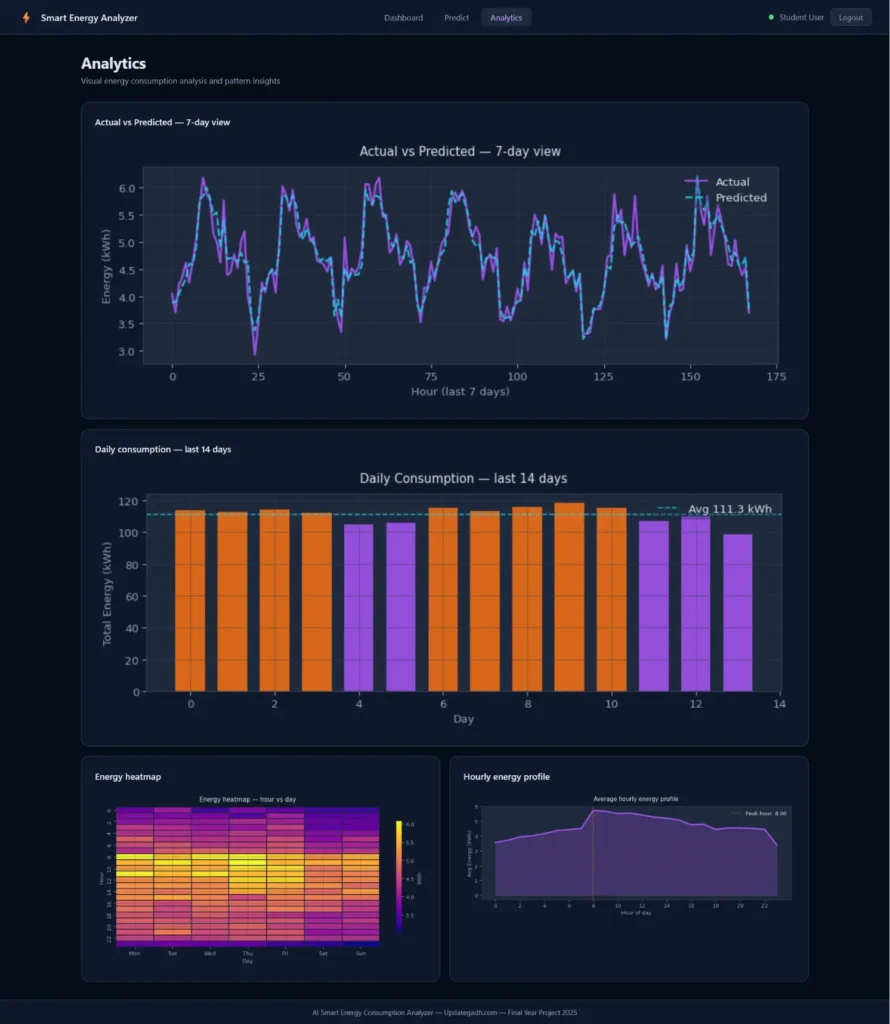
- Displays energy data through interactive graphs and charts
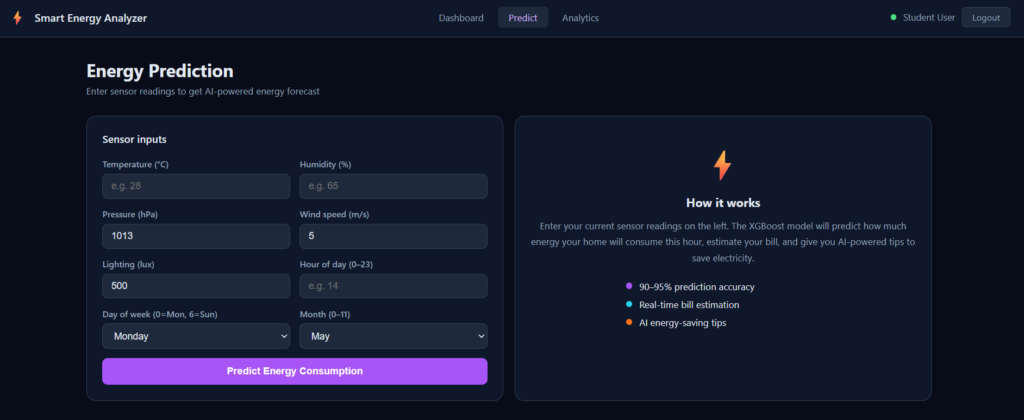
The core algorithm used is XGBoost Regressor, which processes smart home sensor data like temperature, humidity, pressure, wind speed, and lighting conditions to predict energy usage with 90–95% accuracy.
Project Abstract
The proposed project, AI-Based Smart Energy Consumption Analyzer and Optimization System Using Machine Learning and Flask, is designed to predict household energy consumption accurately and provide smart optimization suggestions using Artificial Intelligence and Machine Learning techniques.
The system processes smart home sensor data using the XGBoost Regressor algorithm. Advanced feature engineering techniques, including lag features, rolling statistics, interaction features, and temporal features, are applied to improve prediction accuracy.
A Flask-based web application is developed to provide a secure, user-friendly interface. The system also integrates Groq API and Large Language Models (LLMs) to generate intelligent energy-saving recommendations. Graphical visualizations such as energy trend graphs, actual vs predicted comparison graphs, and correlation heatmaps are generated for in-depth analysis.
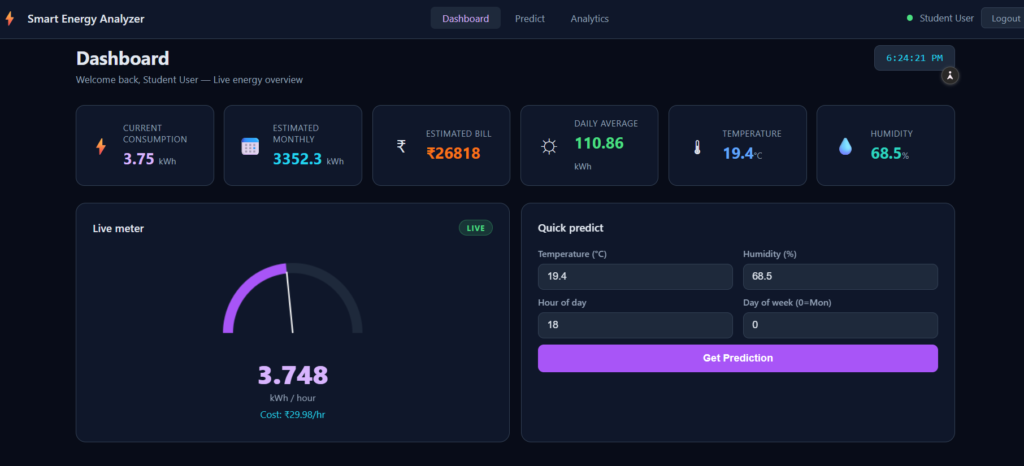
Screenshots
Dashboard:-
Project Objectives
- Develop a machine learning model to predict household energy consumption accurately
- Apply advanced feature engineering — lag features, rolling statistics, temporal, and interaction variables
- Build a secure Flask-based web application with user login and registration
- Integrate Groq API and LLMs to generate personalized energy-saving suggestions
- Visualize energy usage patterns through graphs and charts
- Estimate electricity bills based on predicted energy consumption
- Help users reduce electricity wastage and improve overall energy efficiency
Car Price Prediction System Using Machine Learning
Key Features at a Glance
| Feature | What It Does | Technology Used |
|---|---|---|
| Energy prediction | Forecasts electricity usage before it happens | XGBoost Regressor |
| Bill estimation | Calculates your expected electricity bill in advance | Python logic |
| AI recommendations | Personalized tips to cut energy waste | Groq API + LLM |
| Visual graphs | Energy trends, actual vs predicted, heatmaps | Matplotlib, Seaborn |
| Secure login | User authentication and data privacy | Flask + SQLite |
| Sensor data analysis | Processes temperature, humidity, wind speed, lighting | Pandas, NumPy |
Technology Stack Used
Software Requirements
| Component | Tool / Technology | Purpose |
|---|---|---|
| Programming Language | Python 3.10+ | Core development |
| Web Framework | Flask | Build the web application UI |
| ML Algorithm | XGBoost Regressor | Predict energy consumption |
| Data Processing | Pandas, NumPy | Clean and engineer features |
| Visualization | Matplotlib, Seaborn | Generate graphs and heatmaps |
| Database | SQLite | Store user and prediction data |
| AI API | Groq API | Generate smart energy-saving tips |
| Model Saving | Joblib | Save and reload the trained ML model |
Hardware Requirements
| Component | Minimum Requirement |
|---|---|
| Processor | Intel i3 / AMD Ryzen 3 |
| RAM | 8 GB |
| Storage | 10 GB free space |
| GPU | Optional — not required |
| Internet | Required for Groq API |
| Display | 1366 × 768 or higher |
ML Algorithm Comparison — Why XGBoost?
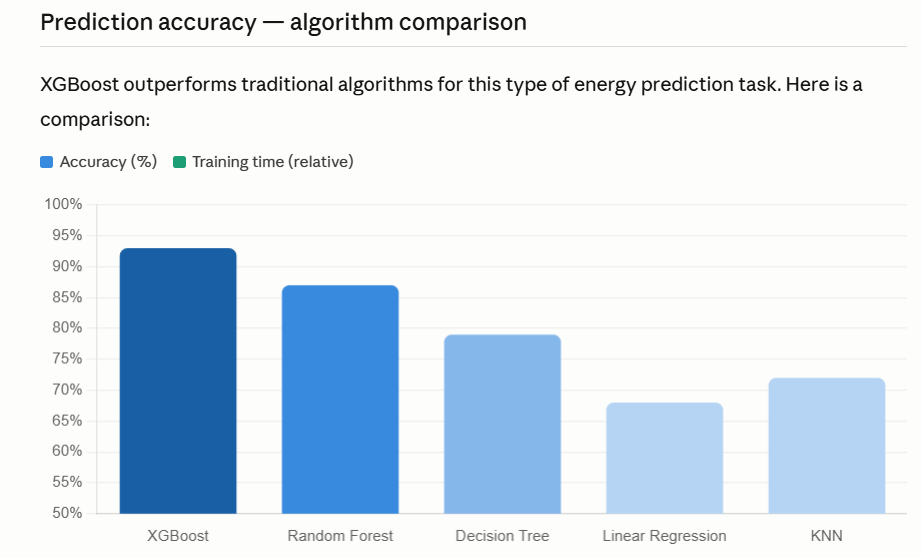
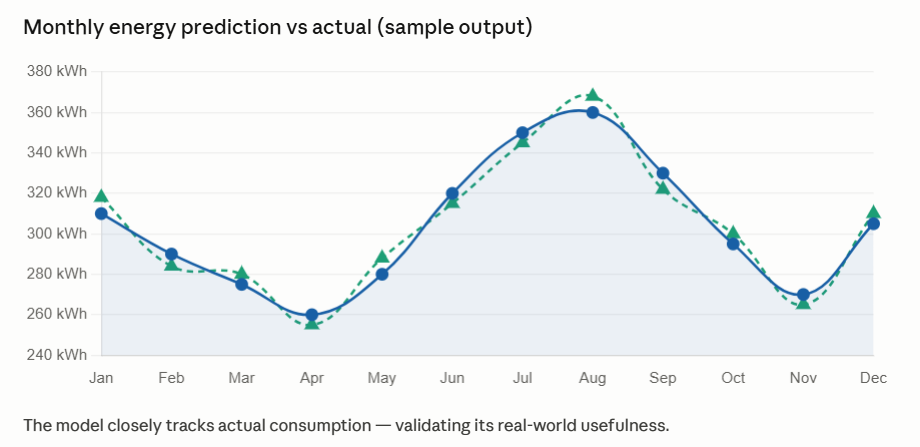
There are many machine learning algorithms available for regression tasks. Here is how they compare for this energy prediction project:
| Algorithm | Prediction Accuracy | Training Speed | Best For |
|---|---|---|---|
| XGBoost Regressor | 90–95% | Fast | Structured sensor data |
| Random Forest | 85–88% | Moderate | General tabular data |
| Decision Tree | 75–80% | Very fast | Simple patterns |
| Linear Regression | 65–70% | Very fast | Linear relationships only |
| KNN | 70–74% | Slow | Small datasets |
XGBoost is chosen because it handles missing values automatically, works well with structured/tabular data like sensor readings, delivers the highest accuracy, and trains faster than deep learning models — making it ideal for this project.
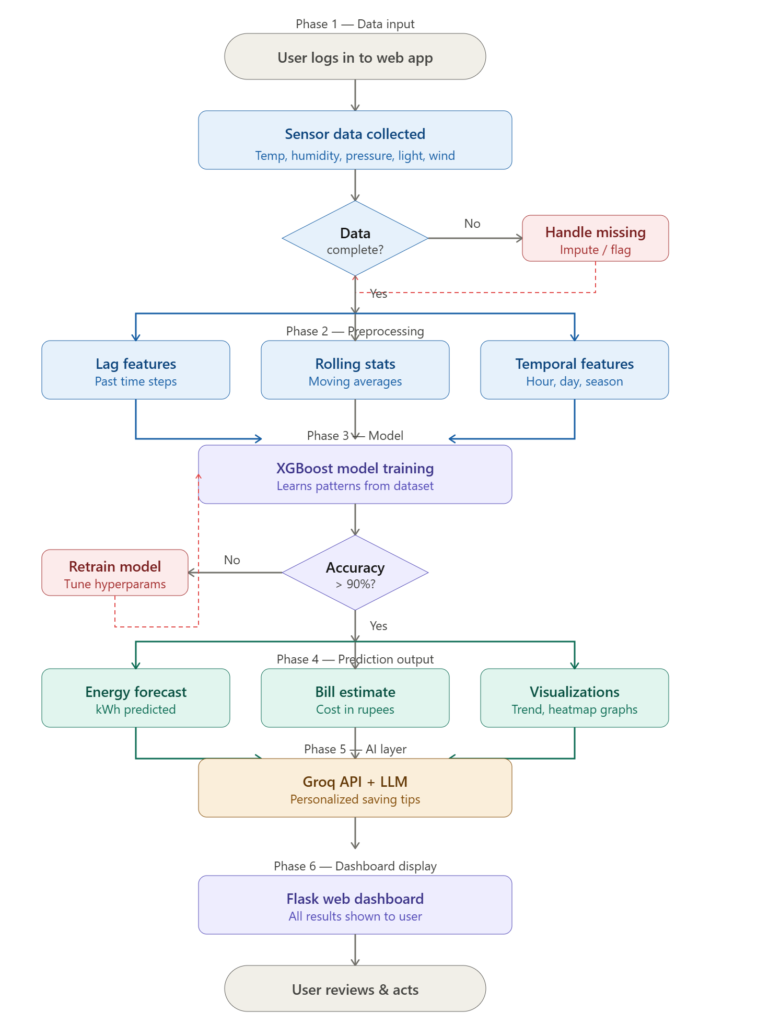
How the System Works — Step by Step
Here is a simple breakdown of the complete pipeline:
- Data Collection — Smart home sensors collect real-time data: temperature, humidity, pressure, wind speed, and lighting conditions.
- Feature Engineering — Raw sensor data is converted into meaningful ML features using lag values, rolling averages, time-of-day patterns, and interaction variables.
- Model Training — The XGBoost Regressor model is trained on the historical dataset to learn energy consumption patterns.
- Prediction — New sensor data is fed into the trained model to predict upcoming energy consumption in kWh.
- AI Recommendations — The predicted energy data is sent to the Groq API, which returns personalized energy-saving suggestions using an LLM.
- Web Dashboard — All predictions, bill estimates, AI tips, and graphs are displayed on the Flask-based web application for easy access.
What is XGBoost?
XGBoost (Extreme Gradient Boosting) is a powerful and fast Machine Learning algorithm built for structured data like tables and sensor readings. It works by building many small decision trees one after another — each one corrects the errors of the previous one — until the final result is highly accurate.
Key advantages for this project:
- Automatically handles missing values in sensor data
- Works very well with small and medium-sized datasets
- Delivers high accuracy with proper feature engineering
- Much faster to train compared to deep learning models
- Widely used in industry for energy, finance, and healthcare predictions
What is the Groq API?
Groq API provides lightning-fast access to Large Language Models (LLMs). In this project, after the energy consumption is predicted, the data is passed to the Groq API. The LLM reads this data and generates human-readable, personalized energy-saving recommendations.
For example, if the model predicts high energy usage between 6 PM and 9 PM, the system may suggest:
- “Shift heavy appliance usage to off-peak hours to save up to 20% on your bill.”
- “Your AC usage pattern shows 30% higher consumption than average — consider adjusting the thermostat.”
- “Turning off the water heater 20 minutes earlier can reduce daily consumption significantly.”
This is what makes the project truly intelligent — not just a prediction tool, but a smart energy advisor.
Real-World Applications
| Sector | Application | Benefit |
|---|---|---|
| Smart homes | Monitor and optimize daily appliance usage | Lower electricity bills |
| Industries | Predict demand and reduce peak-hour consumption | Significant cost savings |
| Commercial buildings | Office and mall energy management | Reduce large-scale waste |
| Smart cities | Integrate with IoT infrastructure for city-wide monitoring | Overall energy efficiency |
| Utility companies | Better load forecasting and demand balancing | Improved grid stability |
Who Should Use This Project?
This project is the perfect match for:
- B.Tech / B.E. students — Computer Science, Information Technology, Electrical, and Electronics branches
- MCA students — Looking for AI and Machine Learning-based final year projects
- M.Tech students — Interested in advanced ML with real-world application
- BCA students — Suitable as a Python + Flask-based web project
Why This is a Great Final Year Project
| Factor | Why It Matters |
|---|---|
| Trending technologies | Uses AI, ML, Flask, and LLM — all in-demand skills |
| Real-world problem | Electricity cost reduction is a universal, relatable problem |
| High accuracy | 90–95% prediction accuracy is excellent for a university project |
| Full stack | Covers both backend ML and frontend web application in one project |
| Easy to explain | Visual graphs and clear output make viva presentations simple |
| Data science coverage | Feature engineering, regression, and visualization — all in one place |
Conclusion
The AI-Based Smart Energy Consumption Analyzer and Optimization System is a complete, industry-relevant final year project that combines Machine Learning, Web Development, and AI-powered recommendations into one powerful application.
Whether you are a B.Tech, MCA, or BCA student, this project gives you hands-on experience with real-world AI tools — XGBoost for accurate predictions, Flask for building a professional web app, and Groq API for intelligent recommendations. It is easy to run, easy to explain, and highly impressive in front of your university panel.
SEO Keywords
- best AI-based smart energy consumption analyzer
- AI-based smart energy consumption analyzer GitHub
- AI-based smart energy consumption analyzer PDF
- AI-based smart energy consumption analyzer app