
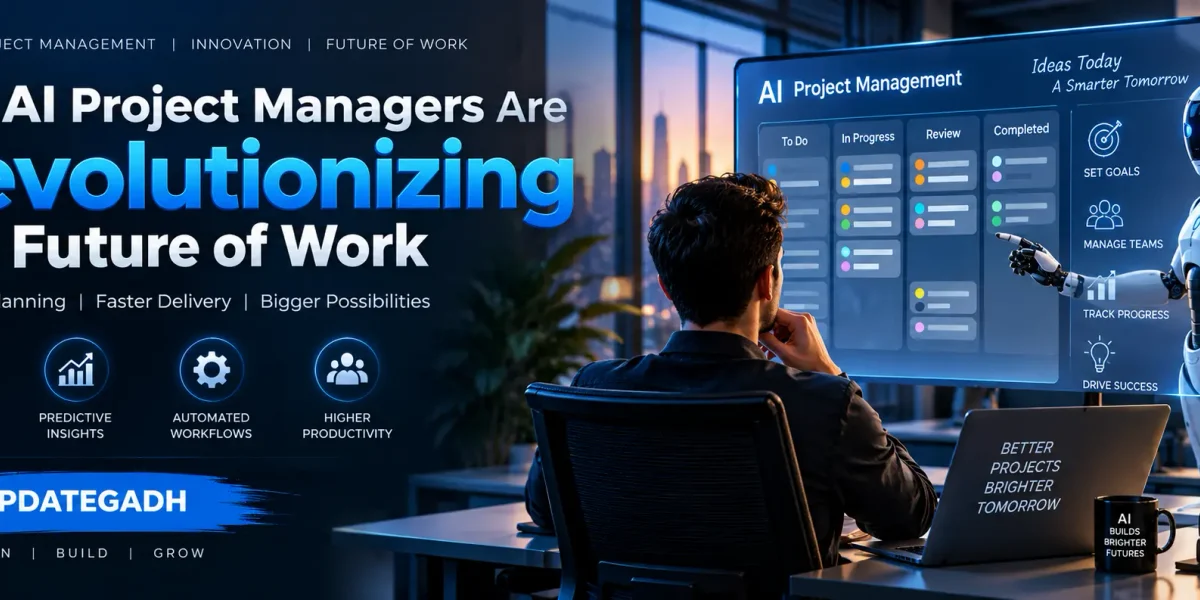
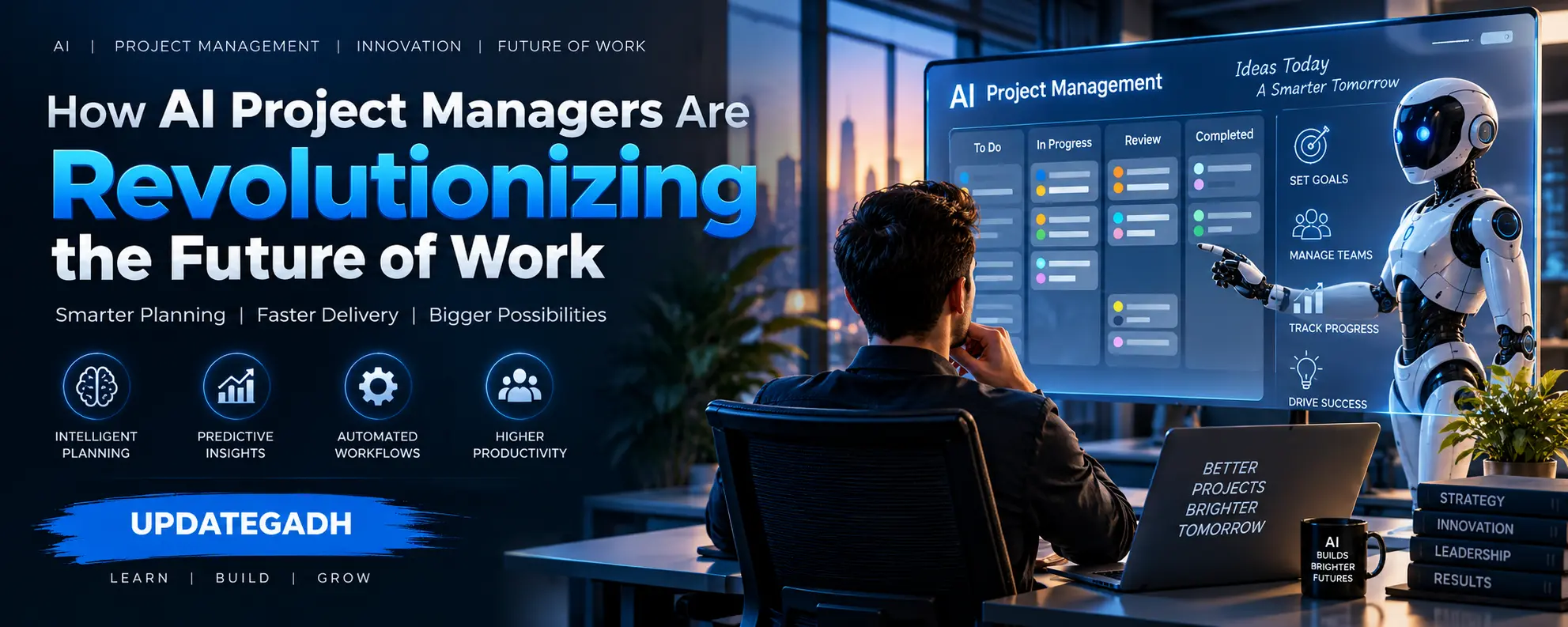
AI Project Managers Are Revolutionizing the Future of Work
Artificial Intelligence is changing the way businesses operate, make decisions, and solve complex problems. From healthcare and finance to manufacturing and transportation, AI is becoming an important part of modern organizations. Project management is also experiencing this transformation. AI project managers are combining project management principles with artificial intelligence, machine learning, predictive analytics, and intelligent automation to improve workflows, manage risks, and help teams deliver projects more efficiently.
As AI projects become more complex, organizations need professionals who can understand both business objectives and technological possibilities. AI project managers play an important role in connecting these two areas and turning ambitious ideas into practical, measurable outcomes.
Table of Contents
Complete Advance AI Topics: Click Here
SQL Tutorial: Click Here
The Rise of AI in Project Management
Traditional project management depends heavily on planning, communication, scheduling, resource management, and continuous monitoring. AI is adding another layer of intelligence to these activities by helping project teams analyze large amounts of information and identify patterns that may not be immediately visible.
AI-powered project management tools can assist with task prioritization, deadline prediction, risk identification, resource allocation, reporting, and workflow automation. Instead of replacing the project manager, these technologies can provide valuable information that supports faster and more informed decision-making.
The Role of AI Project Managers
Examining Their Duties and Primary Responsibilities
An AI project manager is responsible for coordinating people, technology, resources, and business objectives throughout the project lifecycle. Their responsibilities can include defining project goals, creating schedules, allocating resources, coordinating teams, monitoring progress, managing risks, and communicating with stakeholders.
AI projects require additional attention because their outcomes can depend on data quality, model performance, infrastructure, testing, and continuous improvement. Therefore, project managers need to work closely with data scientists, machine learning engineers, software developers, business teams, and other stakeholders.
Managing Challenges in a Fast-Moving AI Industry
The AI industry changes rapidly. New models, tools, frameworks, and techniques appear regularly, while project requirements can change as organizations learn more about what is technically possible.
AI project managers must therefore balance innovation with practical project constraints. They may need to manage changing requirements, limited resources, technical uncertainty, tight deadlines, and expectations from stakeholders. Strong communication and adaptability become especially important in this environment.
Bridging the Gap Between Vision and Execution
One of the most important responsibilities of an AI project manager is turning an ambitious idea into an executable plan. A business may have a broad objective such as using AI to automate a process or improve customer experiences. The project manager helps transform that vision into defined goals, deliverables, milestones, timelines, and measurable outcomes.
This bridge between business vision and technical execution helps ensure that AI initiatives remain aligned with organizational objectives rather than becoming technology experiments without a clear purpose.
Transforming Ideas into Action
Turning Ambitious Ideas into Workable Projects
AI projects often begin with exciting but broad ideas. An AI project manager helps break these ideas into smaller and achievable components. This can involve defining the problem, identifying the required data, determining technical requirements, establishing project milestones, and setting realistic deadlines.
A well-defined project plan gives team members a clearer understanding of what needs to be achieved and how their individual contributions support the overall objective.
Strategic Planning and Decision-Making
Strategic thinking is essential when managing AI projects. Project managers must evaluate priorities, identify potential obstacles, allocate resources, and make decisions when circumstances change.
For example, if a machine learning model does not achieve the expected performance, the project manager may coordinate with technical teams to determine whether the issue relates to data, model selection, infrastructure, or project requirements. The objective is to make informed decisions without losing sight of the project’s business goals.
Successful Project Execution
Successful AI projects generally require collaboration across multiple disciplines. A project manager can help establish clear responsibilities, maintain communication between teams, monitor milestones, and ensure that technical development remains connected to business requirements.
Whether the project involves an intelligent recommendation system, predictive analytics platform, automated customer support solution, or another AI application, effective project coordination can significantly influence how efficiently the idea moves from planning to implementation.
Overcoming Challenges in the AI Landscape
Managing Complexity and Uncertainty
AI projects can involve uncertainties that are less common in conventional software projects. A model may not perform as expected, available data may contain inconsistencies, or an organization may discover new requirements during development.
Data quality is another major consideration. Machine learning systems depend heavily on the information used to train and evaluate them. Poor-quality or incomplete data can affect project outcomes and require additional time for preparation and validation.
Addressing Technical, Ethical, and Organizational Challenges
AI project managers must consider more than technical performance. Issues such as algorithmic bias, privacy, transparency, security, responsible data usage, and regulatory requirements can also influence an AI initiative.
Effective project management requires collaboration between technical specialists, business leaders, legal teams, compliance professionals, and other stakeholders when appropriate. This multidisciplinary approach can help organizations identify important concerns before they become larger project problems.
Problem-Solving and Adaptability
AI project managers need to remain flexible when unexpected problems arise. Instead of relying entirely on the original plan, they may need to reassess priorities, adjust timelines, redistribute resources, or modify project objectives.
Agile approaches can be particularly useful because they allow teams to work incrementally, evaluate results, gather feedback, and make adjustments throughout development. Adaptability enables AI teams to respond to new technical findings without completely losing project direction.
Driving Innovation and Impact
Fostering Innovation
AI project managers can help create an environment where teams are encouraged to explore new ideas while maintaining clear business objectives. They can support experimentation, encourage collaboration, and help teams evaluate emerging technologies in a structured way.
The challenge is to balance innovation with practical considerations such as budget, timelines, security, reliability, and organizational priorities.
Impact Across Different Industries
AI project management has relevance across a wide range of industries. In healthcare, AI initiatives can support areas such as medical research and operational analysis. In finance, AI can be applied to fraud detection, forecasting, and customer services. Manufacturing organizations can use AI for predictive maintenance and process optimization, while transportation companies can explore intelligent routing and predictive systems.
In each case, project managers help coordinate the people and processes required to move AI solutions from an initial concept toward real-world implementation.
Measuring Results and Business Impact
Innovation becomes more meaningful when its results can be measured. AI project managers can help teams define appropriate success metrics before development begins. Depending on the project, these metrics may involve efficiency, accuracy, cost reduction, processing time, customer experience, or other business objectives.
Clearly defined measurements make it easier for organizations to understand whether an AI initiative is delivering the intended value and where additional improvements may be required.
The Future of AI Project Management
Emerging Trends
The future of AI project management is likely to involve deeper integration between intelligent tools and traditional project management practices. Predictive analytics, AI-assisted planning, automated reporting, intelligent risk detection, explainable AI, and agile methodologies are among the areas influencing how AI projects are managed.
AI tools can increasingly assist project teams with routine administrative activities, allowing project managers to spend more time on communication, strategic planning, stakeholder management, and complex decision-making.
How the Role May Change
As organizations adopt AI across more business functions, AI project managers may increasingly need to understand both technology and organizational transformation. Their responsibilities may extend beyond simply delivering a technical project to ensuring that AI solutions are adopted effectively within the organization.
Responsible AI practices are also becoming an important consideration. Project managers may need to work with different stakeholders to address transparency, privacy, fairness, security, and compliance throughout the project lifecycle.
Skills Required for Future AI Project Managers
Professionals interested in AI project management can benefit from developing a combination of technical, business, and interpersonal skills. Important areas include:
- Project management: Planning, scheduling, budgeting, risk management, and stakeholder coordination.
- AI and machine learning fundamentals: Understanding how AI systems are developed, evaluated, and deployed.
- Data literacy: Understanding data quality, preparation, analysis, and interpretation.
- Communication: Explaining technical concepts clearly to both technical and non-technical stakeholders.
- Strategic thinking: Connecting technology initiatives with business objectives.
- Adaptability: Responding effectively to changing technologies and project requirements.
- Responsible AI awareness: Recognizing issues involving privacy, bias, transparency, security, and compliance.
YT:- DecodeIT
Conclusion
AI project managers are becoming an important link between artificial intelligence, business strategy, and successful execution. Their role goes beyond creating schedules or monitoring deadlines. They help teams transform ambitious AI ideas into structured projects, coordinate multidisciplinary teams, manage uncertainty, address risks, and measure meaningful results.
As AI continues to influence different industries, effective project management will remain essential for turning technological possibilities into practical solutions. The future will require professionals who can understand emerging technology while also leading people, managing complexity, and keeping projects aligned with real-world objectives.
The growth of AI project management raises an important question for organizations and professionals alike: How can we use AI not simply to build smarter systems, but to manage and deliver better projects? The answer may shape how the future of work is planned, developed, and delivered.
Keywords
AI Project Managers, AI Project Management, Artificial Intelligence Project Management, AI in Project Management, Future of Work, AI Management, Machine Learning Project Management, AI Project Manager Skills, AI Project Planning, Intelligent Project Management, AI Automation, AI Industry


Your passion for what you do is evident in every post It’s inspiring to see someone truly fulfilling their purpose and making a positive impact