Python vs Scala
Python vs Scala is a common comparison for developers who want to understand which programming language is more suitable for their projects. Both are high-level, general-purpose languages, but they differ in areas such as typing, performance, syntax, scalability, and application development.
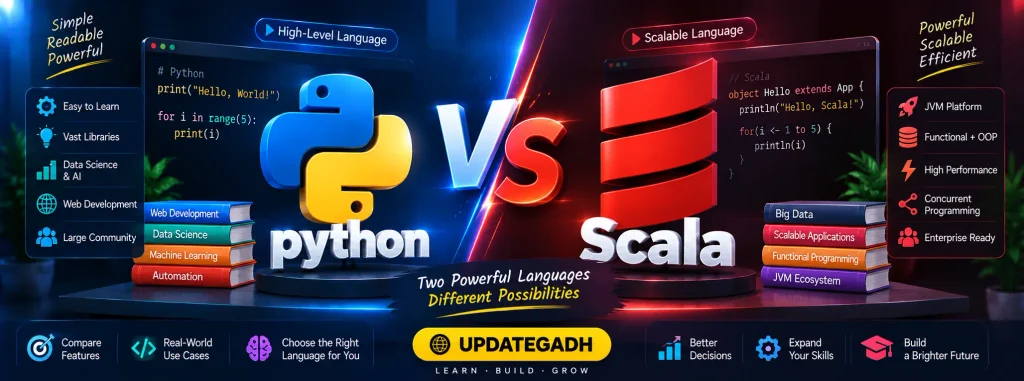
Python is widely known for its simple syntax, readability, and large collection of libraries. Scala, on the other hand, combines object-oriented and functional programming and runs on the Java Virtual Machine (JVM).
In this tutorial, we will understand Python and Scala and explore their major differences.
Complete Advance AI Topics: Click Here
SQL Tutorial: Click Here
What is Python?
Python is a high-level, general-purpose programming language known for its simple syntax and readability. It allows developers to perform different tasks with comparatively fewer lines of code.
Python provides a large collection of built-in modules, libraries, and frameworks. Because of its flexibility and extensive ecosystem, it is used in many areas, including:
- Web development
- Artificial intelligence
- Machine learning
- Data science
- Automation
- Natural language processing
Python supports object-oriented programming and uses dynamic typing. Developers do not normally need to specify the data type of a variable while declaring it.
name = "Akshay"
age = 23

print(name)
print(age)
Python’s simple syntax and large developer community also make it a popular language for beginners.
What is Scala?
Scala stands for Scalable Language. It is a high-level, general-purpose programming language that combines object-oriented programming with functional programming.
Scala runs on the Java Virtual Machine (JVM) and can work with existing Java code and libraries. This interoperability makes Scala useful for applications that are part of the Java ecosystem.
Scala uses a static type system, meaning types are checked at compile time. This can help developers identify certain errors before the application runs.
Scala is also used for applications that require scalability, high performance, and concurrent programming. Its functional programming features and support for asynchronous programming make it useful for large and complex applications.
Python vs Scala: Key Differences
The following table highlights some important differences between Python and Scala:
| Sr. No. | Python | Scala |
|---|---|---|
| 1 | Python is dynamically typed. | Scala is statically typed. |
| 2 | Python has simple and beginner-friendly syntax. | Scala has a more advanced syntax and concepts. |
| 3 | Data types generally do not need to be explicitly declared. | Scala uses static typing and supports explicit type declarations. |
| 4 | Python is generally interpreted and is known for development simplicity. | Scala code is compiled to JVM bytecode before execution. |
| 5 | Types are primarily checked at runtime. | Types are checked at compile time. |
| 6 | Python has a very large global developer community. | Scala has a smaller but strong developer community. |
| 7 | Python is commonly recommended for beginners. | Scala requires familiarity with more advanced programming concepts. |
| 8 | Python has a large collection of libraries and frameworks. | Scala benefits from the JVM ecosystem and Java libraries. |
| 9 | Dynamic typing can make some errors appear during execution. | Static typing can help detect many type-related errors during compilation. |
| 10 | Python provides multiprocessing and other approaches for concurrent workloads. | Scala provides strong support for concurrent and asynchronous programming. |
| 11 | Python has extensive tools for machine learning, data science, and NLP. | Scala provides functional programming features and JVM-based tools. |
| 12 | Python has a large pool of developers worldwide. | Scala has a comparatively smaller developer pool. |
| 13 | Python can be used for concurrency, although the approach depends on the workload. | Scala is well-suited to concurrent programming. |
| 14 | Python is widely used for small, medium, and large applications. | Scala is commonly used for scalable and complex applications. |
| 15 | Python emphasizes simplicity and development productivity. | Scala combines scalability, functional programming, and JVM compatibility. |
Python vs Scala for Data Engineering
Both Python and Scala can be used in data engineering. Python is popular because of its easy syntax and extensive data-processing ecosystem. Scala is also widely associated with JVM-based big-data technologies and can be useful when performance and large-scale processing are important requirements.
The choice depends on the project’s technology stack, team expertise, performance requirements, and development needs.
Python vs Scala Performance
Python and Scala approach execution differently. Python generally focuses on ease of development and flexibility, while Scala is compiled for the JVM and can provide strong performance for suitable workloads.
However, programming language performance depends on the application, libraries, algorithms, runtime environment, and implementation. Therefore, the language alone does not determine the performance of every application.
Python vs Scala for Apache Spark
Python and Scala are both used with Apache Spark. Python is often selected because of its simple syntax and familiarity among data professionals. Scala has a natural connection with Spark because Spark itself is built primarily around the Scala/JVM ecosystem.
Developers should consider their existing skills, project requirements, Spark features being used, and the surrounding technology stack before selecting a language.
Applications of Python
Python is commonly used in:
- Web applications
- Machine learning
- Artificial intelligence
- Data analysis
- Automation
- Scientific computing
- Natural language processing
Applications of Scala
Scala can be used for:
- Large-scale applications
- Data processing
- Concurrent applications
- JVM-based software
- Big-data applications
- Distributed systems
YT:- DecodeIT
Python vs Scala: Which One Should You Learn?
The choice between Python and Scala depends on your goals and project requirements. Python can be a practical option when simplicity, rapid development, machine learning, data science, and a large library ecosystem are important.
Scala can be considered when a project requires JVM compatibility, functional programming, static typing, scalability, or advanced concurrent programming.
Students and beginners may find Python easier to start with, while developers working with JVM-based systems and large-scale data applications may find Scala relevant to their requirements.
Conclusion
Python and Scala are powerful programming languages, but they have different strengths and development approaches. Python focuses heavily on simplicity, readability, flexibility, and a broad ecosystem, while Scala combines object-oriented and functional programming with static typing and JVM compatibility.
Python is widely used in areas such as AI, machine learning, data science, web development, and automation. Scala is particularly relevant to scalable JVM-based applications, concurrent programming, and data-processing environments.
Instead of choosing a language based only on popularity or performance, developers should consider the project’s requirements, existing technology stack, team skills, scalability needs, and development goals.
Frequently Asked Questions
What is the main difference between Python and Scala?
Python is dynamically typed and focuses on simplicity and readability, while Scala is statically typed and combines object-oriented and functional programming on the JVM.
Is Python easier to learn than Scala?
Python generally has a simpler syntax and is widely used as a beginner-friendly programming language. Scala introduces additional concepts related to functional programming and static typing.
Which is better for data engineering, Python or Scala?
Both can be used for data engineering. The appropriate choice depends on the project’s tools, technology stack, performance requirements, and developer expertise.
Can Python and Scala be used with Apache Spark?
Yes. Apache Spark supports both Python and Scala, allowing developers to choose based on their project requirements and existing programming skills.
Is Scala faster than Python?
Scala runs on the JVM and is compiled to JVM bytecode, while Python commonly relies on an interpreter/runtime. Actual performance depends on the workload, implementation, libraries, and execution environment.
Keywords
Python vs Scala, Python vs Scala performance, Python vs Scala for Spark, Python vs Scala for data engineering, Scala vs Python, Python and Scala difference, Python vs Scala comparison, Scala programming language, Python programming language, Scala vs Java, Python vs Scala salary, Python vs Scala Reddit, Python vs Scala for big data, Python Scala data science, Python Scala programming