AI-Powered Programming vs Traditional Programming
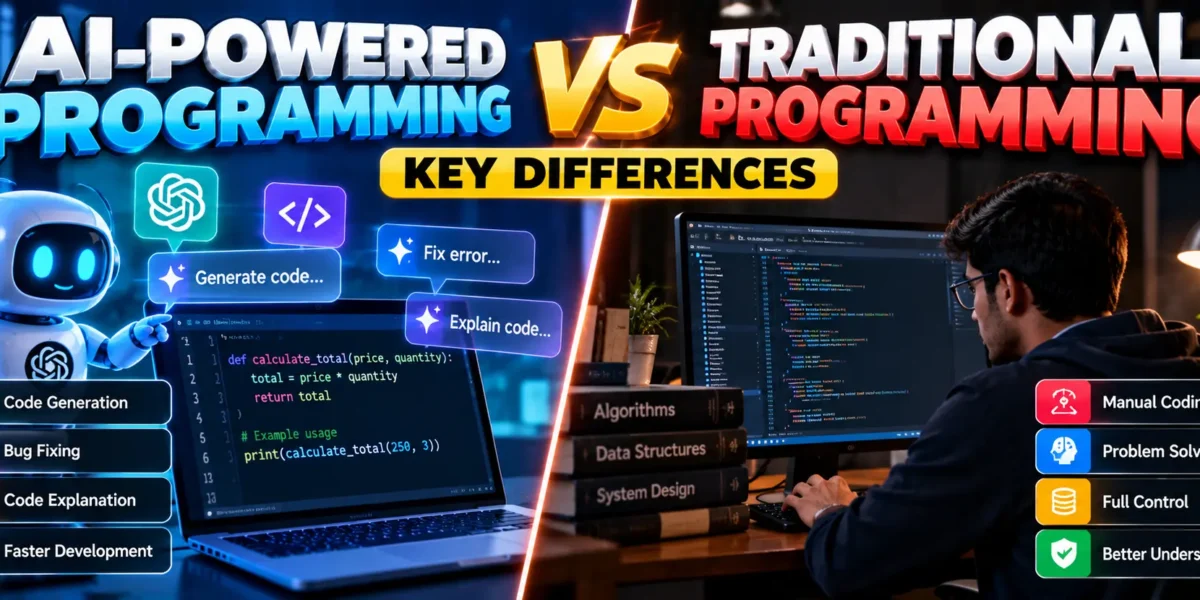
Software development is changing rapidly as artificial intelligence becomes an important part of the programming process. Developers can now use AI-powered coding assistants to generate code, explain errors, suggest improvements, and automate repetitive tasks. Traditional programming, however, remains an essential approach in which developers manually design, write, test, and maintain software according to defined requirements.
Understanding AI-Powered Programming vs Traditional Programming helps students, developers, and software teams choose the right development approach for their projects. Both methods have advantages and limitations, and the best choice depends on project complexity, security requirements, available skills, and the level of human supervision needed.
Complete Advance AI Topics: Click Here
Real Time Projects on YouTube:- DecodeIT
What Is AI-Powered Programming?
AI-powered programming is a software development approach that uses artificial intelligence tools to assist with coding activities. These tools can generate code from natural-language instructions, recommend functions, explain programming concepts, identify potential bugs, and help developers understand unfamiliar code.
AI coding assistants use trained models to predict and generate relevant code based on the context and instructions they receive. Examples include AI-assisted code completion, code generation, debugging assistance, test generation, and code documentation.
AI-powered programming does not necessarily mean that an entire application is developed without human involvement. Developers usually need to provide requirements, review generated code, test functionality, and correct errors before using the results.
What Is Traditional Programming?
Traditional programming is the conventional approach to software development in which developers write and organize code using programming languages, frameworks, libraries, and development tools. They translate project requirements into algorithms, functions, data structures, and application logic.
In this approach, developers typically handle tasks such as designing the system, writing code, debugging errors, testing features, and maintaining the application. They may use standard IDE features, documentation, debuggers, and automated testing tools without relying on generative AI.
Traditional programming provides direct control over implementation and can be especially useful when software requires carefully defined behavior, strict validation, or detailed control over its architecture.
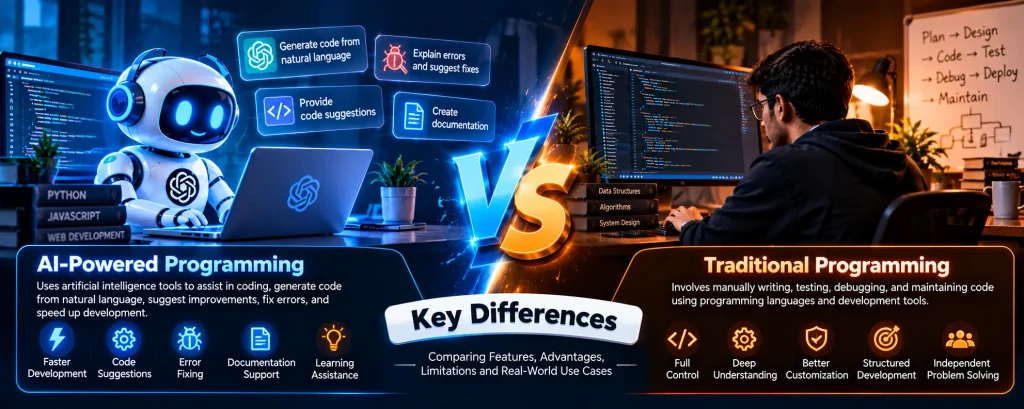
AI-Powered Programming vs Traditional Programming: Project Overview
| Comparison Factor | AI-Powered Programming | Traditional Programming |
|---|---|---|
| Code Creation | AI can generate code from prompts and context. | Developers write code directly. |
| Development Speed | Can accelerate repetitive and well-defined tasks. | Depends heavily on developer experience and project complexity. |
| Human Involvement | Requires instructions, review, and validation. | Developers handle implementation and decision-making directly. |
| Debugging | AI can suggest causes and potential fixes. | Developers investigate errors using debugging tools and analysis. |
| Learning Process | Can explain concepts and provide examples. | Often involves documentation, practice, and independent problem-solving. |
| Code Accuracy | Generated code may contain incorrect assumptions or errors. | Code quality depends on implementation, testing, and review. |
| Customization | Can adapt generated solutions to supplied requirements. | Developers have direct control over implementation choices. |
| Security | Generated code must be checked for vulnerabilities. | Manually written code also requires security review and testing. |
| Best Use | Code assistance, prototyping, repetitive tasks, and explanations. | Precise implementation, complex logic, and detailed control. |
What Are the Key Differences Between AI and Traditional Programming?
1. Code Generation
The main difference is how code is created. AI-powered programming allows developers to describe a task in natural language and receive suggested code. Traditional programming requires developers to implement the solution directly using their chosen language.
For example, a developer can ask an AI assistant to create a Python function that validates an email address. With traditional programming, the developer writes the function manually by applying the required validation rules.
2. Development Speed
AI-assisted tools can reduce the time spent on repetitive work, boilerplate code, simple functions, and documentation. They may also help developers explore possible implementations quickly.
Traditional programming can take longer for tasks that involve extensive manual coding, but experienced developers may work very efficiently when requirements and implementation patterns are already familiar. AI-generated code can also require additional time for verification, integration, and debugging.
3. Debugging and Error Handling
AI tools can analyze error messages, explain likely causes, and suggest possible fixes. They can also help developers understand unfamiliar exceptions or identify suspicious code patterns.
Traditional debugging relies on techniques such as breakpoints, logging, stack traces, test cases, and step-by-step code inspection. These methods remain essential because an AI-generated explanation may be incomplete or incorrect.
4. Learning and Skill Development
AI-powered programming can help beginners understand programming concepts by providing explanations, examples, and alternative solutions. It can make it easier to explore unfamiliar frameworks and languages.
However, copying generated code without understanding it can weaken problem-solving skills. Traditional programming encourages learners to practice algorithms, understand syntax, analyze errors, and build independent coding ability. A balanced learning approach uses AI for guidance while still requiring students to write, explain, and test their own solutions.
5. Code Quality and Reliability
AI-generated code can be useful, but it is not automatically correct, efficient, or secure. It may overlook edge cases, misunderstand requirements, use outdated patterns, or introduce unnecessary complexity.
Traditional programming also produces bugs when developers make mistakes or misunderstand requirements. In both approaches, reliable software requires code reviews, automated tests, clear requirements, and appropriate validation.
6. Security and Privacy
AI coding assistants can suggest security improvements, but they may also generate code with unsafe input handling, weak authorization checks, or other vulnerabilities. Developers should review authentication, permissions, database queries, dependency choices, and sensitive-data handling carefully.
Traditional programming gives developers direct control over the code they write, but manually written software is not inherently secure. Security depends on engineering practices, testing, threat analysis, and ongoing maintenance rather than the coding method alone.
7. Cost and Resource Requirements
AI-powered programming may reduce development effort for certain tasks, but AI tools can have subscription fees, usage limits, or infrastructure costs. Reviewing generated code and integrating it into an application also requires time and expertise.
Traditional programming may require more manual effort for repetitive tasks, but it can be performed using conventional development tools without a dedicated AI service. The overall cost depends on the project, the team’s experience, available tools, and long-term maintenance needs.
What Are the Advantages of AI-Powered Programming?
- Faster Prototyping: Developers can create initial implementations quickly and explore different approaches.
- Code Suggestions: AI assistants can recommend completions, functions, and alternative implementations.
- Debugging Assistance: They can explain errors and suggest possible solutions.
- Documentation: AI can help draft comments, function descriptions, and technical explanations.
- Learning Support: Beginners can request explanations and examples of unfamiliar concepts.
- Repetitive Task Automation: AI can assist with boilerplate code, test templates, and routine transformations.
What Are the Limitations of AI-Powered Programming?
- Incorrect Output: AI may generate code that looks plausible but does not work correctly.
- Requirement Misunderstanding: Ambiguous prompts can lead to unsuitable implementations.
- Security Risks: Generated code may contain vulnerabilities that require expert review.
- Overdependence: Excessive reliance can limit independent debugging and programming practice.
- Context Limitations: An AI assistant may not fully understand the application’s architecture or business rules.
- Verification Effort: Developers must test and review the generated code before relying on it.
What Are the Advantages of Traditional Programming?
- Direct Control: Developers can make implementation decisions at every stage.
- Detailed Understanding: Writing code manually can strengthen knowledge of algorithms, data structures, and program behavior.
- Predictable Implementation: Developers can follow established specifications and coding standards directly.
- Flexible Architecture: Experienced developers can design code around specific system requirements.
- Independent Development: Teams can work without depending on AI service availability or usage limits.
What Are the Limitations of Traditional Programming?
- Repetitive Work: Developers may spend significant time writing similar code repeatedly.
- Manual Debugging: Finding the cause of complicated bugs can require extensive investigation.
- Slower Initial Prototyping: Building an initial version may take longer when every component must be written manually.
- Learning Challenges: Beginners may need to consult multiple resources to understand unfamiliar concepts.
- Maintenance Effort: Large applications require ongoing testing, refactoring, and documentation regardless of how the code was created.
When Should You Use AI-Powered Programming?
AI-powered programming is useful when developers need help with repetitive coding, quick prototypes, code explanations, test generation, or exploring implementation alternatives. It can be particularly helpful when learning a new language or working with unfamiliar libraries.
For example, a developer creating a student management application might use AI to draft a basic form, explain a database error, or generate initial test cases. The developer should still validate database operations, access permissions, and application behavior before deployment.
When Should You Use Traditional Programming?
Traditional programming is valuable when requirements demand careful control over implementation, detailed reasoning, or strict integration with existing systems. It is also important when developers need to understand every part of a solution or work in environments with specific restrictions on external tools.
Applications involving financial transactions, sensitive personal information, complex business rules, or critical infrastructure require rigorous engineering and review. Developers may use AI assistance where permitted, but they should not treat generated code as a substitute for testing, security analysis, or professional judgment.
Is AI-Powered Programming Replacing Traditional Programming?
AI-powered programming is changing how developers work, but it does not eliminate the need for programming knowledge. AI tools can generate code and accelerate certain tasks, yet software still requires people to define requirements, make architectural decisions, evaluate trade-offs, test behavior, and maintain systems.
The two approaches can also be combined. A developer can use AI to draft a function, manually inspect the logic, run automated tests, improve the implementation, and review security concerns. This combination preserves human control while using AI to reduce selected parts of the workload.
Which Programming Approach Is Best for Students?
For students, the most effective approach is to learn programming fundamentals first and use AI as a supporting tool. Understanding variables, loops, functions, data structures, algorithms, and debugging makes it easier to evaluate whether generated code is correct.
Students can write a solution independently, ask AI to explain alternative approaches, compare the results, and test both implementations. This method encourages learning without treating generated answers as unquestionable solutions.
Frequently Asked Questions
1. What is the difference between AI-powered programming and traditional programming?
AI-powered programming uses artificial intelligence to assist with code generation, explanations, and debugging, while traditional programming relies on developers writing and implementing code directly.
2. Is AI-powered programming faster than traditional programming?
It can be faster for repetitive tasks, prototypes, and code suggestions, but the overall time depends on complexity, review requirements, debugging, and integration.
3. Can AI write an entire software application?
AI can generate substantial portions of an application, but complex projects still require requirements analysis, architectural decisions, testing, security review, and maintenance.
4. Is traditional programming still important?
Yes. Programming fundamentals, debugging, system design, and code review remain essential for creating reliable software, whether AI tools are used or not.
5. Should beginners learn coding or use AI tools?
Beginners should learn coding fundamentals and use AI tools to clarify concepts, explore examples, and receive feedback. They should also practice writing and debugging code independently.
Final Thoughts
AI-Powered Programming vs Traditional Programming is not simply a choice between modern tools and older methods. AI-assisted development can improve productivity for selected tasks, while traditional programming provides the fundamental skills and direct control needed to build and maintain reliable software.
Keywords: AI-Powered Programming vs Traditional Programming: Key Differences, AI programming vs traditional programming, AI-assisted coding, traditional software development, advantages of AI programming, AI coding tools, programming for beginners, future of software development