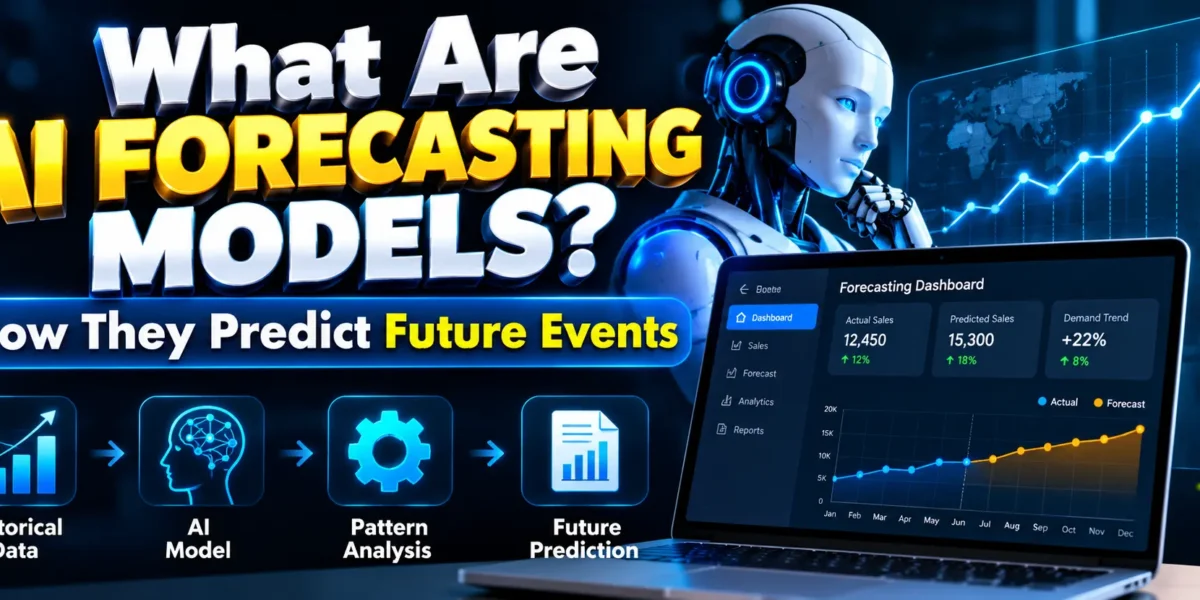
What Are AI Forecasting Models
Artificial Intelligence (AI) is transforming how businesses, researchers, and organizations prepare for the future. From predicting weather conditions to estimating product demand, AI forecasting models help analyze historical data and identify patterns that can be used to estimate future outcomes.
These models combine machine learning, statistical techniques, and data analysis to generate forecasts. They are useful in industries such as healthcare, finance, agriculture, retail, and transportation. Understanding how AI forecasting models work is also valuable for students interested in artificial intelligence and data science.
Table of Contents
Explore More: Complete Advance AI Topics: Click Here
What Are AI Forecasting Models?
AI forecasting models are computer-based systems that analyze historical and current data to estimate future values, trends, or events. They learn patterns from available information and use those patterns to generate predictions.
For example, an online store can analyze previous sales, seasonal demand, and product prices to estimate how many products customers might purchase next month. Similarly, forecasting models can help estimate electricity consumption, website traffic, and future business requirements.
However, AI forecasts are estimates rather than guaranteed outcomes. Their reliability depends on the quality of data, the selected algorithm, and changing real-world conditions.
How Do Work?
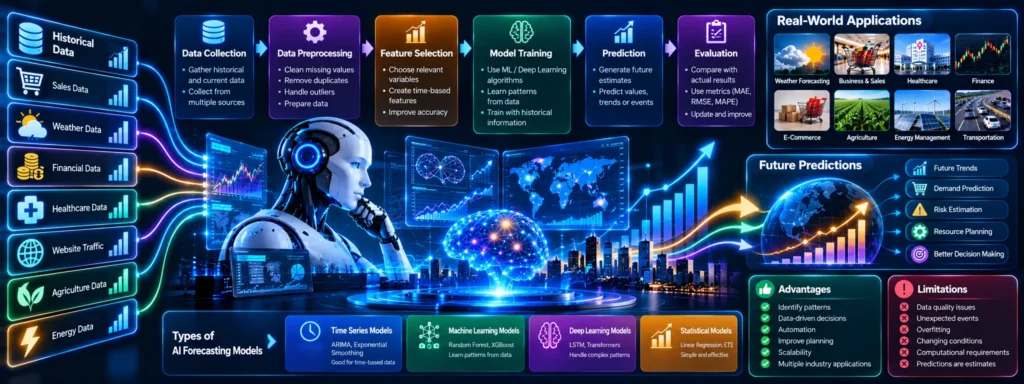
AI forecasting models generally follow these steps:
1. Data Collection
The process begins by collecting historical information, such as sales records, weather measurements, customer activity, or energy consumption.
2. Data Preprocessing
The collected data is cleaned by handling missing values, duplicate records, and inconsistencies. Properly prepared data helps the model learn meaningful patterns.
3. Feature Selection
Relevant variables are selected to improve predictions. For example, a sales forecasting model may use previous sales, product prices, holidays, and promotional activities.
4. Model Training
A suitable statistical or machine learning algorithm learns relationships from historical observations.
5. Prediction Generation
After training, the model uses available information to estimate future values for a selected period.
6. Evaluation
The predictions are compared with actual results using evaluation metrics. Models can be adjusted or retrained when their performance decreases.
Types
1. Time Series Forecasting Models
Time series models analyze data recorded over time. They are commonly used for sales forecasting, website traffic analysis, weather trends, and electricity demand. Examples include ARIMA and exponential smoothing.
2. Machine Learning Models
Machine learning algorithms learn relationships between different variables to estimate future outcomes. Random Forest and XGBoost are examples that can be applied to suitable forecasting problems.
3. Deep Learning Models
Deep learning models use neural networks to learn complex patterns from large datasets. LSTM networks and Transformer-based architectures are examples used in certain time-dependent forecasting tasks.
4. Statistical Forecasting Models
Statistical methods use mathematical relationships to estimate future values. Linear regression and exponential smoothing can provide useful forecasts without requiring complex AI systems.
Real-World Applications of AI Forecasting
- Weather Forecasting: Estimates temperature, rainfall, and other weather conditions.
- Business: Predicts sales trends and supports inventory planning.
- Healthcare: Helps estimate patient demand and healthcare resource requirements.
- Finance: Analyzes historical market data to estimate possible future movements.
- E-Commerce: Forecasts product demand and customer purchasing patterns.
- Agriculture: Supports crop yield estimation and agricultural planning.
- Energy: Estimates electricity demand and renewable energy generation.
Complete Advance AI Topics: Click Here
Real Time Projects on YouTube:- DecodeIT
Example of AI Sales Forecasting
Suppose a store records monthly sales of 100, 120, 135, 150, and 170 units from January through May. An AI forecasting model can analyze these observations to identify the general sales trend.
After considering additional factors such as seasonal demand, pricing, and promotions, the model can estimate sales for June. The forecast can help the store plan inventory and purchasing requirements. However, the actual sales may differ from the prediction.
Technologies Used in AI Forecasting
Students and developers can build forecasting projects using the following technologies:
- Python: Programming language for data analysis and machine learning.
- Pandas: Data cleaning and manipulation.
- NumPy: Numerical calculations.
- Scikit-learn: Machine learning algorithms and evaluation tools.
- Statsmodels: Statistical analysis and time series forecasting.
- Matplotlib: Visualizing historical data and forecasts.
- TensorFlow: Developing deep learning models.
Advantages
- Identify trends and patterns in historical data.
- Support data-driven planning and decision-making.
- Automate repetitive forecasting tasks.
- Help businesses estimate future demand.
- Process large datasets with suitable computing resources.
- Support applications across multiple industries.
Limitations
AI forecasting models also have certain limitations. Poor-quality data can produce unreliable results, while unexpected events can change previously observed patterns. Complex models may require additional computing resources, and overfitting can reduce performance on new data.
Developers should test models on historical periods that were not used for training, compare predictions with simple baselines, and communicate uncertainty clearly.
Conclusion
For students, AI forecasting is an excellent topic for learning Python, machine learning, data preprocessing, time series analysis, and model evaluation. Starting with a simple dataset and gradually testing different algorithms is a practical way to understand how forecasting systems work.
Frequently Asked Questions (FAQs)
1. What are AI forecasting models?
They are systems that use historical data and statistical or machine learning techniques to estimate future values, trends, or events.
2. Which programming language is used for AI forecasting?
Python is widely used because it offers libraries such as Pandas, Scikit-learn, Statsmodels, and TensorFlow.
3. Can AI forecasting models predict the future accurately?
They can generate useful estimates, but accuracy depends on data quality, model performance, and how predictable the situation is.
4. What is the difference between AI forecasting and traditional forecasting?
Traditional forecasting often relies on established statistical methods, while AI forecasting can also learn complex relationships from data. Both approaches can be effective.
5. Is AI forecasting useful for students?
Yes. It helps students understand data analysis, machine learning, prediction techniques, and practical AI applications.
Keywords: What Are AI Forecasting Models? How They Predict Future Events, AI forecasting models, AI forecasting, machine learning forecasting, time series forecasting, predictive analytics, Python forecasting, artificial intelligence,Forecasting Models Forecasting Models forecasting models in machine learning forecasting models for time series forecasting models in plant