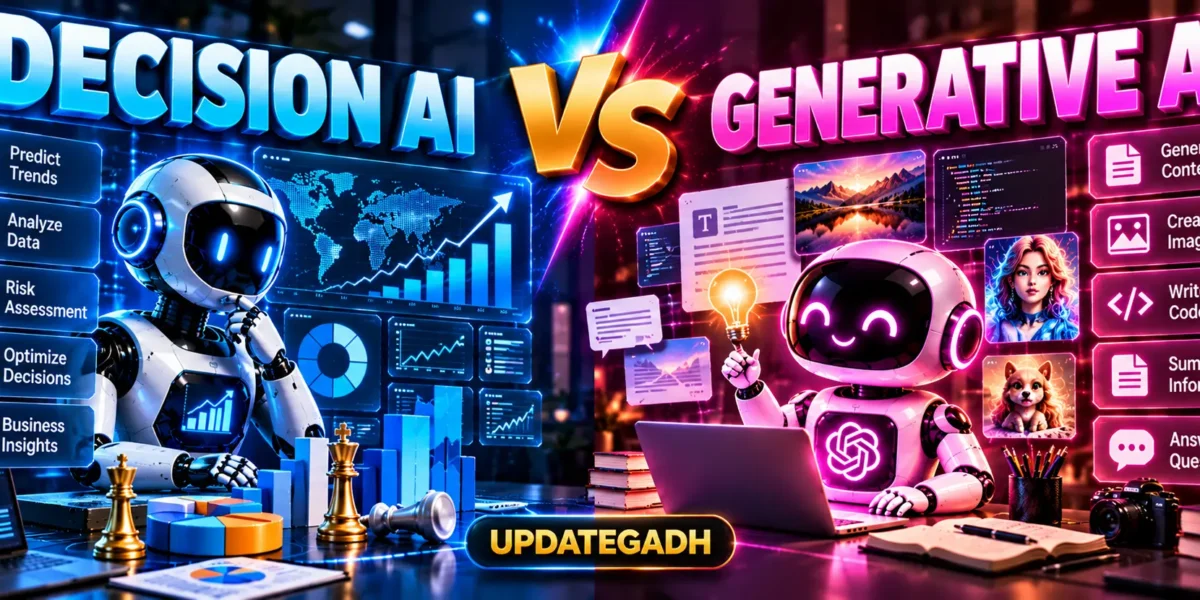
Decision AI vs Generative AI
Artificial Intelligence is helping businesses make smarter decisions, automate operations, and improve customer experiences. Two important AI approaches are Decision AI and Generative AI. Although both use data and advanced algorithms, they solve different types of business problems.
Decision AI focuses on analyzing information, predicting outcomes, and recommending or selecting actions. Generative AI focuses on creating new content, such as text, images, summaries, code, and business documents.
Table of Contents

Complete Advance AI Topics: Click Here
Real Time Projects on YouTube:- DecodeIT
What Is Decision AI?
Decision AI refers to AI systems that help businesses evaluate information, predict possible outcomes, and make informed decisions. These systems can use machine learning, optimization techniques, predictive analytics, and business rules to recommend actions.
Decision AI is especially useful when a business needs to answer questions such as which customers may leave, how much inventory to maintain, or which transactions require additional review.
Key Features of Decision AI
- Predictive Analytics: Estimates future outcomes using historical and current data.
- Risk Assessment: Identifies potentially risky transactions, customers, or business activities.
- Decision Optimization: Helps select suitable actions based on objectives and constraints.
- Pattern Recognition: Identifies trends and relationships in business data.
- Operational Efficiency: Supports consistent decisions in repetitive business processes.
Example of Decision AI
A retail company can use Decision AI to forecast product demand based on previous sales, seasonal trends, and current inventory. The system can recommend how much stock to order to reduce shortages and unnecessary storage costs.
What Is Generative AI?
Generative AI is a type of artificial intelligence that creates new content based on patterns learned from training data. It can generate written content, images, computer code, summaries, and other outputs in response to user instructions.
Businesses use Generative AI to speed up content production, support employees, improve customer communication, and simplify knowledge-intensive tasks.
Key Features of Generative AI
- Content Creation: Generates emails, reports, product descriptions, and marketing materials.
- Natural Language Processing: Understands and responds to instructions written in everyday language.
- Summarization: Converts lengthy documents into shorter, useful summaries.
- Code Generation: Helps developers write, explain, and improve software code.
- Conversational Support: Helps answer questions and provide information through chat interfaces.
Example of Generative AI
An e-commerce company can use Generative AI to create product descriptions, draft promotional emails, summarize customer feedback, and prepare responses to common customer questions.
Key Differences
| Comparison Factor | Decision AI | Generative AI |
|---|---|---|
| Primary Purpose | Support decisions and actions | Create new content |
| Main Output | Predictions, scores, recommendations, optimized choices | Text, images, code, summaries, and other content |
| Typical Data | Structured data and business metrics, sometimes unstructured data | Text, images, code, and other training or contextual data |
| Common Techniques | Predictive models, optimization, rules, and classification | Large language models, diffusion models, and other generative models |
| Business Applications | Demand forecasting, fraud detection, risk scoring | Content creation, document assistance, conversational interfaces |
| Success Measurement | Decision accuracy, business outcomes, cost, and risk | Relevance, quality, usefulness, and factual accuracy |
| Main Challenge | Data quality, bias, and changing business conditions | Incorrect outputs, hallucinations, and data privacy |
Real-World Business Applications
1. Banking and Financial Services
Decision AI can evaluate transaction patterns, estimate credit risk, and flag suspicious activity for review. Generative AI can help employees summarize financial documents, explain policies, and draft customer communications.
2. Retail and E-Commerce
Decision AI can forecast demand, optimize inventory, and recommend pricing strategies. Generative AI can produce product descriptions, marketing campaigns, and customer-support responses.
3. Healthcare Operations
Decision AI can support scheduling, resource allocation, and certain risk assessments when appropriately validated. Generative AI can help summarize documents and draft administrative reports. Clinical applications require appropriate validation and professional oversight.
4. Customer Service
Decision AI can route support tickets, prioritize urgent cases, and predict escalation risks. Generative AI can understand customer questions and draft personalized responses based on approved information.
Which Is Better for Business Problems?
Neither Decision AI nor Generative AI is universally better. The right choice depends on the problem a business wants to solve.
- Choose Decision AI when you need forecasting, risk scoring, classification, optimization, or data-driven recommendations.
- Choose Generative AI when you need content creation, document summarization, natural-language interaction, or coding assistance.
- Combine both when a workflow requires reliable analytical decisions alongside content generation or communication.
For example, a logistics company can use Decision AI to identify the most efficient delivery routes and Generative AI to explain delivery delays to customers in clear, personalized language.
Can Decision AI and Generative AI Work Together?
Yes. Combining both approaches can create more useful business workflows. Decision AI can analyze structured data and recommend an action, while Generative AI can explain the recommendation or produce the related report.
For example, a sales team could use Decision AI to identify customers who may be at risk of leaving. Generative AI could then draft personalized follow-up messages for the sales team to review. Human approval can remain part of the workflow when decisions or communications are sensitive.
Businesses should evaluate both systems for accuracy, privacy, cost, explainability, and measurable business value before deployment.
Frequently Asked Questions (FAQs)
1. Is Decision AI the same as Generative AI?
No. Decision AI focuses on predictions, recommendations, and selecting actions, while Generative AI creates new content. Some applications can combine both approaches.
2. Which AI is better for business automation?
Decision AI is useful for analytical decisions and optimization. Generative AI is useful for content-related tasks and conversational workflows. The best option depends on the process being automated.
3. Can small businesses use both technologies?
Yes. Small businesses can use Generative AI for marketing and customer communication and Decision AI for sales forecasting, inventory planning, and other data-driven tasks, depending on their available data and budget.
4. What is the biggest limitation of Generative AI?
Generative AI can produce incorrect or misleading information. Important outputs should be checked, especially when they affect financial, legal, operational, or customer decisions.
Conclusion
Decision AI and Generative AI serve different but complementary purposes in modern business. Decision AI helps organizations analyze information, predict outcomes, and make better decisions. Generative AI helps them create content, communicate efficiently, and work with information more effectively.
Decision AI vs Generative AI: Which Is Better for Business Problems?, Decision AI vs Generative AI, Decision AI, Generative AI, Decision Intelligence, Generative AI for Business, AI for Business Problems, Business AI Solutions, AI Business Applications, Predictive Analytics, AI Decision Making, Generative AI Use Cases, AI Automation, Artificial Intelligence in Business