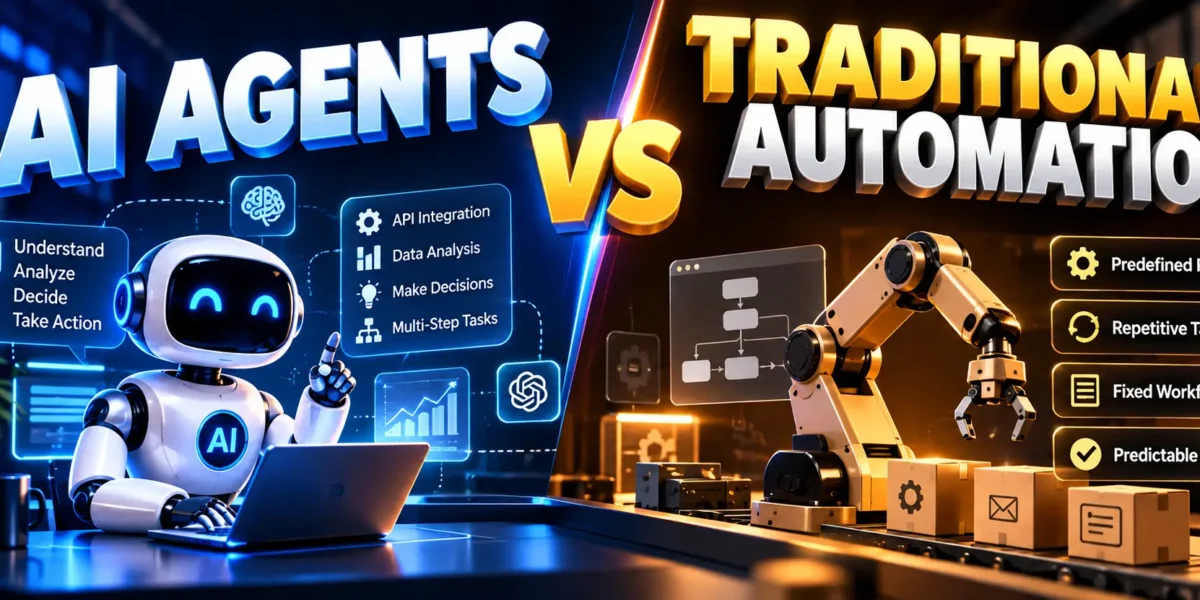
AI Agents vs Traditional Automation
Artificial Intelligence is changing how businesses and individuals complete everyday tasks. Traditional automation has helped organizations save time by performing repetitive activities, while AI agents introduce a more flexible approach by understanding goals, making decisions, and adapting to changing situations. Understanding AI Agents vs Traditional Automation is important for students, developers, and businesses exploring modern technology.
Although both approaches reduce manual work, they differ in how they process information, handle unexpected situations, and complete tasks. In this tutorial, we will explore their differences, real-world applications, advantages, limitations, and future scope.
Table of Contents
Complete Advance AI Topics: Click Here
Real Time Projects on YouTube:- DecodeIT
What Are AI Agents?
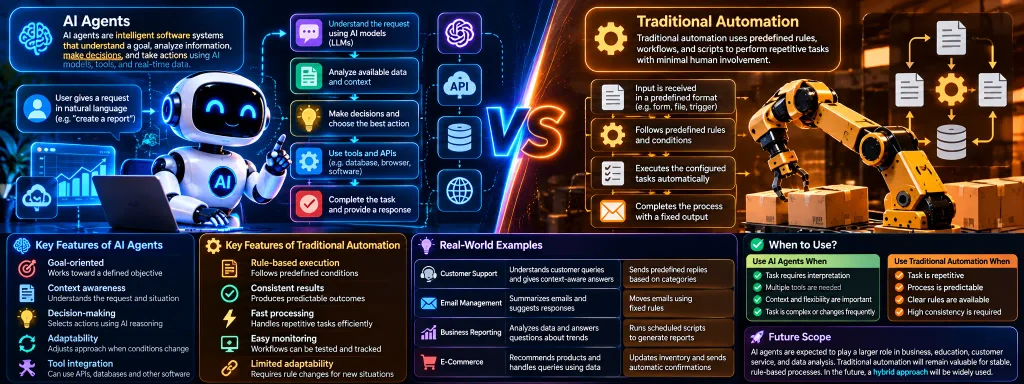
AI agents are software systems designed to understand a goal, analyze available information, make decisions, and take actions toward completing a task. Depending on their design, they can use large language models (LLMs), APIs, databases, external tools, and memory to perform multi-step activities.
For example, an AI agent used in customer support can understand a customer’s question, search a knowledge base, retrieve relevant information, and prepare a suitable response. If it has the necessary permissions, it may also initiate an approved action.
Key Features of AI Agents
- Goal-oriented: Work toward a defined objective instead of following only a fixed sequence.
- Context awareness: Use available information to understand requests and situations.
- Decision-making: Select actions based on the information and tools available.
- Adaptability: Adjust their approach when circumstances change, within their capabilities.
- Tool integration: Interact with APIs, databases, and other software when configured.
What Is Traditional Automation?
Traditional automation uses predefined rules, workflows, scripts, and triggers to perform tasks with minimal human involvement. It is especially effective when a process is repetitive, predictable, and governed by clear instructions.
For example, an automated system can send an email whenever a customer completes a purchase. Similarly, a scheduled script can generate a daily sales report by collecting records from a database.
Key Features of Traditional Automation
- Rule-based execution: Follows predefined conditions and instructions.
- Consistent results: Produces predictable outcomes when inputs and conditions remain consistent.
- Fast processing: Handles repetitive tasks efficiently.
- Easy monitoring: Workflows can be tested against defined rules.
- Limited adaptability: Usually requires updated rules or programming to handle new situations.
Comparison Table
| Basis | AI Agents | Traditional Automation |
|---|---|---|
| Working Method | Goal-oriented and context-dependent | Predefined rules and workflows |
| Decision-Making | Can select actions using AI reasoning | Uses programmed conditions |
| Adaptability | Can adjust to new information within its capabilities | Usually requires rule changes |
| Input Handling | Can interpret unstructured text and supported inputs | Works best with structured, expected inputs |
| Task Execution | Can coordinate multiple steps and tools | Executes predefined sequences |
| Predictability | Outputs and actions may vary | Usually highly predictable |
| Cost and Complexity | May require AI models, monitoring, and safeguards | Often simpler for stable processes |
| Best Use Case | Tasks requiring interpretation and flexible decisions | Repetitive tasks with clear rules |
Real-World Examples
1. Customer Support
Traditional Automation: Sends a predefined reply when a customer selects a particular support category.
AI Agent: Interprets the customer’s message, searches relevant documentation, and prepares a context-aware answer. Refunds and account changes should require appropriate authorization.
2. Email Management
Traditional Automation: Moves emails into folders based on sender addresses, keywords, or predefined rules.
AI Agent: Can summarize messages, identify their purpose, prioritize tasks, and suggest suitable responses using the available context.
3. Business Reporting
Traditional Automation: Runs a scheduled script to collect database records and generate a report.
AI Agent: Can analyze available business data, answer questions about trends, and prepare a report using connected tools. Its findings should be verified against the underlying data.
4. E-Commerce Management
Traditional Automation: Updates inventory when an order is placed and sends an order confirmation automatically.
AI Agent: Can help analyze customer queries, recommend products, and investigate stock-related questions using connected inventory systems.
Advantages of AI Agents
- Handle tasks that require interpreting natural language and context.
- Support multi-step workflows involving multiple tools.
- Adapt their approach when new information becomes available.
- Help employees reduce time spent on complex information-processing tasks.
- Support personalized customer experiences.
Advantages of Traditional Automation
- Provides reliable execution for clearly defined processes.
- Reduces repetitive manual work.
- Offers predictable behavior and easier testing.
- Can operate without the cost of running an AI model.
- Works well for scheduled tasks, data validation, and rule-based workflows.
Limitations
AI agents can produce incorrect information, misunderstand requests, or select inappropriate actions. They may also require additional infrastructure, monitoring, and security controls. Access to sensitive data should be restricted, and important actions should have approval mechanisms.
Traditional automation is less suitable for tasks involving ambiguous requests or changing conditions that were not anticipated during development. Maintaining large collections of rules can also become difficult as business requirements grow.
When Should You Use
Choose traditional automation when the task is repetitive, predictable, and based on clear rules. Examples include scheduled backups, invoice generation, email notifications, and routine database updates.
Choose AI agents when a task requires interpreting natural language, gathering information from multiple sources, or selecting among different actions based on context. Examples include research assistance, intelligent customer support, and complex information processing.
In many situations, a hybrid approach works best. Traditional automation can handle reliable execution, while an AI agent interprets requests or recommends the next step. For example, an AI agent can classify a customer request, while a predefined workflow validates the request and performs an authorized action.
Future Scope
AI agents are expected to play a growing role in software development, business operations, education, customer service, and data analysis. Improvements in AI models and tool integration may make them more capable of handling complex workflows.
Traditional automation will remain valuable because many business processes need consistency, predictable execution, and clear audit trails. Rather than completely replacing traditional automation, AI agents are likely to complement existing systems and expand the range of tasks that can be automated.
Conclusion
AI Agents vs Traditional Automation is not simply a comparison between old and new technology. Both approaches solve different types of problems. Traditional automation is suitable for stable, rule-based tasks, while AI agents are useful for tasks requiring interpretation, contextual decisions, and multi-step execution.
Keywords: AI Agents vs Traditional Automation, AI Agents, Traditional Automation, AI Automation, Intelligent Automation, AI Technology, Automation Examples, Artificial Intelligence Tutorial,AI Agents vs Traditional Automation, AI Agents, Traditional Automation, AI Automation, Intelligent Automation, Agentic AI, AI Tools, Workflow Automation, Artificial Intelligence, AI Technology, AI Agents Examples, Automation Examples, AI Tutorial, Business Process Automation, Large Language Models