
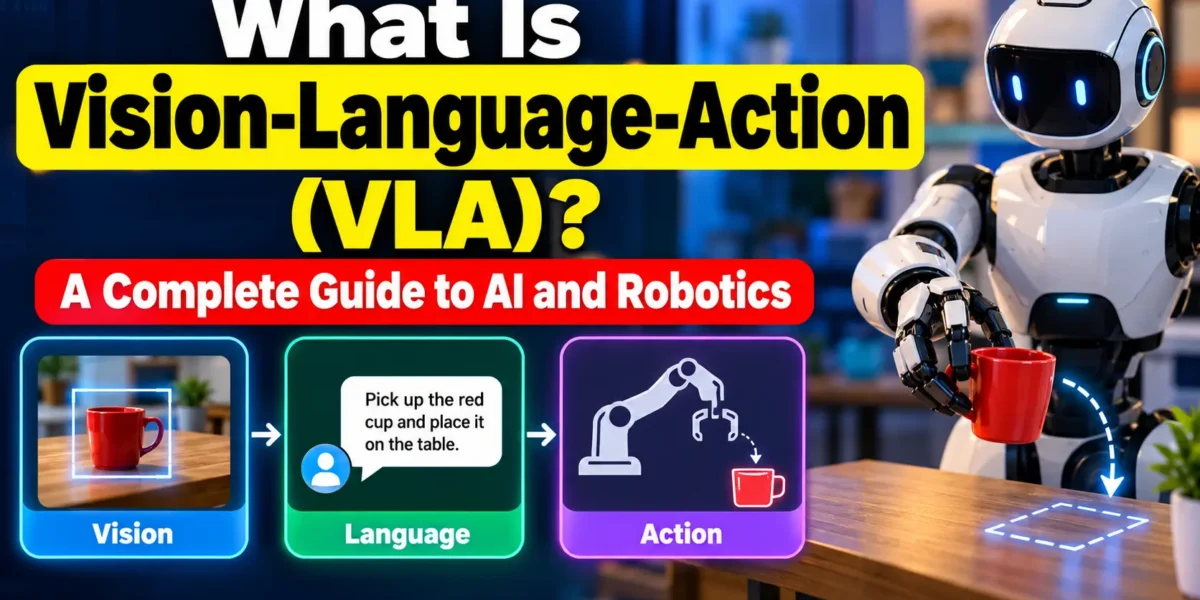
What Is Vision-Language-Action
Artificial intelligence is moving beyond text generation, image recognition, and chatbots. Modern AI systems are increasingly being developed to interact with the physical world, understand their surroundings, and perform real-world tasks. One important technology driving this development is Vision-Language-Action (VLA).
VLA models combine visual understanding, natural language processing, and robotic control to help machines understand instructions and convert them into physical actions. This technology is becoming an important part of robotics, automation, and Physical AI.
Table of Contents
Complete Advance AI Topics: Click Here
Real Time Projects on YouTube:- DecodeIT
What Is Vision-Language-Action (VLA)?
Vision-Language-Action (VLA) is an artificial intelligence approach that allows robots to understand visual information, interpret human instructions, and generate actions to complete tasks.
The term consists of three main components:
- Vision: Helps the system understand objects, scenes, and its surrounding environment using cameras or other visual inputs.
- Language: Helps the system understand instructions provided in ordinary human language.
- Action: Converts the combined understanding into commands that control a robot’s movements or operations.
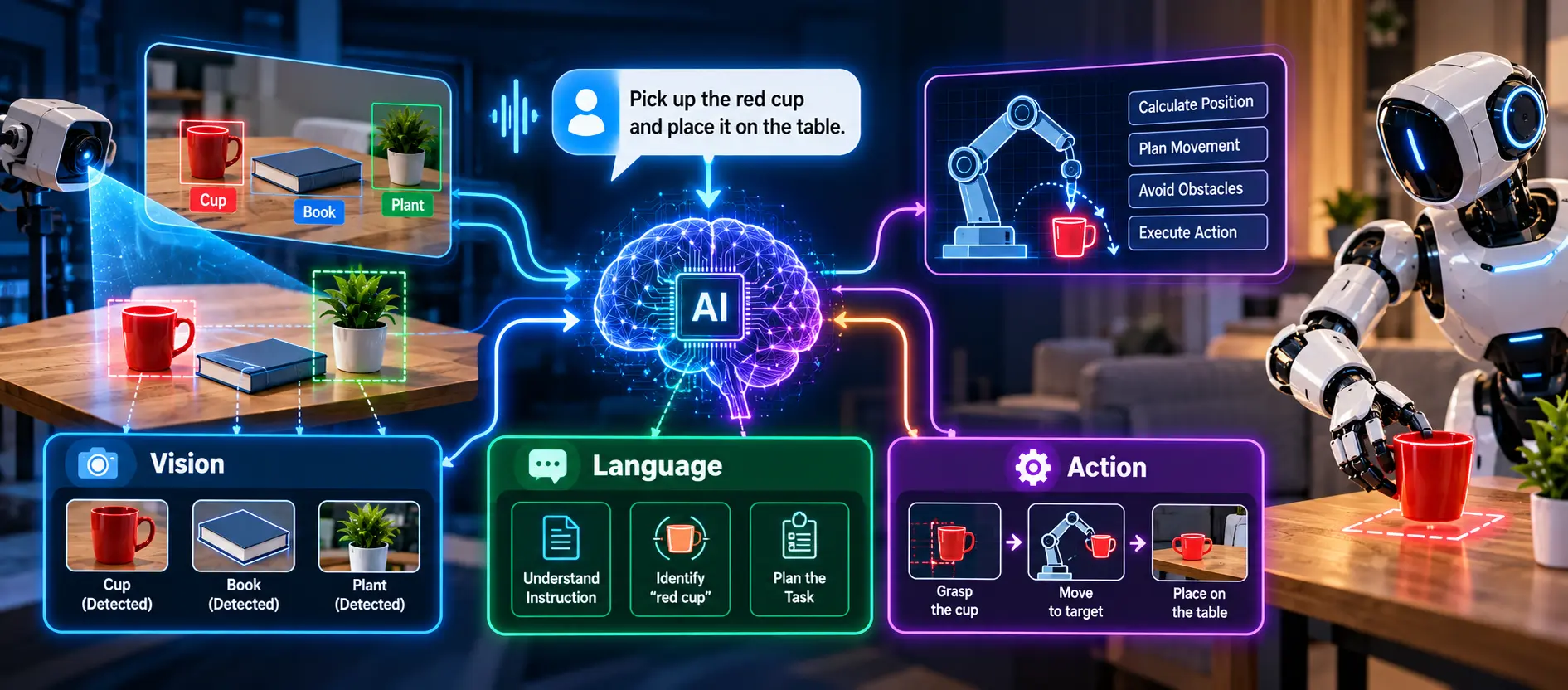
For example, imagine telling a robot, “Pick up the red cup and place it on the table.” A VLA model can analyze the camera image, identify the red cup, interpret the instruction, and generate the actions needed to move and manipulate the object.
Unlike an AI chatbot that primarily generates text, a VLA model is designed to connect AI understanding with physical behavior.
How Does Vision-Language-Action Work?
VLA systems typically use trained AI models, visual inputs, language instructions, and robot-control mechanisms. Their workflow can be explained in the following steps.
1. Visual Perception
The robot captures images of its surroundings through cameras. The AI model processes this information to identify objects, their positions, and relevant details about the environment.
For example, it may recognize a cup, a table, and a nearby obstacle.
2. Language Understanding
The system receives a natural language instruction and interprets the user’s intended task.
For example, the instruction “Move the blue box beside the door” requires the model to understand the object, the desired movement, and the target location.
3. Task Interpretation and Action Prediction
The model connects its visual understanding with the instruction and predicts an appropriate action or sequence of actions. Depending on the system, these outputs may represent positions, movement targets, action tokens, or other robot-control commands.
4. Robot Execution
A robot-control system translates the predicted actions into movements using its hardware, actuators, and controllers. The robot then attempts to complete the task while respecting its physical capabilities and safety limits.
5. Feedback and Adjustment
Cameras and sensors can provide updated information about the environment. The system may use this feedback to adjust its next actions when an object moves or the original plan does not work.
This process helps the robot respond to changing conditions rather than relying entirely on a fixed sequence of movements.
Key Features of VLA Models
Vision-Language-Action systems offer several important capabilities:
- Multimodal Understanding: Combines visual observations with natural language instructions.
- Natural Language Interaction: Allows users to describe tasks without manually programming every movement.
- Action Generation: Produces action representations that can be used by robotic control systems.
- Task Generalization: Some models can adapt to unfamiliar objects, instructions, and environments.
- Object Recognition: Helps robots identify and interact with relevant objects in their surroundings.
- Multi-Step Task Support: Can help break complex instructions into smaller actions.
- Adaptive Behavior: Feedback-enabled systems can respond to changes in their environment.
The availability and quality of these capabilities depend on the model, training data, robot hardware, and deployment setup.
Real-World Applications of Vision-Language-Action
1. Industrial Automation
Factories can use VLA-based robotic systems for object handling, sorting, assembly assistance, and other tasks requiring visual understanding and flexible instructions.
2. Warehouse Management
Robots may identify packages, move objects, organize products, and assist with material handling in warehouses.
3. Healthcare Assistance
Robotic systems could assist with tasks such as transporting supplies and organizing equipment. Medical environments require additional safety controls and appropriate human supervision.
4. Household Robots
Future home robots could help with activities such as picking up objects, arranging items, and placing belongings in designated locations.
5. Humanoid Robotics
Humanoid robots can use VLA models to connect human instructions with physical actions, supporting tasks that require interaction with objects in human-designed environments.
6. Research and Education
Students and researchers can explore VLA concepts to understand multimodal AI, robotic perception, machine learning, and intelligent control systems.
Examples of Vision-Language-Action Models
Several research and development efforts demonstrate how VLA technology is being applied to robotics.
RT-2
Developed by Google DeepMind, RT-2 combines web-scale vision-language knowledge with robotic training data to generate actions for robot control.
Gemini Robotics
Google’s robotics models extend multimodal AI capabilities toward physical interaction, helping robots interpret instructions and perform tasks.
These examples demonstrate the growing connection between general-purpose AI models and robotic systems.
VLA vs. Traditional Robotics
| Feature | Traditional Robotics | Vision-Language-Action |
|---|---|---|
| Instructions | Often predefined programs | Can interpret natural language |
| Environment | Frequently structured | Can handle varied environments, depending on training |
| Visual Understanding | May use separate vision modules | Integrates vision with language and action learning |
| Task Flexibility | Often requires explicit reprogramming | May generalize to new tasks |
| Control | Programmed rules and controllers | Learned action generation with robot-control systems |
VLA does not eliminate traditional robotics. Practical systems still require reliable controllers, hardware integration, calibration, and safety mechanisms.
Benefits of Vision-Language-Action
VLA technology offers several potential benefits:
- Makes human-robot interaction more natural.
- Reduces the need to manually specify every task.
- Can improve flexibility when objects or instructions change.
- Connects general AI knowledge with physical tasks.
- Supports research into more adaptable robotic systems.
- Opens opportunities for intelligent automation across industries.
Challenges and Limitations of VLA
Despite its potential, VLA technology faces several challenges.
- Training Data: Robots need diverse, high-quality training examples covering different objects, environments, and actions.
- Physical Safety: Incorrect actions can damage objects, equipment, or cause injuries. Independent safety controls remain essential.
- Computational Requirements: Large models may require substantial computing resources, although some models are optimized for on-device execution.
- Unpredictable Environments: Lighting changes, moving objects, unfamiliar surroundings, and unexpected obstacles can affect performance.
- Reliability: A model may misunderstand an instruction or predict an unsuitable action. Testing, monitoring, and recovery mechanisms are necessary.
Future of Vision-Language-Action Technology
The future of VLA is closely connected to Physical AI, humanoid robots, and intelligent automation. Researchers are working toward systems that can follow complex instructions, adapt to new environments, manipulate objects more accurately, and complete longer tasks.
Frequently Asked Questions (FAQs)
What does VLA stand for in AI?
VLA stands for Vision-Language-Action. It refers to AI models that connect visual observations and language instructions with actions, particularly in robotics.
Is VLA the same as a Large Language Model?
No. A Large Language Model primarily processes and generates language. A VLA model is designed to generate actions from visual and language inputs, often using a language or multimodal model as part of its architecture.
What is the difference between VLM and VLA?
A Vision-Language Model (VLM) connects images and language to perform tasks such as image understanding and visual question answering. A Vision-Language-Action model extends this approach to generate actions for robotic systems.
Can VLA be used in humanoid robots?
Yes. VLA models can help humanoid robots interpret instructions and perform physical tasks, provided the model is integrated with compatible hardware and control systems.
Is VLA important for students learning AI?
Yes. Learning about VLA introduces students to multimodal AI, robotics, computer vision, natural language processing, and intelligent automation.
Conclusion
Vision-Language-Action is an important development in artificial intelligence that connects what machines see, what people say, and what robots do. By combining visual perception, language understanding, and action generation, VLA models can help robots perform tasks with greater flexibility.
Keywords: What Is Vision-Language-Action, Vision-Language-Action (VLA), VLA Models, Vision Language Action AI, VLA in Robotics, Physical AI, AI Robotics, Vision-Language Models, Humanoid Robots