Multi-Object Tracking vs Object Detection in Computer Vision
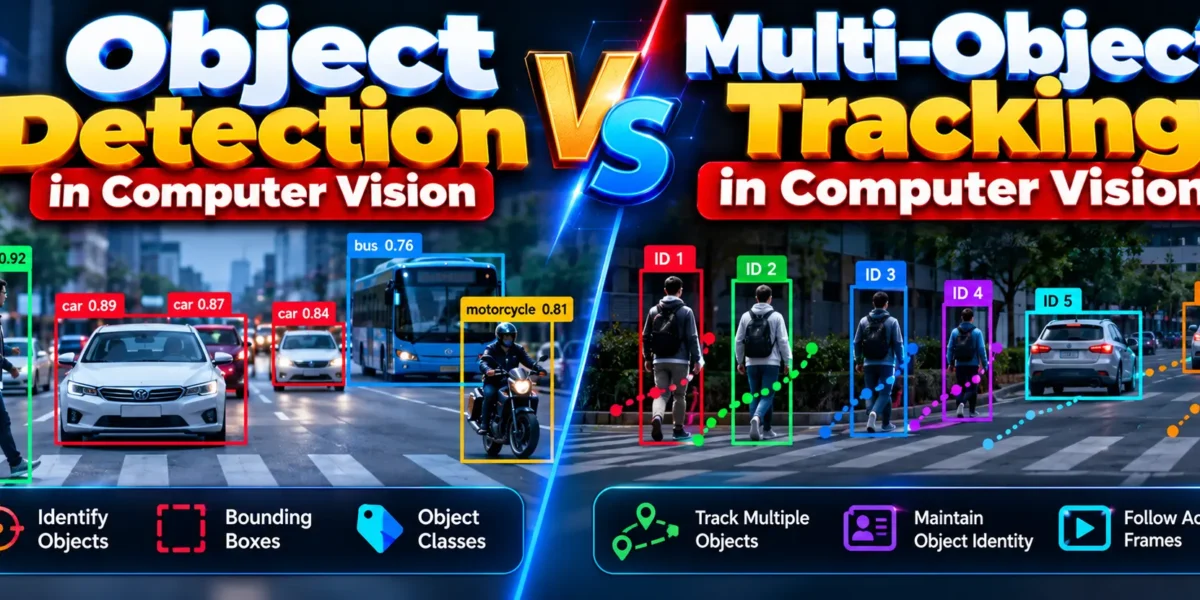
Multi-Object Tracking vs Object Detection in Computer Vision is an important comparison in modern artificial intelligence. Both technologies help computers understand visual information, but they solve different problems. Object detection identifies objects in an image or video frame, while multi-object tracking follows those objects across multiple frames.
These techniques are widely used in video surveillance, autonomous driving, traffic monitoring, sports analytics, and robotics. Understanding their differences helps developers choose the right approach for computer vision applications.
Complete Advance AI Topics: Click Here
Real Time Projects on YouTube:- DecodeIT
What Is Object Detection in Computer Vision?
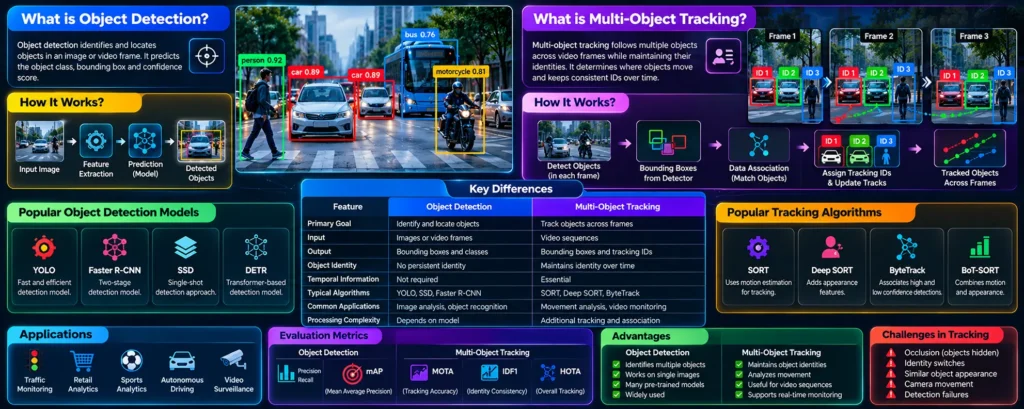
Object detection is a computer vision technique that identifies and locates objects within an image or video frame. It predicts object classes, bounding boxes, and confidence scores.
For example, an object detection model can identify three cars and two pedestrians in a traffic image. However, detection alone does not determine whether a car in the next frame is the same car detected earlier.
Popular object detection models include:
- YOLO: A family of object detection models designed for efficient inference.
- Faster R-CNN: A two-stage detection architecture.
- SSD: A single-shot object detection approach.
- DETR: A transformer-based object detection architecture.
What Is Multi-Object Tracking in Computer Vision?
Multi-Object Tracking (MOT) is a computer vision task that follows multiple objects across video frames while maintaining consistent identities. It determines where objects move and associates detections with previously tracked objects.
For example, if three cars appear in a video, a tracking system can assign IDs such as Car 1, Car 2, and Car 3. As the cars move, the tracker attempts to preserve their identities across frames.
Popular tracking algorithms include SORT, Deep SORT, ByteTrack, and BoT-SORT.
What Is the Difference Between Object Detection and Multi-Object Tracking?
The main difference is that object detection identifies objects in individual frames, whereas multi-object tracking associates objects across frames to maintain their identities over time.
| Feature | Object Detection | Multi-Object Tracking |
|---|---|---|
| Primary Goal | Identify and locate objects | Track objects across frames |
| Input | Images or video frames | Video sequences |
| Output | Bounding boxes and classes | Bounding boxes and tracking IDs |
| Object Identity | No persistent identity by default | Maintains identity over time |
| Temporal Information | Not required | Essential |
| Typical Algorithms | YOLO, SSD, Faster R-CNN | SORT, Deep SORT, ByteTrack |
| Common Applications | Image analysis and object recognition | Movement analysis and video monitoring |
| Processing Complexity | Depends on detector architecture | Adds association and tracking operations |
How Does Object Detection Work?
Object detection processes an image through a trained model and predicts the locations and categories of visible objects.
- Input: An image or video frame is provided to the model.
- Feature Extraction: The model extracts visual features.
- Prediction: It predicts object classes, bounding boxes, and confidence scores.
- Post-processing: Depending on the architecture, overlapping predictions may be filtered.
- Output: Detected objects are displayed or passed to another system.
How Does Multi-Object Tracking Work?
Multi-object tracking commonly combines object detection with data association. The tracker matches detections between frames and assigns consistent IDs to objects.
- Object Detection: Detect objects in the current video frame.
- Motion Prediction: Estimate where previously tracked objects may appear.
- Data Association: Match current detections with existing tracks.
- Identity Assignment: Preserve existing IDs or assign new ones.
- Track Management: Update, temporarily retain, or remove tracks as objects appear and disappear.
Some trackers also use appearance features to help identify objects after temporary occlusion.
Which Algorithms Are Used for Multi-Object Tracking?
SORT, Deep SORT, ByteTrack, and BoT-SORT are commonly used tracking approaches. They differ in how they associate detections and maintain object identities.
- SORT: Uses motion estimation and bounding-box association for lightweight tracking.
- Deep SORT: Extends SORT with appearance information to improve identity association.
- ByteTrack: Associates high-confidence and lower-confidence detections to recover more object tracks.
- BoT-SORT: Combines motion and appearance-based techniques, with support for camera-motion compensation.
How to Perform Object Detection Using Python?
Object detection can be implemented in Python using the Ultralytics library and a pretrained YOLO model. The following example detects objects in an image.
Install the library:
pip install ultralyticsPython example:
from ultralytics import YOLO

model = YOLO("yolo11n.pt")

results = model.predict(
    source="image.jpg",
    conf=0.25,
    save=True
)

for result in results:
    print(result.boxes)
Replace image.jpg with your image path. The model predicts bounding boxes and object categories without assigning persistent tracking IDs.
How to Perform Multi-Object Tracking Using Python?
Multi-object tracking can be implemented using a detector with a compatible tracking algorithm. The following example uses YOLO with ByteTrack to follow objects in a video.
from ultralytics import YOLO

model = YOLO("yolo11n.pt")

results = model.track(
    source="video.mp4",
    tracker="bytetrack.yaml",
    persist=True,
    save=True
)

for result in results:
    if result.boxes.id is not None:
        print(result.boxes.id)
Replace video.mp4 with your video file. The tracker attempts to maintain consistent IDs as detected objects move through the video.
Note: Tracking accuracy depends on video quality, object visibility, detector performance, and tracking configuration. Persistent IDs are not guaranteed under every condition.
Where Are Object Detection and Multi-Object Tracking Used?
Object detection is useful for identifying objects, while tracking is useful when movement, identity, or activity over time matters.
| Application | Object Detection | Multi-Object Tracking |
|---|---|---|
| Traffic Monitoring | Detect vehicles | Follow vehicles across frames |
| Retail Analytics | Detect people | Analyze movement paths |
| Sports Analytics | Identify players | Track player movement |
| Autonomous Driving | Identify nearby objects | Estimate object movement over time |
| Video Surveillance | Detect people or vehicles | Maintain identities across frames |
What Are the Main Challenges in Multi-Object Tracking?
Multi-object tracking becomes difficult when objects overlap, disappear temporarily, or look similar. These situations can cause incorrect identity assignments.
- Occlusion: Objects become partially or fully hidden.
- Identity Switches: The tracker assigns an incorrect identity to an object.
- Camera Movement: Camera motion makes association more difficult.
- Similar Appearance: Objects with similar visual features are harder to distinguish.
- Missed Detections: Detection failures interrupt object tracks.
How Are Object Detection and Tracking Performance Measured?
Object detection is commonly evaluated using precision, recall, and mean Average Precision (mAP). Multi-object tracking requires additional metrics that evaluate identity consistency and association quality.
Common tracking metrics include MOTA, IDF1, HOTA, and identity switches. These help evaluate whether a system detects objects and maintains their identities accurately.
Which Is Better: Object Detection or Multi-Object Tracking?
Neither approach is universally better because they address different requirements. Object detection is suitable when identifying objects in individual images or frames is sufficient. Multi-object tracking is more appropriate when the application must follow objects and preserve identities over time.
Many video analytics systems combine both approaches: detection identifies objects, and tracking associates them across frames.
Frequently Asked Questions
1. What is the main difference between object detection and object tracking?
Object detection identifies and locates objects, while object tracking follows objects across video frames and attempts to maintain consistent identities.
2. Can YOLO perform multi-object tracking?
Yes. Ultralytics YOLO supports tracking workflows using algorithms such as ByteTrack and BoT-SORT.
3. Is multi-object tracking possible without object detection?
Yes. Some tracking approaches integrate detection and tracking into a unified model, although tracking-by-detection is widely used.
4. Which algorithm is suitable for real-time object tracking?
SORT and ByteTrack are commonly considered for efficient tracking, but actual real-time performance depends on the detector, hardware, and video resolution.
5. What programming language is commonly used for object detection and tracking?
Python is widely used because it supports computer vision and machine learning libraries such as OpenCV, PyTorch, and Ultralytics.
Conclusion
Multi-Object Tracking vs Object Detection in Computer Vision highlights two related but distinct capabilities. Object detection answers what objects are present and where they are located, while multi-object tracking adds identity and movement information across video frames.
Keywords: Multi-Object Tracking vs Object Detection in Computer Vision, object detection vs object tracking, multi-object tracking algorithms, YOLO object detection, ByteTrack vs Deep SORT, object tracking in Python, computer vision tutorial, real-time object tracking, MOT vs object detection,Multi-Object Tracking, Object Detection, Computer Vision, Object Tracking vs Object Detection, Multi-Object Tracking Algorithms, YOLO, Deep SORT, ByteTrack, BoT-SORT, SORT Algorithm, Machine Learning, Deep Learning, Artificial Intelligence, Python Computer Vision, OpenCV, Real-Time Object Tracking, Object Detection Algorithms, Video Analytics, Computer Vision Tutorial, AI and Machine Learning