Artificial Intelligence Future Ideas
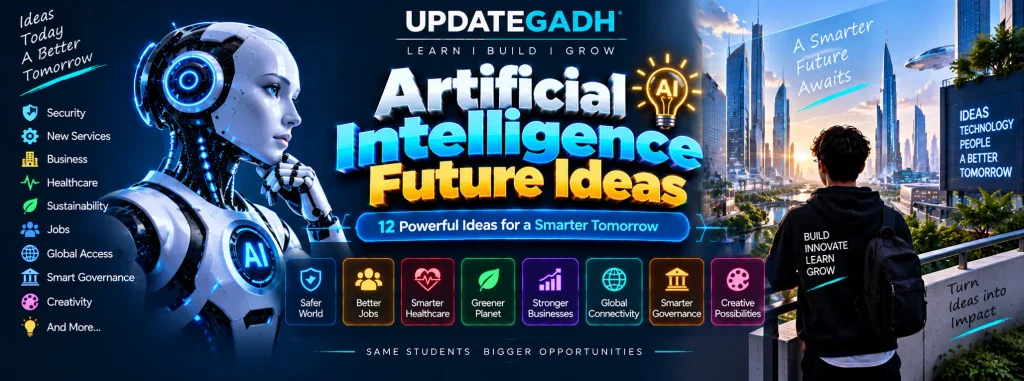
Artificial Intelligence (AI) is developing rapidly and is expected to influence many areas of society over the coming years. From healthcare and business to sustainability, creativity, communication, and government operations, AI and Machine Learning are opening new possibilities while also raising important questions about ethics, employment, privacy, and responsible technology use.
This article explores 12 Artificial Intelligence future ideas based on predictions and perspectives shared by technology, business, healthcare, education, and creative-industry experts. These ideas provide an overview of how AI could transform different aspects of our lives and work.
Table of Contents
1. Enhancing Security
Nicolas Horbaczewski, CEO of the Drone Racing League, envisions a future in which AI-powered drones become increasingly useful in everyday life. He compares the potential development of drones with the growth of mobile phones during the 1990s.
AI-enabled drones could support applications such as package delivery, emergency response, inspection, and monitoring. They may also help inspect locations that are difficult or dangerous for humans to access, potentially improving the speed and efficiency of security-related operations.
2. Creating New Services and Raising Ethical Concerns
Martin Ford, a writer for The New York Times, predicts that AI could contribute to problem-solving and innovation by enabling the development of new products, services, and markets.
At the same time, the growth of AI may raise concerns related to job displacement, privacy, security, and military applications. According to this perspective, discussions surrounding the ethical and responsible use of AI are likely to remain important as the technology develops.
Download New Real Time Projects: Click here
3. Empowering Businesses
Matthew Kamen, VP of Engineering at Foursquare, believes that the trust barrier surrounding AI applications may decrease as people and organizations gain more experience with these technologies.
As confidence in AI systems grows, businesses may increasingly use AI to support decision-making, improve user interactions, automate processes, and increase operational efficiency. Professionals such as analysts and developers can use AI technologies to create intelligent enterprise and consumer applications.
4. Transforming Healthcare
Serkan Kutan, CTO of Zocdoc, highlights the potential of AI to transform healthcare. AI systems can process large amounts of clinical information quickly and may assist healthcare professionals with diagnosis, data analysis, and treatment planning.
By automating certain routine tasks, AI could allow medical professionals to spend more time interacting directly with patients. This could contribute to more efficient healthcare workflows while supporting medical decision-making.
5. Advancing Sustainability
Nikita Johnson highlights the potential role of AI in addressing challenges related to urbanization, population growth, resource management, and climate change.
Machine Learning can be used to analyze large datasets and optimize the use of resources. AI applications in sustainability could help organizations identify patterns, improve efficiency, and develop technology-based approaches to environmental challenges.
6. Making Humans Smarter
John Steicher, Managing Director at Barclays Investment Bank, points toward the continued growth of computational power and data-analysis capabilities.
As AI systems become capable of processing larger amounts of information, they may provide more sophisticated predictions and models. Steicher compares AI training with educating a child, emphasizing the importance of how intelligent systems are designed and trained.
Well-designed AI systems could become useful tools for supporting human decision-making, research, learning, and collaboration.
7. Inspiring Creativity in Art
Stephanie Dinkins, a transdisciplinary AI artist, believes Artificial Intelligence can have a significant influence on creative fields.
Rather than viewing AI only as a replacement for human creativity, this perspective considers AI as a tool or medium that artists can use to explore new forms of expression. AI-based creative tools can allow artists to experiment with new techniques and develop innovative works.
Dinkins also emphasizes the importance of diversity, dignity, and cultural understanding when developing and using AI technologies so that creative AI can contribute positively to society.
8. Creating New Job Opportunities
Carolyn Frantz, Microsoft Corporate Secretary, views AI as a technology that can transform the workforce. Automation may reduce the need for certain repetitive roles while creating demand for new types of work.
The source cites a projection that 75 million jobs may disappear while 133 million new roles could be created. These changes could lead to new opportunities involving AI development, management, implementation, and other technology-related responsibilities.
9. Bridging Language Barriers
AI-powered language technologies are already being used to support communication between people who speak different languages. Platforms such as Duolingo and Skype demonstrate how technology can assist with language learning and communication.
Mark Sparwell of Microsoft Education envisions further improvements in real-time translation. More advanced translation technologies could support international communication, cultural exchange, education, and global collaboration.
Although AI translation is not perfect, continued development could make communication across languages more accessible.
10. Transforming Government Operations
Academic Kevin D’Souza predicts that AI could help streamline government and administrative processes. AI systems may assist with analyzing complex information, reducing paperwork, and improving certain public-administration workflows.
Governments may also use AI to study complex cases and explore new approaches to public services. However, AI adoption in government requires careful consideration of potential risks, accountability, privacy, and responsible implementation.
11. Improving Accessibility in Healthcare
Paul Bates, director of NHS services at Babylon Health, highlights the potential of AI to improve access to healthcare services.
AI-powered chatbots and digital healthcare platforms can provide users with information and assistance through automated interactions. Such technologies may help patients access basic healthcare information while reducing some of the workload placed on healthcare providers.
The development of these systems could contribute to more accessible and affordable healthcare services, while appropriate medical oversight remains important.
12. Redefining Artistic Expression
Sonja Baumel, an Austrian artist, explores the role of computational creativity in modern art. AI-powered technologies can combine computational techniques with artistic processes, giving creators new ways to experiment.
In the future, exhibitions could become collaborative environments where technology, science, and human creativity interact. This approach could encourage artists and technologists to explore new forms of artistic expression and develop innovative experiences.
Complete Advance AI Topics: Click Here
SQL Tutorial: Click Here
Conclusion
The future of Artificial Intelligence could extend far beyond traditional software applications. The ideas discussed above show how AI may influence security, business, healthcare, sustainability, employment, communication, government operations, and creative industries.
At the same time, the development of AI brings important questions about ethics, privacy, employment, safety, diversity, and human responsibility. The future impact of AI will depend not only on technological progress but also on how responsibly these technologies are designed, implemented, and used.
For students and aspiring developers, learning AI, Machine Learning, Python, and related technologies can provide a strong foundation for understanding and participating in this rapidly developing field.
Keywords
future of artificial intelligence pdf, Artificial Intelligence Future Ideas, future of artificial intelligence in India, future of artificial intelligence essay, artificial intelligence future jobs, artificial intelligence projects for students, how will AI change the future of work, future of artificial intelligence ppt, future of artificial intelligence speech, artificial intelligence future ideas ppt, AI future trends, future of AI, Artificial Intelligence future opportunities, AI and future technology