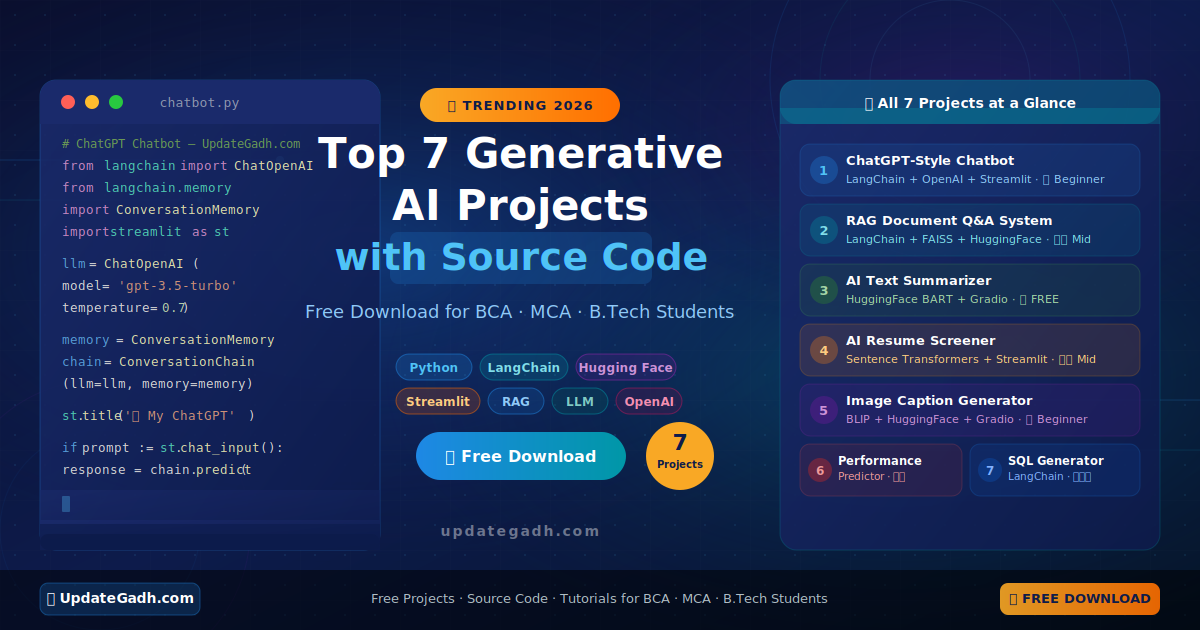
Generative AI Projects with Source Code
Table of Contents
Project tutorials, coding guides & placement tips for students.
1. What is Generative AI? (Simple Explanation for Students)
Generative AI refers to artificial intelligence systems that can CREATE new content text, images, audio, and code based on patterns learned from huge datasets. Unlike traditional AI that only classifies or predicts, Generative AI actually produces brand-new, original output.
| Traditional AI (Old) | Generative AI (2026) |
|---|---|
| Classifies spam emails | Writes a reply to your email automatically |
| Detects disease in X-rays | Generates a medical report from symptoms |
| Recommends a movie | Writes a full movie script |
| Detects objects in images | Generates a new image from a text prompt |
| Predicts house prices | Creates a complete real estate listing |
The core technologies powering Generative AI are Large Language Models (LLMs) like GPT-4 and Llama 3, Diffusion Models for image generation, and Retrieval-Augmented Generation (RAG) for building AI apps on your own data.
2. Why Choose a Generative AI Project for Your Final Year?
- Recruiters in 2026 are actively seeking candidates with hands-on GenAI experience
- Most students still submit Java and PHP projects a GenAI project immediately sets you apart
- These projects use free tools (Hugging Face, Groq, Streamlit) no paid API needed
- A working GenAI live demo always impresses your college examination committee
- GenAI skills transfer directly to real jobs at Infosys, TCS, Wipro, and tech startups
Pro Tip: A simple GenAI project with a great live demo beats a complex Java project with a poor presentation every time. Build something that WORKS and that you can EXPLAIN clearly.
3. Tools & Libraries You Need Install These First
All 7 projects use Python. Install these tools before you begin:
| Library / Tool | What It Does | Install Command |
|---|---|---|
| Python 3.10+ | Core programming language | Download from python.org |
| LangChain | Framework to build LLM apps | pip install langchain |
| Streamlit | Build web UIs for AI apps instantly | pip install streamlit |
| Transformers | Free Hugging Face LLM models | pip install transformers |
| OpenAI SDK | Access GPT-3.5 / GPT-4 API | pip install openai |
| FAISS | Vector database for RAG systems | pip install faiss-cpu |
| Gradio | Quick demo UI builder | pip install gradio |
| Sentence Transformers | Text to vector embeddings | pip install sentence-transformers |
4. The 7 Best Generative AI Projects with Source Code
Project 1: ChatGPT-Style Chatbot Python + LangChain + Streamlit
| Difficulty | ⭐ Beginner | Build Time | 23 Hours |
| Tech Stack | LangChain · OpenAI · Streamlit | Best For | BCA / MCA Final Year |
Build a full conversational AI chatbot that remembers your entire chat history just like ChatGPT. The user types a question, the LLM generates a smart response, and the memory module stores previous messages so the bot handles follow-up questions intelligently.
Source Code chatbot.py
# ChatGPT-Style Chatbot with LangChain + Streamlit
# UpdateGadh.com | Free Download

from langchain.chat_models import ChatOpenAI
from langchain.memory import ConversationBufferMemory
from langchain.chains import ConversationChain
import streamlit as st
import os

os.environ['OPENAI_API_KEY'] = 'your-api-key-here'

# Initialise LLM with conversation memory
llm    = ChatOpenAI(model_name='gpt-3.5-turbo', temperature=0.7)
memory = ConversationBufferMemory()
chain  = ConversationChain(llm=llm, memory=memory, verbose=False)

st.title(' My ChatGPT  Built with LangChain')
st.caption('Final Year Project | UpdateGadh.com')

if 'messages' not in st.session_state:
    st.session_state.messages = []

for msg in st.session_state.messages:
    st.chat_message(msg['role']).write(msg['content'])

if prompt := st.chat_input('Ask me anything...'):
    st.chat_message('user').write(prompt)
    response = chain.predict(input=prompt)
    st.chat_message('assistant').write(response)
    st.session_state.messages.append({'role':'user',      'content': prompt})
    st.session_state.messages.append({'role':'assistant', 'content': response})

# TO RUN:  streamlit run chatbot.py
How to Run Step by Step
- Run:
pip install langchain openai streamlit - Get your free API key from platform.openai.com
- Replace
'your-api-key-here'with your actual key - Run:
streamlit run chatbot.py - Open browser at your chatbot is live!
Project 2: AI Document Q&A with RAG LangChain + FAISS + Hugging Face
| Difficulty | ⭐⭐ Intermediate | Build Time | 34 Hours |
| Tech Stack | LangChain · FAISS · Hugging Face | Best For | MCA / B.Tech AI Final Year |
Why This Project is Special: RAG is the #1 trending GenAI architecture in the job market in 2026. Almost no Indian student projects use RAG yet be the first in your college!
Upload any PDF document a textbook, research paper, or company manual and ask questions about it in plain English. The AI finds relevant sections using FAISS vector search and generates accurate, grounded answers. This is the same technology used in enterprise AI assistants at companies like Google and Microsoft.
Source Code rag_qa.py
# AI Document Q&A with RAG Architecture
# UpdateGadh.com | Free Download

from langchain.document_loaders import PyPDFLoader
from langchain.text_splitter import RecursiveCharacterTextSplitter
from langchain.embeddings import HuggingFaceEmbeddings
from langchain.vectorstores import FAISS
import streamlit as st

st.title(' AI Document Q&A  Ask Anything About Your PDF')
uploaded = st.file_uploader('Upload a PDF', type='pdf')

if uploaded:
    with open('temp.pdf', 'wb') as f:
        f.write(uploaded.read())

    loader   = PyPDFLoader('temp.pdf')
    docs     = loader.load()
    splitter = RecursiveCharacterTextSplitter(chunk_size=500, chunk_overlap=50)
    chunks   = splitter.split_documents(docs)

    embeddings = HuggingFaceEmbeddings(model_name='all-MiniLM-L6-v2')
    vectordb   = FAISS.from_documents(chunks, embeddings)

    question = st.text_input('Ask a question about your document:')
    if question:
        retriever = vectordb.as_retriever(search_kwargs={'k': 3})
        results   = retriever.get_relevant_documents(question)
        st.subheader('Relevant Answer:')
        for r in results:
            st.write(r.page_content)

# TO RUN:  streamlit run rag_qa.py
Project 3: AI Text Summarizer Hugging Face BART + Gradio (100% Free)
| Difficulty | ⭐ Beginner Easiest on this list | Build Time | 12 Hours |
| Tech Stack | Hugging Face BART · Gradio | Best For | BCA Mini Project · Class 12 AI |
Paste any long article, news story, or research paper and get a short, accurate AI-generated summary in seconds. Uses Facebook’s BART-Large-CNN model. No API key or payment required 100% free.
Source Code summarizer.py
# AI Text Summarizer  Free, No API Key Needed
# UpdateGadh.com | Free Download

from transformers import pipeline
import gradio as gr

# Load free BART model from Hugging Face
summarizer = pipeline('summarization', model='facebook/bart-large-cnn')

def summarize_text(text):
    if len(text.split()) < 30:
        return 'Please enter a longer text (at least 30 words).'
    result = summarizer(text, max_length=150, min_length=40, do_sample=False)
    return result[0]['summary_text']

interface = gr.Interface(
    fn          = summarize_text,
    inputs      = gr.Textbox(lines=10, placeholder='Paste your article here...'),
    outputs     = gr.Textbox(label='AI Summary'),
    title       = 'AI Text Summarizer  UpdateGadh.com',
    description = 'Powered by Facebook BART | Final Year Project'
)
interface.launch()

# TO RUN:  python summarizer.py
Project 4: AI Resume Screener & Ranker Sentence Transformers + Streamlit
| Difficulty | ⭐⭐ Intermediate | Build Time | 34 Hours |
| Tech Stack | Sentence Transformers · Streamlit | Best For | MCA / B.Tech Placement Season 2026 |
Upload a job description and multiple resumes. The AI ranks all resumes from best to worst match using semantic similarity it understands the actual meaning of words, not just keyword counting. A real-world HR-tech application that always impresses examiners.
Source Code resume_screener.py
# AI Resume Screener & Ranking System
# UpdateGadh.com | Free Download

from sentence_transformers import SentenceTransformer
from sklearn.metrics.pairwise import cosine_similarity
import streamlit as st

model = SentenceTransformer('all-MiniLM-L6-v2')

st.title(' AI Resume Screener  UpdateGadh.com')
job_desc = st.text_area('Paste Job Description:', height=150)
resumes  = st.text_area('Paste Resumes (separate each with ---)', height=300)

if st.button('Rank Resumes') and job_desc and resumes:
    resume_list = [r.strip() for r in resumes.split('---') if r.strip()]
    jd_vec      = model.encode([job_desc])
    res_vecs    = model.encode(resume_list)
    scores      = cosine_similarity(jd_vec, res_vecs)[0]
    ranked      = sorted(zip(resume_list, scores), key=lambda x: x[1], reverse=True)

    st.subheader('Ranked Results (Best Match First):')
    for i, (resume, score) in enumerate(ranked, 1):
        st.markdown(f'**Rank {i}  |  Match Score: {score:.1%}**')
        st.info(resume[:250] + '...')

# TO RUN:  streamlit run resume_screener.py
Project 5: AI Image Caption Generator BLIP Model + Gradio
| Difficulty | ⭐ Beginner | Build Time | 12 Hours |
| Tech Stack | BLIP · Hugging Face · Gradio | Best For | B.Tech AI/ML Project |
Upload any image and the AI automatically generates a natural language description of what it sees. Uses Salesforce’s BLIP model a state-of-the-art image captioning model available for free. Great for a Computer Vision final year project.
Source Code image_caption.py
# AI Image Caption Generator using BLIP
# UpdateGadh.com | Free Download

from transformers import BlipProcessor, BlipForConditionalGeneration
from PIL import Image
import gradio as gr

processor = BlipProcessor.from_pretrained('Salesforce/blip-image-captioning-base')
model     = BlipForConditionalGeneration.from_pretrained('Salesforce/blip-image-captioning-base')

def generate_caption(image):
    inputs  = processor(image, return_tensors='pt')
    output  = model.generate(**inputs)
    caption = processor.decode(output[0], skip_special_tokens=True)
    return caption

interface = gr.Interface(
    fn          = generate_caption,
    inputs      = gr.Image(type='pil', label='Upload an Image'),
    outputs     = gr.Textbox(label='AI-Generated Caption'),
    title       = 'AI Image Caption Generator  UpdateGadh.com',
    description = 'Upload any image and get an AI caption instantly. Powered by Salesforce BLIP.'
)
interface.launch()

# TO RUN:  python image_caption.py
Project 6: Student Performance Predictor Scikit-learn + Streamlit
| Difficulty | ⭐⭐ Intermediate | Build Time | 34 Hours |
| Tech Stack | Scikit-learn · Pandas · Streamlit | Best For | BCA / MCA / B.Tech Final Year |
Predict a student’s final exam score based on study hours, attendance, previous marks, and other inputs. Uses a machine learning model trained on student data. Includes a Streamlit dashboard where you can enter inputs and get a live prediction.
Source Code student_predictor.py
# Student Performance Predictor  ML + Streamlit
# UpdateGadh.com | Free Download

import pandas as pd
from sklearn.ensemble import RandomForestRegressor
from sklearn.model_selection import train_test_split
import streamlit as st
import numpy as np

# Sample training data (replace with your own dataset)
data = pd.DataFrame({
    'study_hours':  [2,4,6,8,10,3,5,7,9,1],
    'attendance':   [60,70,80,90,95,65,75,85,92,50],
    'prev_marks':   [40,55,65,75,85,48,60,70,80,35],
    'final_score':  [42,58,68,78,88,50,63,73,83,38]
})

X = data[['study_hours','attendance','prev_marks']]
y = data['final_score']
model = RandomForestRegressor(n_estimators=100, random_state=42)
model.fit(X, y)

st.title(' Student Performance Predictor  UpdateGadh.com')
st.write('Enter student details to predict the final exam score:')

study  = st.slider('Daily Study Hours',     1, 12, 5)
attend = st.slider('Attendance (%)',        40, 100, 75)
prev   = st.slider('Previous Exam Marks',   0, 100, 60)

if st.button('Predict Score'):
    prediction = model.predict([[study, attend, prev]])[0]
    st.success(f'Predicted Final Score: {prediction:.1f} / 100')

# TO RUN:  streamlit run student_predictor.py
Project 7: AI SQL Query Generator LangChain + SQLite + OpenAI
| Difficulty | ⭐⭐⭐ Advanced | Build Time | 45 Hours |
| Tech Stack | LangChain · SQLite · OpenAI · Streamlit | Best For | MCA / B.Tech CSE Final Year |
Type a question in plain English like “Show me all students who scored above 80” and the AI automatically writes and runs the correct SQL query on your database. This is a genuinely impressive advanced project that combines NLP and database management.
Source Code sql_generator.py
# AI SQL Query Generator with LangChain
# UpdateGadh.com | Free Download

from langchain.utilities import SQLDatabase
from langchain.llms import OpenAI
from langchain_experimental.sql import SQLDatabaseChain
import streamlit as st
import os

os.environ['OPENAI_API_KEY'] = 'your-api-key-here'

# Connect to SQLite database
db  = SQLDatabase.from_uri('sqlite:///students.db')
llm = OpenAI(temperature=0, verbose=True)
db_chain = SQLDatabaseChain.from_llm(llm, db, verbose=True)

st.title(' AI SQL Query Generator  UpdateGadh.com')
st.write('Ask questions about your database in plain English:')

question = st.text_input('Your Question:', placeholder='Show all students who scored above 80')

if st.button('Generate & Run Query') and question:
    with st.spinner('Generating SQL query...'):
        result = db_chain.run(question)
        st.success('Query executed successfully!')
        st.write(result)

# TO RUN:  streamlit run sql_generator.py
5. All 7 Projects Quick Reference Table
Pick the project that matches your skill level and deadline:
| # | Project Name | Difficulty | Tech Stack | Best For |
|---|---|---|---|---|
| 1 | ChatGPT-Style Chatbot | ⭐ Beginner | LangChain + OpenAI + Streamlit | BCA / MCA |
| 2 | RAG Document Q&A | ⭐⭐ Intermediate | LangChain + FAISS + HuggingFace | MCA / B.Tech AI |
| 3 | AI Text Summarizer | ⭐ Beginner | HuggingFace BART + Gradio | BCA Mini Project |
| 4 | AI Resume Screener | ⭐⭐ Intermediate | Sentence Transformers + Streamlit | B.Tech / MCA |
| 5 | Image Caption Generator | ⭐ Beginner | BLIP + HuggingFace + Gradio | B.Tech AI/ML |
| 6 | Student Performance Predictor | ⭐⭐ Intermediate | Scikit-learn + Streamlit | BCA / MCA / B.Tech |
| 7 | SQL Query Generator | ⭐⭐⭐ Advanced | LangChain + SQLite + OpenAI | MCA / B.Tech CSE |
6. How to Present Your GenAI Project to Your College Committee
Start with the PROBLEM Explain the real-world problem your project solves. Example: “HR teams spend 8 hours screening 200 resumes. My AI does it in 30 seconds.”
- Show a LIVE DEMO Always run your project live in front of the committee. Live demos impress far more than screenshots.
- Explain the TECHNOLOGY simply “The AI reads the document, breaks it into chunks, and finds the most relevant answer using vector similarity.”
- Mention REAL-WORLD USE CASES Tell the committee where this tech is already used: ChatGPT, Google Bard, Microsoft Copilot, Notion AI.
- Prepare for QUESTIONS Common ones: What is your accuracy? What are the limitations? How would you scale this?
7. Frequently Asked Questions (FAQ)
Is a Generative AI projects accepted for BCA final year submission?
Yes, absolutely. Generative AI projects are fully accepted by all Indian universities for BCA final year submissions in 2026. They are modern, relevant, and demonstrate strong programming skills. Ensure your project has a clear problem statement, working code, and a complete project report.
Do I need to pay for the OpenAI API to build these projects?
No, not for most projects. Projects 3, 4, and 5 use completely free Hugging Face models no API key or credit card required. For Project 1 (ChatGPT Chatbot), the free OpenAI tier gives you enough credits to build and demo your project without any payment.
How long does it take to complete a Generative AI projects?
The simplest project the AI Text Summarizer takes 1 to 2 hours to build. The RAG Q&A system takes 3 to 4 hours. Add 2 to 3 extra days for writing your project report and preparing your presentation slides.
What is RAG and why is it important for 2026 projects?
RAG stands for Retrieval-Augmented Generation. It allows an AI to answer questions about your own documents without retraining the model. The system finds relevant sections and sends them to the LLM as context. RAG is the most in-demand GenAI skill in the 2026 job market any project using RAG will stand out to both examiners and recruiters.
Can I add these projects to my resume?
Absolutely yes. A working Generative AI project on your resume is one of the strongest signals you can send to recruiters in 2026. Add a GitHub link to your code. If you deploy it on Hugging Face Spaces or Streamlit Cloud (both free), include the live demo link too that makes your resume even stronger.
Conclusion
Generative AI is not just a trend it is the future of software development. By building one of these 7 Generative AI projects with source code, you are not just finishing your college assignment. You are learning the exact skills that Indian and global companies are actively hiring for in 2026.
Start with the AI Text Summarizer if you are a beginner it takes less than 2 hours and gives you a fully working app to demo. Then move to the RAG Document Q&A system for a truly impressive final year submission.
generative ai projects github generative ai projects with source code
artificial intelligence projects for students generative ai projects for final year
best generative ai projects generative ai projects kaggle generative ai projects for beginners generative ai projects pdf generative ai projects with source code generative ai projects with source code github generative ai projects with code generative ai projects for final year generative ai projects for resume
generative ai projects for hackathon generative ai projects on github generative ai projects for final year students generative ai projects in healthcare generative ai projects for portfolio