Artificial Intelligence in Healthcare
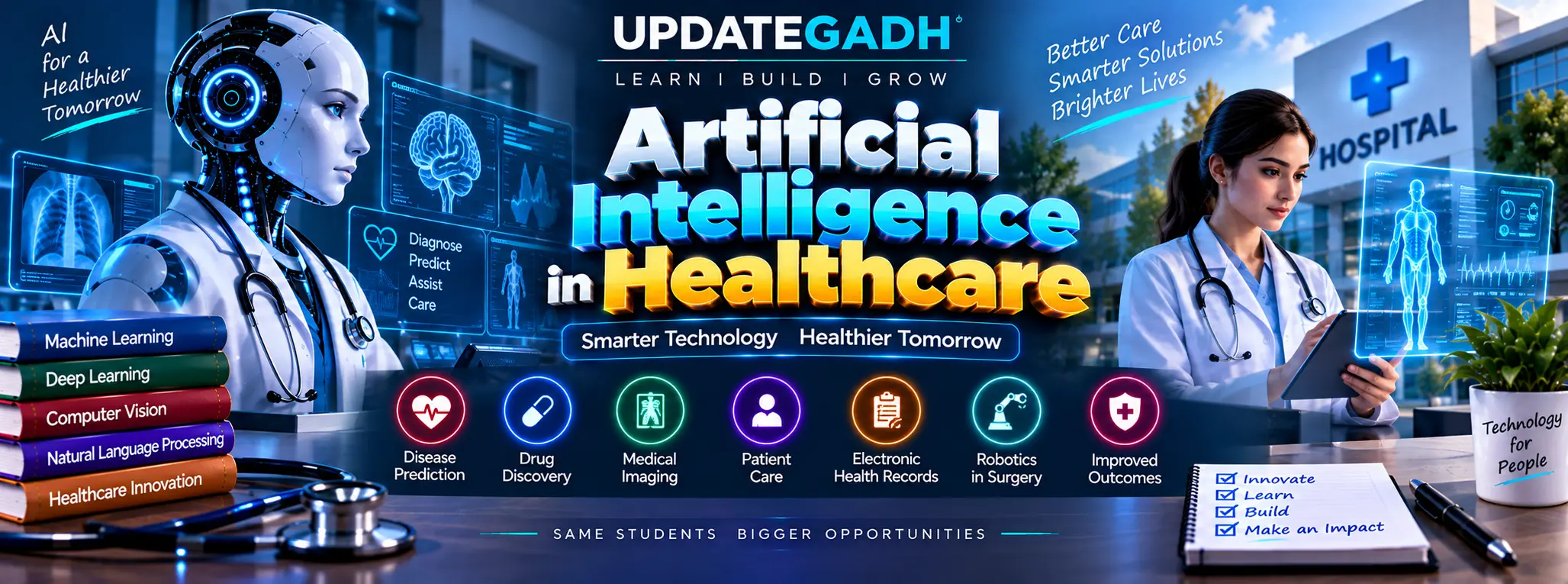
Artificial Intelligence (AI) is transforming industries around the world, and healthcare is one of the sectors experiencing significant changes. By using technologies such as Machine Learning, Computer Vision, Natural Language Processing (NLP), Robotics, and Deep Learning, AI systems can process and analyze complex medical information.
These technologies are changing how healthcare organizations approach diagnosis, treatment, patient care, research, and daily operations. AI can help healthcare professionals work with large amounts of information and support more efficient healthcare processes.
Table of Contents
Complete Advance AI Topics: Click Here
SQL Tutorial: Click Here
Introduction to Artificial Intelligence
Artificial Intelligence is a branch of computer science focused on developing systems that can perform tasks that typically require human intelligence. These tasks can include reasoning, learning from previous information, recognizing patterns, and making decisions.
AI systems can process large volumes of data and generate useful insights. This capability makes Artificial Intelligence valuable in many fields, including healthcare, where large amounts of medical and patient data are generated every day.
AI in Healthcare
Artificial Intelligence in healthcare involves using intelligent algorithms and technologies to analyze medical information, support treatment decisions, predict potential health risks, and improve patient care.
AI systems can process historical information stored in Electronic Health Records (EHRs) and use it to identify patterns that may support disease prevention, diagnosis, and treatment. Healthcare institutions such as Memorial Sloan Kettering Cancer Center and Mayo Clinic have explored AI applications to support healthcare operations and research.
Technology companies, including IBM and Google, have also developed AI-based healthcare technologies aimed at improving healthcare delivery and supporting operational efficiency.
Download New Real Time Projects: Click here
AI Technologies in Healthcare
Several Artificial Intelligence technologies contribute to innovation in healthcare. Some of the major technologies include:
1. Machine Learning (ML)
- Application: Machine Learning can support precision medicine by analyzing patient information and helping identify potentially suitable treatment approaches.
- Impact: ML can support personalized healthcare by considering patient characteristics and treatment-related information.
2. Natural Language Processing (NLP)
- Application: NLP can analyze unstructured clinical notes, assist with patient reports, and classify medical or research documents.
- Impact: NLP helps convert and interpret information contained in medical records and other healthcare documents.
3. Robotics
- Application: Robotics can support surgical procedures, patient care, and hospital logistics.
- Impact: AI-assisted robotic systems can improve precision and efficiency in certain medical procedures.
4. Rule-Based Expert Systems
- Application: Rule-based systems can support decision-making in Electronic Health Record systems using predefined rules.
- Impact: They can simplify certain diagnostic and decision-making processes by applying structured logic.
5. Robotic Process Automation (RPA)
- Application: RPA can automate repetitive administrative tasks such as billing and updating patient records.
- Impact: Automation can reduce repetitive workloads and allow healthcare professionals to dedicate more time to patient-related activities.
AI-Based Healthcare System vs. Traditional Healthcare
| AI-Based Healthcare System | Traditional Healthcare System |
|---|---|
| Can analyze EHR data to support disease and treatment outcome prediction. | Primarily relies on existing clinical studies and available medical information. |
| Can support personalized medicine using patient-specific information. | Identifying suitable treatment or specialists can require more manual assessment. |
| Can assist healthcare professionals in analyzing information and reducing certain manual errors. | Manual processes can increase the possibility of diagnostic or administrative errors. |
Key Roles of AI in Healthcare
Artificial Intelligence can be applied across several areas of healthcare. Some important roles include:
1. Disease Prediction and Prevention
AI systems can analyze patient information to identify patterns associated with potential health risks. These insights can support preventive healthcare and risk assessment.
2. Drug Research and Manufacturing
AI can support drug research by analyzing large datasets and helping researchers identify potential candidates and patterns during the development process.
3. Radiology and Medical Imaging
AI-based image analysis can assist healthcare professionals in examining medical images such as CT and MRI scans and identifying potential abnormalities.
4. Screening
AI technologies can support screening processes by analyzing medical images and other patient information. Such systems are being explored for the early identification of conditions including skin and breast cancer.
5. Psychiatry
AI can support mental-health-related analysis by processing relevant information and identifying patterns that may assist healthcare professionals in assessment and prevention efforts.
Current Research in AI Healthcare
Research and development in Artificial Intelligence continue to introduce new applications in healthcare. Some important areas include:
1. Radiology
AI-based systems are being researched and used to assist with the analysis of medical images and support the detection of conditions such as pneumonia and cancer.
2. Screening
AI systems are being investigated for their ability to support the detection and screening of various diseases. Some research has reported strong performance in specific cancer-detection tasks.
3. Primary Care
AI can support primary-care decision-making through predictive modeling, data analysis, and other information-processing techniques.
4. Electronic Health Records (EHR)
AI can analyze historical information stored in Electronic Health Records to identify patterns that may support predictive analysis and personalized healthcare.
YT:- DecodeIT
Conclusion
Artificial Intelligence in healthcare is changing the way medical information can be analyzed and used. Machine Learning, Deep Learning, NLP, Computer Vision, Robotics, and automation technologies can support areas such as diagnosis, medical imaging, drug research, patient care, and administrative operations.
At the same time, healthcare AI must operate within important ethical, legal, privacy, and social considerations. As research continues, emerging applications such as brain-computer interfaces may provide additional opportunities to assist people with disabilities.
Keywords
artificial intelligence in healthcare ppt, artificial intelligence in healthcare pdf, 10 common applications of artificial intelligence in healthcare, AI in healthcare examples, artificial intelligence in healthcare research paper pdf, artificial intelligence in healthcare courses in India, AI in healthcare research paper, artificial intelligence in healthcare articles, AI in healthcare, artificial intelligence in education, artificial intelligence in healthcare book