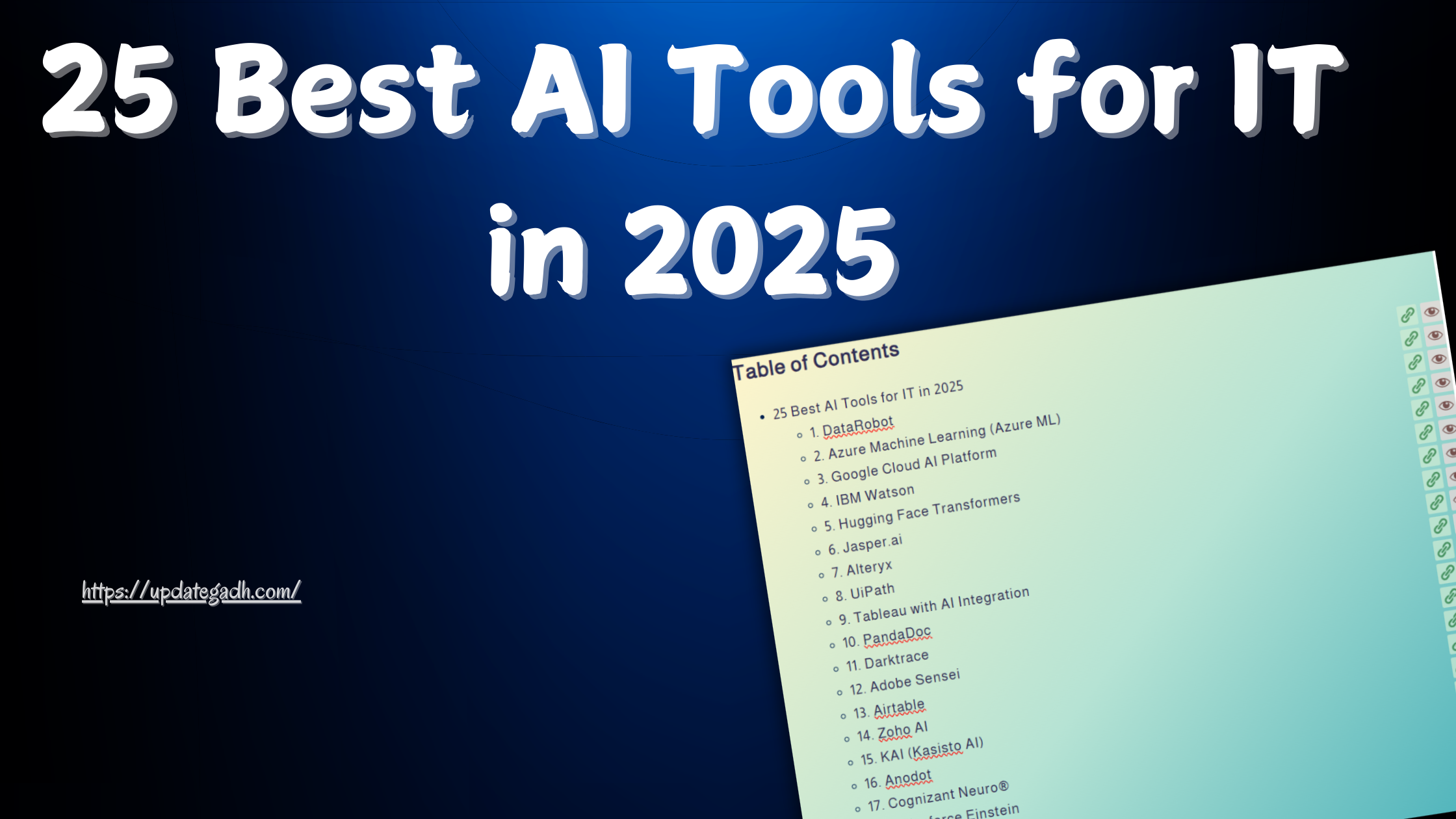
25 Best AI Tools for IT
Artificial Intelligence is no longer a futuristic concept — it is actively reshaping how IT teams build systems, secure networks, analyze data, and deliver value. In 2027, AI tools have become essential across every layer of IT operations, from cloud infrastructure to natural language processing and robotic process automation.
Whether you are a data scientist, software developer, IT manager, or cybersecurity professional, this curated list of the 25 best AI tools for IT in 2027 will help you identify the right platforms to maximize efficiency and stay ahead of the competition.
Complete Advance AI Topics: Click Here
SQL Tutorial: Click Here
25 Best AI Tools for IT Professionals in 2027
1. DataRobot
Category: Machine Learning Automation
DataRobot is an enterprise-grade machine learning platform that automates the building, deployment, and monitoring of AI models. It is especially powerful for data scientists who need to accelerate predictive analytics pipelines without writing every model from scratch. DataRobot significantly reduces the time from raw data to production-ready models.
2. Azure Machine Learning (Azure ML)
Category: Cloud AI / ML Platform
Microsoft Azure ML is a comprehensive cloud-based platform for building, training, and deploying machine learning models at enterprise scale. IT teams benefit from its seamless integration with the broader Azure ecosystem, making it a natural fit for organizations already operating within a Microsoft cloud environment.
3. Google Cloud AI Platform
Category: Cloud AI / ML Platform
Google Cloud AI Platform provides a powerful suite of tools for developing custom machine learning models. Its pre-trained APIs for natural language, computer vision, and speech recognition make it highly versatile. IT teams can deploy, manage, and scale AI solutions directly within the Google Cloud infrastructure.
4. IBM Watson
Category: Enterprise AI
IBM Watson has been a benchmark in enterprise AI for years. Its suite of tools covers natural language processing (NLP), computer vision, and data-driven decision-making. IT teams across industries use Watson for intelligent customer support, operational insights, and automated workflow management.
5. Hugging Face Transformers
Category: NLP / Open-Source AI
Hugging Face provides one of the most widely used open-source libraries for natural language processing. IT professionals and developers use it to implement advanced language models for tasks such as sentiment analysis, text summarization, translation, and question answering — without building models from scratch.
6. Jasper.ai
Category: AI Content Generation
Jasper.ai is a leading AI writing assistant that helps IT teams generate professional documentation, reports, and technical content faster. It produces human-like, structured text that reduces the manual effort required for routine writing tasks such as knowledge base articles, release notes, and internal communications.
7. Alteryx
Category: Data Analytics Automation
Alteryx empowers IT teams to prepare, blend, and analyze complex datasets through an intuitive drag-and-drop interface. It is particularly effective for automating repetitive data workflows and generating actionable business insights without requiring deep programming expertise.
8. UiPath
Category: Robotic Process Automation (RPA)
UiPath is one of the most adopted RPA platforms globally. It allows IT teams to automate repetitive business processes — from data entry and report generation to system monitoring and inventory management. By removing manual, rule-based tasks, UiPath frees up IT resources for higher-value strategic work.
9. Tableau with AI Integration
Category: Data Visualization / BI
Tableau’s AI-powered analytics layer transforms raw data into interactive, visual dashboards that support faster and more informed decision-making. IT teams use it to track KPIs, identify trends, and communicate complex data insights to non-technical stakeholders with clarity.
10. PandaDoc
Category: Document Workflow Automation
PandaDoc uses AI to streamline the creation, delivery, and e-signing of business documents. For IT departments, it is invaluable in managing contracts, service level agreements, NDAs, and vendor documentation — all within a secure, digital workflow.
11. Darktrace
Category: AI Cybersecurity
Darktrace is a market leader in AI-driven cybersecurity. Its self-learning AI engine continuously monitors network behavior and automatically identifies and responds to anomalies in real time — before threats escalate. IT security teams use Darktrace to stay ahead of sophisticated cyberattacks without relying on predefined rules.
12. Adobe Sensei
Category: AI for Creative & Content Operations
Adobe Sensei is an AI and machine learning framework embedded across Adobe’s product suite. For IT and creative operations teams, it automates content tagging, image recognition, and intelligent editing — dramatically speeding up asset management and content production workflows.
13. Airtable
Category: Project & Data Management
Airtable combines the flexibility of a spreadsheet with the power of a relational database, enhanced by AI-driven automation. IT teams use it for project tracking, asset management, and cross-team collaboration — all within a customizable, no-code interface.
14. Zoho AI (Zia)
Category: AI-Powered CRM
Zoho’s built-in AI assistant, Zia, brings predictive analytics, sentiment analysis, and intelligent recommendations directly into CRM and business operations. IT teams in both small and large enterprises leverage Zoho AI to improve customer management workflows and automate routine CRM tasks.
15. KAI (Kasisto AI)
Category: Conversational AI / FinTech
KAI by Kasisto specializes in conversational AI for the financial sector. It enables IT teams in banking and finance to automate complex customer queries with human-like interactions — improving response times, reducing support costs, and delivering consistent customer experiences at scale.
16. Anodot
Category: AI Anomaly Detection / Monitoring
Anodot provides real-time AI-driven analytics specifically designed to detect anomalies across business data streams. For IT operations teams, it is particularly effective in monitoring network traffic, cloud performance, and application health — enabling rapid incident response before issues impact end users.
17. Cognizant Neuro
Category: Intelligent Automation
Cognizant Neuro is an enterprise AI platform built to help IT departments monitor, manage, and optimize automation workflows at scale. It improves operational efficiency by reducing manual errors, providing intelligent orchestration, and delivering end-to-end visibility across automation pipelines.
18. Salesforce Einstein
Category: AI-Powered CRM / Predictive Analytics
Salesforce Einstein delivers AI-driven predictive analytics natively within the Salesforce platform. IT and business teams use it to personalize customer experiences, prioritize leads, forecast outcomes, and automate routine CRM processes — all powered by machine learning models trained on real business data.
19. Amazon SageMaker
Category: Managed ML Platform
Amazon SageMaker is AWS’s fully managed machine learning service that simplifies the complete ML lifecycle — from data labeling and model training to deployment and monitoring. IT professionals working in AWS environments rely on SageMaker to scale machine learning projects efficiently without managing underlying infrastructure.
20. Clarifai
Category: Computer Vision / Image Recognition
Clarifai specializes in image and video recognition using pre-trained and custom AI models. IT teams working in security monitoring, media management, or quality inspection use Clarifai to automate object detection, classification, and visual search at high accuracy and speed.
21. Splunk
Category: IT Operations / Security Analytics
Splunk uses AI to help IT professionals analyze massive volumes of machine-generated data in real time. Its capabilities span security information and event management (SIEM), IT monitoring, and incident detection — making it one of the most trusted platforms for operational intelligence in enterprise IT environments.
22. Zoho Zia
Category: AI Assistant / CRM Automation
Zia is Zoho’s dedicated AI assistant that integrates across the Zoho product ecosystem. It assists IT and business teams with sentiment analysis, sales forecasting, workflow suggestions, and anomaly alerts — delivering conversational AI capabilities that streamline day-to-day CRM operations.
23. Tonic.ai
Category: Synthetic Data Generation
Tonic.ai solves a critical challenge in software development — generating safe, realistic test data without exposing real user information. IT teams use it to create synthetic datasets that mirror production environments, enabling thorough application testing while maintaining full compliance with data privacy regulations.
24. GitHub Copilot
Category: AI Code Assistant
GitHub Copilot is an AI-powered coding assistant developed by GitHub and OpenAI. It integrates directly into popular code editors and suggests code snippets, functions, and entire logic blocks in real time. For IT development teams, Copilot accelerates coding speed, reduces boilerplate writing, and helps developers focus on solving complex problems faster.
25. Dataiku
Category: End-to-End Data Science Platform
Dataiku provides a collaborative, end-to-end platform for data preparation, model development, deployment, and monitoring. IT teams and data science departments use Dataiku to unify their entire ML workflow — from raw data ingestion to production-ready AI — while fostering collaboration between technical and non-technical team members.
Quick Comparison: 25 Best AI Tools for IT in 2027
| # | Tool | Primary Use | Best For |
|---|---|---|---|
| 1 | DataRobot | ML Automation | Data Scientists |
| 2 | Azure ML | Cloud AI Platform | Microsoft Cloud Teams |
| 3 | Google Cloud AI | Custom ML Models | Cloud-Native IT Teams |
| 4 | IBM Watson | Enterprise AI | Large Enterprises |
| 5 | Hugging Face | NLP / Open Source | AI Developers |
| 6 | Jasper.ai | Content Generation | IT Documentation Teams |
| 7 | Alteryx | Data Analytics | Business Analysts |
| 8 | UiPath | RPA | Process Automation Teams |
| 9 | Tableau AI | Data Visualization | BI & Reporting Teams |
| 10 | PandaDoc | Document Automation | IT Contract Management |
| 11 | Darktrace | Cybersecurity | Security Operations |
| 12 | Adobe Sensei | Creative Automation | Content Operations |
| 13 | Airtable | Project Management | Cross-Team Collaboration |
| 14 | Zoho AI | CRM Automation | SMBs & Enterprises |
| 15 | KAI (Kasisto) | Conversational AI | Financial IT Teams |
| 16 | Anodot | Anomaly Detection | Network Monitoring |
| 17 | Cognizant Neuro | Intelligent Automation | Enterprise IT Ops |
| 18 | Salesforce Einstein | Predictive CRM | Sales & IT Teams |
| 19 | Amazon SageMaker | Managed ML | AWS Cloud Teams |
| 20 | Clarifai | Computer Vision | Security / Media IT |
| 21 | Splunk | Security Analytics | SOC & IT Operations |
| 22 | Zoho Zia | AI CRM Assistant | Zoho Ecosystem Users |
| 23 | Tonic.ai | Synthetic Data | Dev & QA Teams |
| 24 | GitHub Copilot | AI Code Assistant | Software Developers |
| 25 | Dataiku | Data Science Platform | ML & Data Teams |
How to Choose the Right AI Tool for Your IT Team
With so many capable platforms available, the selection process should be driven by your team’s specific goals rather than popularity alone. Consider the following before committing to a tool:
- Define your primary use case — cybersecurity, ML development, automation, or data analytics each require different tools.
- Evaluate your existing tech stack — tools like Azure ML or Amazon SageMaker work best when you are already in those cloud ecosystems.
- Assess team skill level — no-code tools like Alteryx or Airtable suit non-developers, while Hugging Face or SageMaker suit experienced ML engineers.
- Consider scalability — enterprise teams need platforms that grow with data volume and user count without performance degradation.
- Check compliance requirements — tools handling sensitive data like Tonic.ai are essential for teams operating under GDPR, HIPAA, or similar regulations.
YT:- DecodeIT
Final Thoughts
The AI tools landscape for IT professionals in 2027 is broader and more capable than ever before. From fully managed cloud ML platforms like Amazon SageMaker and Azure ML to specialized tools like Darktrace for cybersecurity and GitHub Copilot for code acceleration — there is a purpose-built solution for every IT challenge.
The best strategy is to start with the tools that directly address your team’s most pressing bottlenecks, evaluate them in a controlled environment, and gradually expand your AI toolkit as your team’s capabilities grow.
Bookmark this list, share it with your IT team, and take the first step toward building a smarter, AI-augmented IT operation in 2027.
Keywords:
25 Best AI Tools for IT Professionals in 2027, best AI tools for IT professionals 2027, AI tools for IT, artificial intelligence tools, AI tools for developers, AI tools for data scientists, AI tools for cybersecurity, AI tools for software development, machine learning tools, AI automation tools, cloud AI tools, enterprise AI tools, AI productivity tools, AI coding tools, AI cybersecurity tools, machine learning platforms, AI development tools, IT automation tools, AI tools for businesses, AI tools for data analytics, AI tools for cloud computing, GitHub Copilot, Amazon SageMaker, Azure Machine Learning, Hugging Face Transformers, DataRobot, IBM Watson, UiPath, Tableau AI, Dataiku, AI technology 2027, latest AI tools 2027, future of AI in IT.