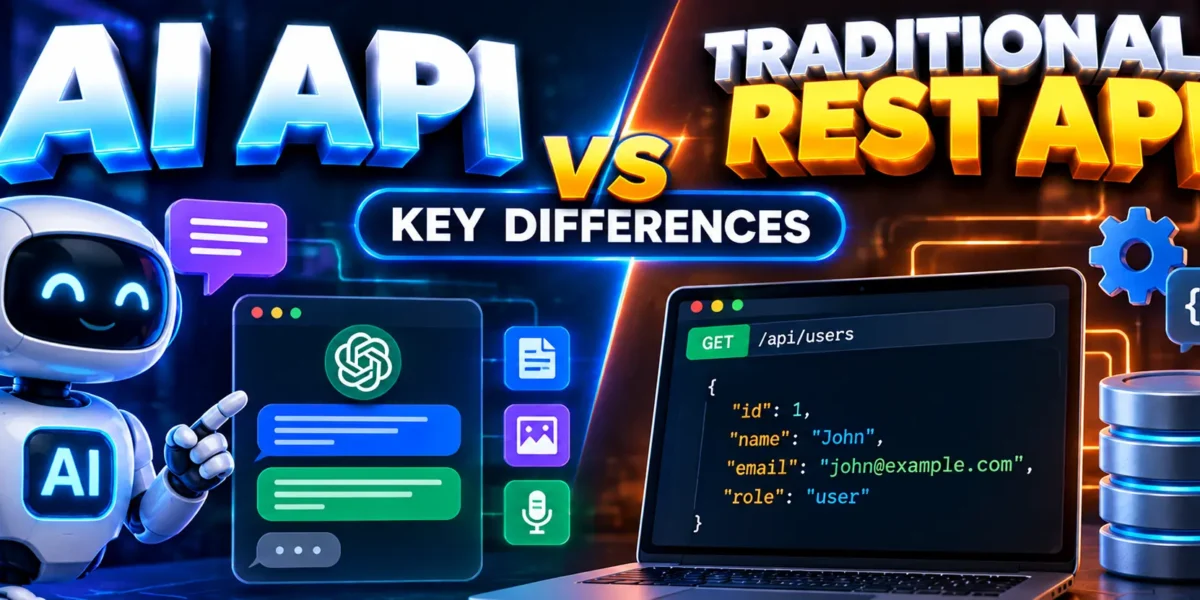
AI API vs Traditional REST API
APIs (Application Programming Interfaces) help applications communicate, exchange data, and connect different services. Traditional REST APIs are widely used to transfer structured data between systems, while AI APIs provide access to artificial intelligence capabilities such as text generation, summarization, image analysis, and natural language processing.
Understanding AI API vs Traditional REST API: Key Differences helps developers choose the right integration for their applications. Although both can use HTTP requests and return responses, they differ in their primary purpose, processing methods, output behavior, and typical use cases.
Complete Advance AI Topics: Click Here
Real Time Projects on YouTube:- DecodeIT
What Is an AI API?
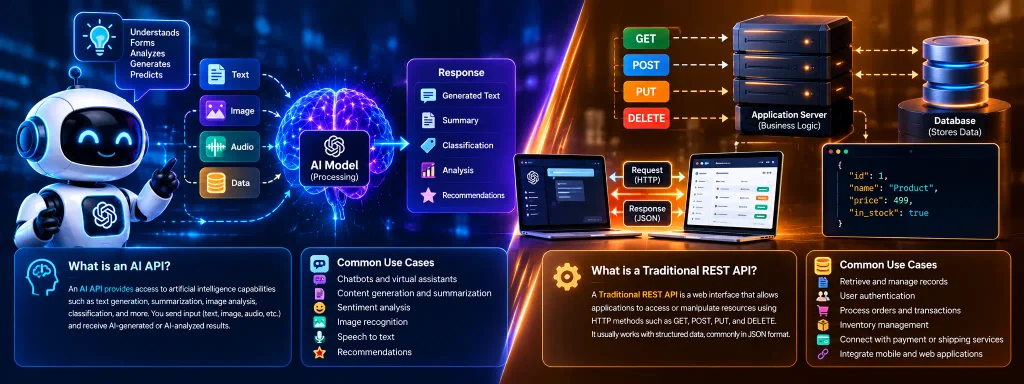
An AI API allows developers to integrate artificial intelligence capabilities into applications without building and hosting every AI model themselves. Depending on the service, developers can send text, images, audio, or other supported inputs and receive AI-generated or AI-analyzed results.
For example, an AI API can summarize a document, answer a question, classify customer feedback, generate content, or extract information from an image. The response may depend on the input, the model, and the instructions provided.
Common Uses of AI APIs
- AI-powered chatbots and virtual assistants.
- Text generation, rewriting, and summarization.
- Sentiment analysis and text classification.
- Image recognition and document analysis.
- Speech recognition and audio processing.
- Semantic search and recommendation features.
What Is a Traditional REST API?
A traditional REST API is a web interface that allows applications to access or manipulate resources through HTTP methods such as GET, POST, PUT, PATCH, and DELETE. REST APIs commonly exchange structured data, often in JSON format.
For example, an e-commerce application can use a REST API to retrieve product details, create an order, update a customer profile, or check inventory. The server typically applies defined business rules and returns a response representing the requested operation.
Common Uses of REST APIs
- Retrieving product and customer information.
- Creating and updating database records.
- Processing orders and booking requests.
- Managing user accounts and permissions.
- Connecting websites with payment or shipping services.
- Integrating mobile applications with backend systems.
What Are the Key Differences Between AI APIs and REST APIs?
The main difference is their purpose: AI APIs provide access to AI capabilities, while traditional REST APIs expose application resources and business operations. However, these categories are not mutually exclusive because an AI service can itself be accessed through a REST API.
| Comparison Factor | AI API | Traditional REST API |
|---|---|---|
| Primary Purpose | Provides AI-powered capabilities | Provides access to resources and operations |
| Processing | Often uses AI models for inference | Usually follows defined application logic |
| Input | May accept text, images, audio, or structured data | Commonly accepts parameters and structured request data |
| Output | May generate content, predictions, or analysis | Usually returns resource data or operation results |
| Predictability | Outputs can vary for similar inputs | Responses are generally more predictable for the same state and request |
| Data Handling | May process input using an AI model | Often reads or modifies application data |
| Validation | Needs input validation and output-quality checks | Needs request validation and business-rule enforcement |
| Typical Applications | Chatbots, summarization, classification, generation | Authentication, CRUD operations, orders, inventory |
| Cost Factors | May depend on tokens, model usage, or processed media | May depend on requests, compute, infrastructure, or service plans |
| Performance | Can require more processing for complex model tasks | Often faster for straightforward data operations, depending on the service |
How Do AI APIs and REST APIs Work?
How Does an AI API Work?
An AI API receives supported input and sends it to an AI model or associated processing service. The model analyzes the input and returns a generated response, classification, prediction, or other supported result.
- The application collects user input.
- The application sends a request to the AI service.
- The AI model processes the input.
- The service returns the result.
- The application displays or further processes the response.
How Does a Traditional REST API Work?
A REST API receives an HTTP request for a resource or operation. The server validates the request, executes the relevant application logic, interacts with a database or another service if needed, and returns an HTTP response.
- The client sends an HTTP request to an endpoint.
- The server validates the request and permissions.
- The application performs the requested operation.
- The server returns a status code and response data.
- The client uses the response to update its interface or continue processing.
What Is the Difference Between AI API and REST API Responses?
A traditional REST API often returns predefined data, such as a product record or an order status. An AI API may return generated or inferred content based on the submitted input.
For example, a product API might return a product’s name and price. An AI API could summarize product reviews or generate a natural-language description based on product information.
Example of a Traditional REST API Response
{
  "product_id": 101,
  "name": "Wireless Headphones",
  "price": 2499,
  "in_stock": true
}
This example represents structured product data returned by an application endpoint.
Example of an AI API Response
{
  "summary": "Wireless headphones for everyday
  listening, with a focus on convenience and portability."
}
This simplified example represents generated text. Actual AI API request and response formats vary by provider and model.
When Should You Use an AI API?
Use an AI API when your application needs capabilities that involve language understanding, content generation, classification, or model-based analysis.
- Build a chatbot that answers questions in natural language.
- Summarize long documents or customer feedback.
- Classify support tickets by topic or urgency.
- Extract information from supported documents or images.
- Generate personalized content from supplied information.
AI-generated results should be validated where accuracy matters. Developers should also consider privacy, model limitations, usage costs, and the possibility of incorrect outputs.
When Should You Use a Traditional REST API?
Use a traditional REST API when an application needs reliable access to defined resources or business operations, such as retrieving records, updating data, or submitting transactions.
- Retrieve products, users, and inventory records.
- Create or update orders.
- Manage login sessions and permissions through suitable authentication endpoints.
- Connect an application to a shipping or payment provider.
- Retrieve reports and structured database information.
For important operations, enforce authentication, authorization, input validation, and appropriate transaction rules on the server.
Can an Application Use Both AI APIs and REST APIs?
Yes. Many applications benefit from using both. A traditional REST API can manage application data and business rules, while an AI API can provide intelligent features on top of that data.
For example, an online store can use REST endpoints to retrieve product details and manage orders. An AI API can help shoppers ask questions about products, summarize reviews, or receive conversational recommendations. The application backend can connect the two while enforcing access controls and validating AI outputs.
What Should Developers Consider Before Choosing an API?
- Purpose: Determine whether the task requires structured data operations, AI inference, or both.
- Accuracy: Consider whether the output must follow strict business rules or can contain generated content.
- Cost: Review request limits, model usage charges, hosting, and infrastructure costs.
- Latency: Evaluate response times under expected workloads.
- Security: Protect API keys, validate requests, and enforce access controls.
- Privacy: Understand what data is sent to external providers and how it is handled.
- Scalability: Test expected request volumes, rate limits, and failure-handling behavior.
- Maintenance: Consider versioning, monitoring, documentation, and provider dependencies.
Final Thoughts
AI APIs and traditional REST APIs serve different purposes, but they can work together within the same application. AI APIs are useful for generating content, analyzing inputs, and supporting natural-language interactions. Traditional REST APIs are useful for exposing data and executing defined application operations.
From a developer’s perspective, the best choice depends on the problem being solved. Use a REST API for predictable business operations, an AI API for model-powered capabilities, or combine both to build applications that are data-driven and intelligent.
Frequently Asked Questions
1. Is an AI API the same as a REST API?
No. An AI API provides access to AI capabilities, while REST describes an architectural style for web APIs. An AI service can itself expose functionality through a REST API.
2. Which API is better for a chatbot?
An AI API is useful for natural-language understanding and response generation. A REST API can provide account information, order records, or other application data that the chatbot needs.
3. Are REST API responses more predictable than AI API responses?
Traditional REST API responses are generally more predictable when requests and underlying data remain the same. AI outputs can vary depending on the model, input, configuration, and generation settings.
4. Can AI APIs connect to databases?
An AI API does not automatically provide unrestricted database access. An application can use its backend or approved tools to retrieve database information and provide relevant data to the AI service.
5. Can I use AI APIs and REST APIs in one project?
Yes. A project can use REST APIs for data retrieval and business operations and AI APIs for tasks such as summarization, classification, and conversational assistance.