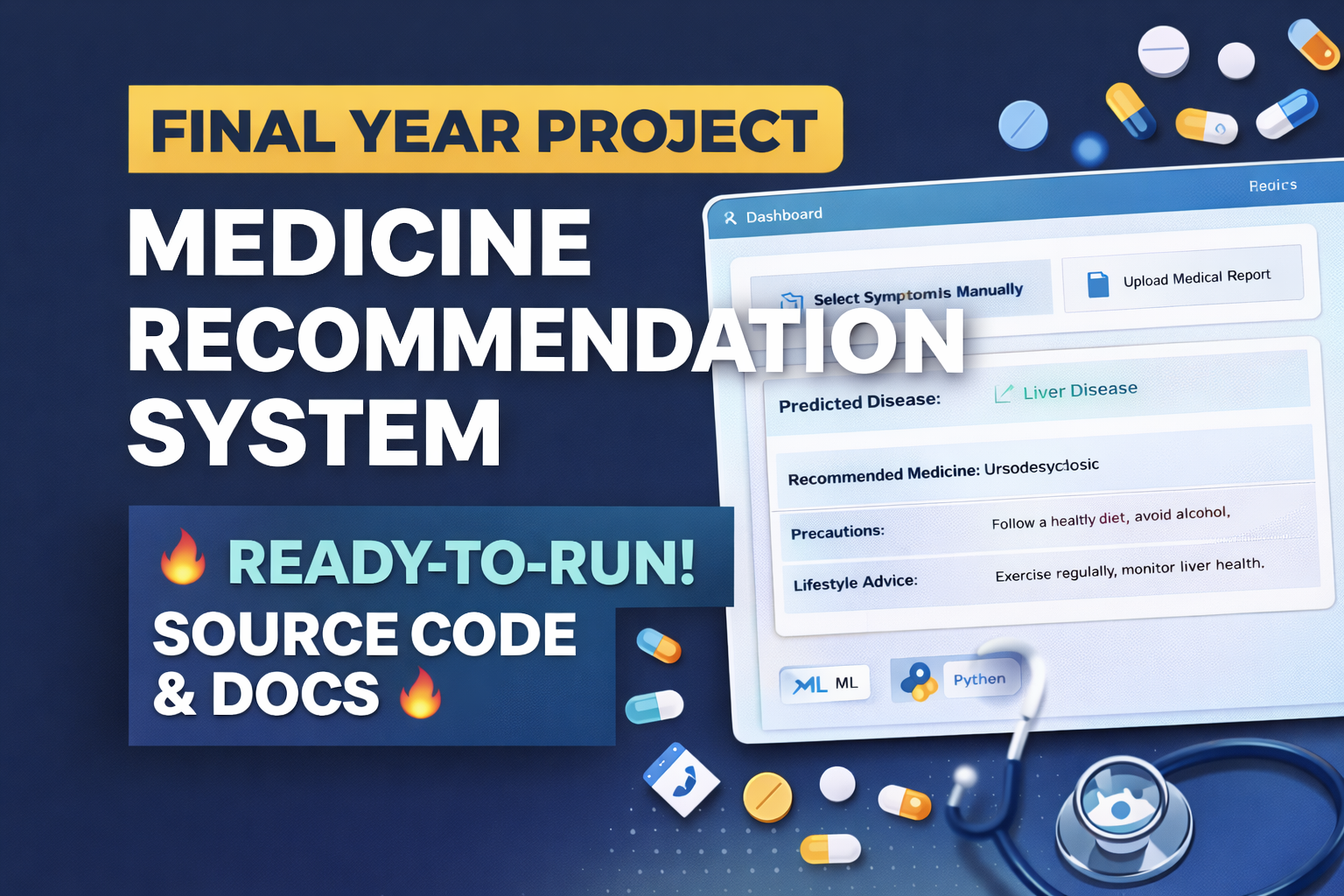
The Medicine Recommendation System is an intelligent web-based healthcare application that predicts diseases based on symptoms and recommends medicines, precautions, and lifestyle suggestions using the Support Vector Machine (SVM) machine learning algorithm.
This project is specially designed for final year students who want to build a real-world AI + Web-based healthcare system using Python and Flask. It is practical, modern, and easy to explain during viva.
Project tutorials, coding guides & placement tips for students.
Why This Project is NEW and Unique?
- Unlike basic symptom checker systems, this project uses SVM Machine Learning algorithm for classification.
- Supports medical report upload (TXT) for automatic symptom extraction.
- Provides medicine + precaution + lifestyle suggestions in one dashboard.
- Includes a complete Admin Panel for managing disease and medicine records.
- Can be extended into a real startup healthcare assistant.
Most college projects only predict disease. But this system goes further by giving recommendations, report upload support, and full web dashboard functionality.
Core Features of the System
| Feature | Description |
|---|---|
| Symptom-Based Prediction | User selects symptoms and system predicts disease using SVM |
| Medicine Recommendation | Suggests medicines based on predicted disease |
| Lifestyle Suggestions | Provides precautions and healthy lifestyle tips |
| Medical Report Upload | Upload TXT report for automatic disease detection |
| Admin Panel | Manage disease, medicine, and precaution records |
Car Price Prediction :- /
System Architecture Overview
| Layer | Technology Used |
|---|---|
| Frontend | HTML5, CSS3 |
| Backend | Python, Flask |
| Machine Learning | Scikit-learn (SVM Algorithm) |
| Data Processing | Pandas, NumPy |
| Report Extraction | PyPDF2 |
How the Machine Learning Model Works
The system uses Support Vector Machine (SVM) classification algorithm.
- Dataset contains symptoms and mapped diseases.
- Data is preprocessed using Pandas.
- SVM model is trained using Scikit-learn.
- The trained model is saved inside the models folder.
- When user selects symptoms, model predicts the disease.
SVM is chosen because it performs well on classification problems and gives high accuracy even with limited datasets.
How to Run the Project
Step 1: Navigate to Project Folder
cd "c:\Users\hp\Desktop\Medicine Recommendation System"
Step 2: Install Required Libraries
pip install -r requirements.txt
Step 3: Train Machine Learning Model
python train_model.py
Step 4: Run Flask Application
python app.py
Step 5: Open Browser
Go to:
Admin Panel Access
- URL:
- Username: admin
- Password: admin123
Admin can add, edit, delete, and manage disease-medicine records easily.
Viva Questions with Answers
-
1. Why did you choose SVM instead of Decision Tree or Random Forest?
I selected Support Vector Machine (SVM) because it performs very well in classification problems, especially when the dataset has high-dimensional features like multiple symptoms. SVM works by finding the optimal hyperplane that separates different disease classes with maximum margin.
Compared to Decision Tree, SVM reduces overfitting in small-to-medium datasets. Compared to Random Forest, SVM is computationally efficient for structured symptom-based data and provides stable accuracy. Since this project focuses on accurate disease classification, SVM was a suitable choice.
-
2. How does the system extract symptoms from uploaded PDF medical reports?
The system uses the PyPDF2 library to extract text from uploaded PDF files. After extracting the raw text, the system performs text preprocessing such as converting to lowercase and removing special characters.
Then it matches keywords from the extracted text with predefined symptom names stored in the dataset. Once symptoms are identified, they are converted into feature vectors and passed to the trained SVM model for disease prediction.
This makes the system semi-automated and more advanced compared to traditional manual symptom selection systems.
-
3. What are the advantages of using Flask for this project?
Flask is a lightweight and flexible Python web framework. It is easy to integrate with machine learning models and allows fast development.
Advantages of Flask in this project:
- Simple routing and template rendering
- Easy integration with Scikit-learn models
- Lightweight and suitable for small to medium projects
- Easy to deploy on cloud platforms
- Flexible structure for adding admin panel and extensions
Flask makes the system scalable and maintainable while keeping the project simple enough for final year students to understand.
-
4. How is the machine learning model trained in this project?
The model is trained using a dataset that maps symptoms to diseases. First, the dataset is loaded using Pandas. Then the symptom columns are converted into numerical format.
After preprocessing, the dataset is split into training and testing sets. The SVM classifier from Scikit-learn is trained using the training data. Finally, the trained model is saved using pickle inside the models folder for future predictions.
-
5. What are the limitations of this system?
Some limitations include:
- The system depends on the quality and size of the dataset.
- It does not replace professional medical advice.
- Accuracy may decrease if new diseases are not included in dataset.
- PDF extraction accuracy depends on report formatting.
However, the system can be improved by adding larger datasets, NLP techniques, and real-time hospital data integration.
- Movie Recommender System Project in Python
- Trending Final Year Project Ideas 2026 for BCA, MCA and B.Tech Students
- Student Marks Predictor Project in Python-Free Source Code
- CSC Banking Management System Software for CSC Centers
- Multi-Agent Research Assistant in Python
Future Enhancements
- Integration with real hospital APIs
- Multi-language support
- Cloud deployment
- User login and history tracking
- Integration with wearable health devices
Important Note for Final Year Students
If you are a final year student and want a ready-to-run project (with proper documentation, DB setup, and full dashboard). Get the full project package from updategadh.com and save your time. Because last-minute project stress is real.
Want Complete Source Code + Documentation?
- Full project
- Database setup
- Admin dashboard
- PPT + Documentation (Kindly inform us at least 2 days in advance)
This Project Package Includes:
- Complete Source Code
- Trained ML Model
- Dataset
- Page Documentation + PPT (Kindly inform us at least 1 days in advance 499 for that)
- Installation Guide
- System Architecture Diagram
Disclaimer
This system is developed for educational purposes only. It does not replace professional medical advice. Always consult a qualified healthcare professional.
- Keyword: Medicine Recommendation System using SVM ML healthcare project, disease prediction system Python, Flask machine learning project, final year ML project with source code, symptom based disease prediction system medicine recommendation system
- personalized medicine recommendation system project
- alternative medicine recommendation system
- ayurvedic medicine recommendation system
- use case diagram for medicine recommendation system
- personalized medicine recommendation system
- er diagram for medicine recommendation system
- personalized medicine recommendation system using machine learning
- architecture diagram for medicine recommendation system