Speculative Execution vs Standard Decoding in LLMs
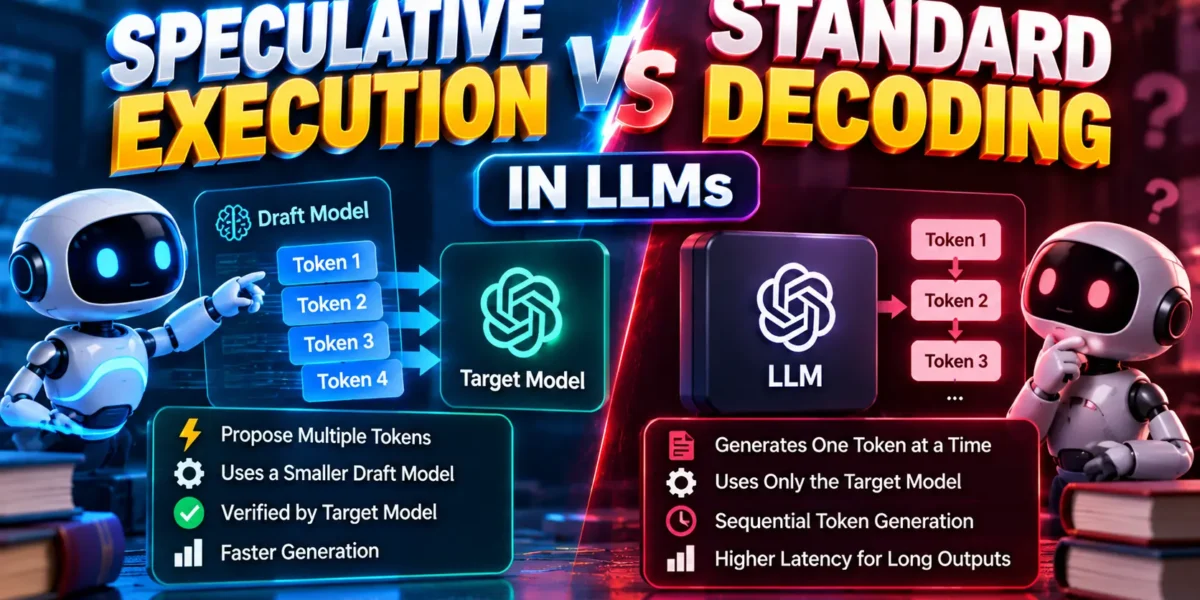
Speculative Execution vs Standard Decoding in LLMs is an important comparison for understanding how large language models generate text and how inference speed can be improved. Standard decoding generates tokens sequentially using the main language model, while speculative decoding uses a smaller draft model to propose multiple tokens that a larger target model verifies together.
Both techniques can produce text using autoregressive language models, but they differ in how token generation is organized. Understanding these approaches helps students and AI developers learn about inference optimization, computational efficiency, latency, and the practical challenges of deploying large language models.
Complete Advance AI Topics: Click Here
Real Time Projects on YouTube:- DecodeIT
What Is Standard Decoding in LLMs?
Standard decoding is the conventional approach in which a language model generates text one token at a time. At each step, the model processes the existing context, predicts the next token, and uses that token as part of the context for generating the following token.
For example, when generating the sentence “Artificial intelligence is useful,” the model predicts a token, updates its context, and repeats the process until the response is complete or a stopping condition is reached.
Although modern inference systems optimize operations such as attention calculations and KV-cache management, standard autoregressive generation still depends on successive token-generation steps.
What Is Speculative Decoding in LLMs?
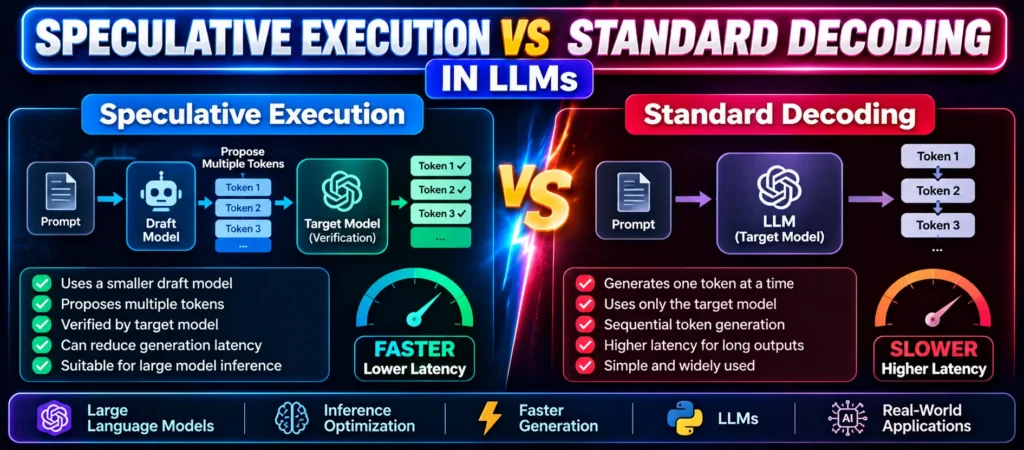
Speculative decoding is an inference optimization technique that allows a smaller draft model to propose several tokens before a larger target model verifies them. Instead of relying exclusively on the target model for every individual token-generation step, the system can verify a group of proposed tokens in one target-model pass.
The draft model generates candidate tokens quickly, and the target model checks those candidates against its own next-token distributions. Accepted tokens can be retained, while rejected proposals are corrected according to the verification algorithm.
When implemented with an appropriate verification and sampling procedure, speculative decoding can preserve the target model’s output distribution while reducing the number of sequential target-model calls needed to generate a response.
How Does Standard Decoding Work?
Standard decoding repeatedly runs the target model to generate the next token based on the current context. Each generated token becomes part of the context for the next generation step.
- Provide the initial prompt to the language model.
- Calculate the probability distribution for the next token.
- Select a token using the configured decoding strategy.
- Add the generated token to the context.
- Repeat until the response is complete.
This process is straightforward and works well across many inference workloads. However, generating long responses can require many sequential decoding steps, which may increase response latency.
How Does Speculative Decoding Work?
Speculative decoding combines fast draft generation with verification by the target model. Its main advantage is that multiple candidate tokens can be checked during a single target-model pass rather than generating every token through a separate target-model step.
- Draft generation: A smaller model proposes a sequence of candidate tokens.
- Parallel verification: The target model evaluates the proposed sequence using its own token probabilities.
- Token acceptance: The system accepts candidate tokens according to the verification algorithm.
- Correction: If a candidate is rejected, the algorithm selects an appropriate replacement token.
- Continued generation: The process repeats from the updated context.
The performance benefit depends on how many draft tokens are accepted, the relative speed of both models, and the cost of verification. Speculative decoding is therefore not guaranteed to be faster in every workload.
What Is the Difference Between Speculative Decoding and Standard Decoding?
The main difference is how the next tokens are generated and verified. Standard decoding relies on sequential target-model generation, whereas speculative decoding uses a draft model to propose multiple tokens for target-model verification.
| Comparison Factor | Standard Decoding | Speculative Decoding |
|---|---|---|
| Generation Method | Sequential token generation | Drafting followed by verification |
| Models Required | Usually one target model | Draft model and target model |
| Verification | Each next token is generated by the target model | Multiple draft tokens can be verified together |
| Latency | Depends on sequential generation steps | Can reduce generation latency |
| Compute Requirements | Primarily target-model inference | Additional draft-model computation |
| Memory Requirements | Generally simpler model setup | May require memory for both models |
| Implementation | Relatively straightforward | Requires drafting and verification logic |
| Output Distribution | Determined by the target model and decoding strategy | Can preserve the same target distribution with correct verification |
| Best Use Case | General-purpose inference | Workloads where speculative verification improves efficiency |
Why Can Speculative Decoding Be Faster?
Speculative decoding can improve inference speed by reducing the number of sequential calls to the target model. This is particularly valuable when the target model is expensive to run and the draft model can generate useful candidate tokens quickly.
Consider a target model that needs to generate a response containing many tokens. With standard decoding, the target model performs successive generation steps. With speculative decoding, it may verify several candidate tokens in one pass, allowing multiple tokens to be accepted from that verification cycle.
However, actual speed improvements depend on the draft model’s quality, acceptance rate, hardware utilization, batch size, memory bandwidth, and verification overhead. If too many proposals are rejected or draft generation is expensive, the benefit may be small or disappear.
What Are the Advantages and Limitations of Standard Decoding?
Standard decoding offers a simpler inference pipeline, while its main limitation is the sequential nature of autoregressive token generation.
Advantages
- Simple implementation and debugging.
- No separate draft model is required.
- Broad compatibility with language model architectures.
- Predictable inference workflow.
Limitations
- Long responses can require many sequential generation steps.
- Token-generation latency can be significant for large models.
- Performance depends on target-model inference efficiency.
What Are the Advantages and Limitations of Speculative Decoding?
Speculative decoding can accelerate token generation, but its effectiveness depends on the cost of drafting and the proportion of candidate tokens accepted by the target model.
Advantages
- Potentially lower response-generation latency.
- Multiple candidate tokens can be verified in one target-model pass.
- Can preserve the target model’s output distribution with correct verification.
- Can improve inference efficiency for suitable workloads.
Limitations
- Requires additional drafting and verification logic.
- May consume more memory when both models must remain available.
- Low acceptance rates can reduce performance gains.
- Additional computation may outweigh the benefits for some workloads.
When Should You Use Each Decoding Method?
Standard decoding is a sensible choice when simplicity, broad compatibility, and a straightforward inference pipeline are priorities. Speculative decoding is worth evaluating when reducing generation latency is important and the draft model can propose tokens efficiently.
- Choose standard decoding for simple deployments, baseline performance testing, and workloads where speculative overhead is not justified.
- Choose speculative decoding when the target model is relatively expensive, candidate acceptance is high, and benchmarking shows a meaningful latency improvement.
- Benchmark both methods when deploying models in production, because hardware, prompt length, output length, and batch size can change the results.
Frequently Asked Questions (FAQs)
1. What is the main difference between speculative decoding and standard decoding?
Standard decoding generates tokens sequentially using the target model, while speculative decoding uses a draft model to propose multiple tokens for verification by the target model.
2. Does speculative decoding always make LLMs faster?
No. Its performance depends on draft-model speed, token acceptance rate, verification overhead, hardware, and workload characteristics.
3. Does speculative decoding change the quality of generated text?
With a correct verification and sampling algorithm, speculative decoding can preserve the target model’s output distribution. Incorrect implementations may not provide this guarantee.
4. Does speculative decoding require two language models?
Conventional speculative decoding uses a draft model and a target model, although specialized speculative methods can use alternative mechanisms to propose candidate tokens.
5. Which decoding method is better for LLM inference?
Neither method is universally better. Standard decoding offers simplicity, while speculative decoding can reduce latency when its drafting and verification overhead is outweighed by the speed gains.
Final Thoughts
Speculative Execution vs Standard Decoding in LLMs highlights two different approaches to autoregressive text generation. Standard decoding relies on sequential target-model inference, while speculative decoding uses draft proposals and target-model verification to reduce sequential generation overhead.
Keywords: Speculative Execution vs Standard Decoding in LLMs, speculative decoding, standard decoding in LLMs, LLM inference optimization, speculative sampling, language model inference speed.