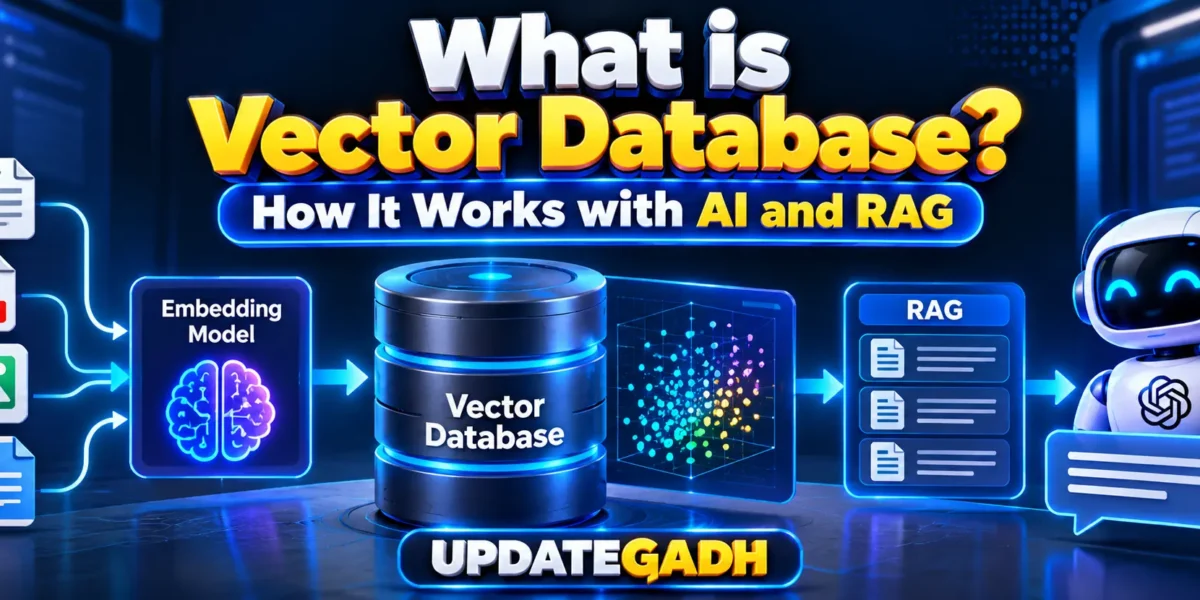
What is Vector Database
Artificial Intelligence applications are becoming more powerful because they can understand text, documents, images, and other types of information. However, storing and searching this information efficiently can become difficult when an AI application needs to work with a large amount of unstructured data. This is where a Vector Database becomes important.
Vector databases are widely used in modern AI applications, especially with Retrieval-Augmented Generation (RAG). They help AI systems find relevant information quickly and provide that information to Large Language Models (LLMs) before generating an answer.
Table of Contents
Complete Advance AI Topics: Click Here
Real Time Projects on YouTube:- DecodeIT
A Vector Database is a specialized database designed to store, manage, and search vector embeddings.
A vector is a numerical representation of information such as text, documents, images, audio, or other data. AI models convert information into vectors so that computers can compare the meaning or characteristics of different pieces of data.
For example, consider these two sentences:
- “Python is a programming language.”
- “Python is commonly used for software development.”
Although the words are different, both sentences have a similar meaning. Their vector representations can also be close to each other in vector space. This allows an AI system to perform semantic search instead of relying only on exact keyword matching.
What is a Vector?
A vector is a collection of numerical values that represents information in a mathematical form.
For example, a simplified vector could look like:
[0.21, -0.45, 0.78, 0.12, 0.63]Real AI embedding models generally produce vectors containing hundreds or thousands of dimensions.
When text is converted into a vector, its semantic characteristics are represented numerically. Similar information tends to produce vectors that are closer together in the vector space.
How Does a Work?
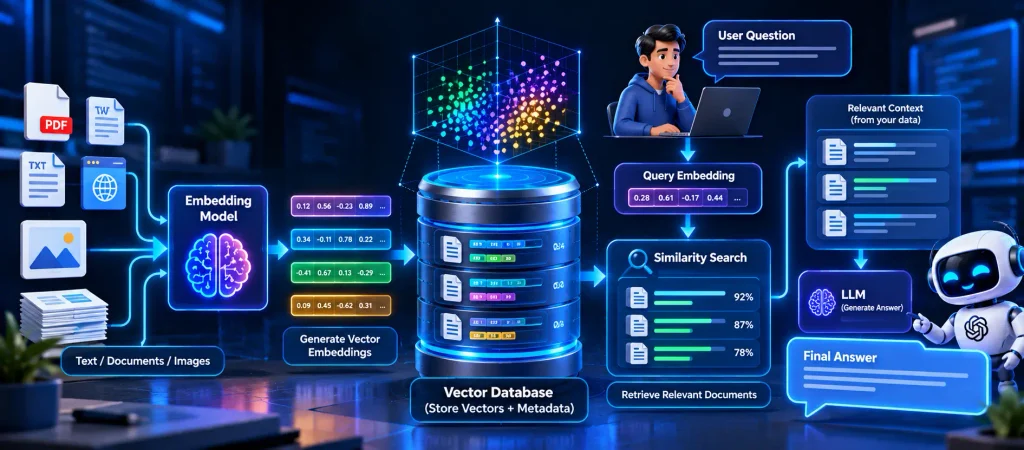
A vector database generally works through the following process:
1. Collect the Data
The application first collects information such as documents, articles, PDFs, product descriptions, FAQs, or database records.
2. Generate Embeddings
An embedding model converts the collected information into numerical vectors.
Text
  ↓
Embedding Model
  ↓
Vector
  ↓
Vector Database
3. Store the Vectors
The generated vectors are stored inside a vector database along with useful metadata. Metadata can include document names, categories, IDs, URLs, timestamps, or other information.
4. Convert the User Query
When a user asks a question, the query is also converted into a vector using the same or compatible embedding process.
5. Perform Similarity Search
The database compares the query vector with stored vectors and finds the most similar results.
6. Return Relevant Information
The most relevant documents or text chunks are returned to the application. This information can then be provided to an AI model to generate a response.
What is Semantic Search?
Traditional keyword search mainly looks for matching words. Semantic search focuses more on the meaning and relationship between the query and stored information.
For example, suppose a database contains:
"How can I reset my account password?"A user may search:
"I forgot my login password. What should I do?"The exact words are different, but the meaning is similar. A vector database can identify this relationship by comparing their vector representations.
What is RAG?
RAG stands for Retrieval-Augmented Generation. It is a technique that combines information retrieval with an AI language model.
Instead of asking an AI model to answer only from its existing knowledge, RAG retrieves relevant information from an external data source and provides it to the model as context.
This is particularly useful for company documents, educational content, internal knowledge bases, product documentation, and other custom datasets.
How Does Vector Database Work with RAG?
A typical RAG system works like this:
User Question
      ↓
Convert Question into Vector
      ↓
Search Vector Database
      ↓
Retrieve Relevant Documents
      ↓
Send Context + Question to LLM
      ↓
Generate Answer
Step 1: Prepare Documents
Documents are collected and usually divided into smaller sections called chunks. Chunking makes it easier to retrieve only the relevant parts of a document.
Step 2: Create Embeddings
Each document chunk is converted into a vector using an embedding model.
Step 3: Store Vectors
The vectors, document chunks, and metadata are stored in a vector database.
Step 4: User Asks a Question
When the user enters a question, the question is converted into a vector.
Step 5: Retrieve Relevant Information
The vector database performs a similarity search and returns the most relevant chunks.
Step 6: Generate the Final Answer
The retrieved information is passed to the Large Language Model along with the user’s question. The model uses this context to generate a relevant response.
Why are Vector Databases Important for AI?
Vector databases are useful because modern AI applications often need to search through large amounts of unstructured information.
- Semantic Search: Finds information based on meaning rather than only keywords.
- Fast Retrieval: Designed to efficiently search high-dimensional vectors.
- AI Knowledge Bases: Can store embeddings from documents and other data.
- RAG Applications: Provides relevant context to AI language models.
- Scalability: Can manage large collections of vector embeddings.
- Personalized AI: Can retrieve information from custom datasets.
Popular Vector Database Technologies
Several technologies are commonly used for vector search and AI applications, including:
- FAISS
- Chroma
- Qdrant
- Milvus
- Weaviate
- Pinecone
The best choice depends on the project requirements, deployment environment, dataset size, scalability needs, and application architecture.
Vector Database vs Traditional Database
| Feature | Traditional Database | Vector Database |
|---|---|---|
| Primary Data | Structured data | Vector embeddings |
| Search Method | Keyword, filters, SQL queries | Similarity search |
| Main Use | Application data | AI and semantic retrieval |
| AI Applications | Limited by itself | Highly suitable |
| RAG | Can provide data, but needs additional retrieval logic | Designed for vector-based retrieval |
Real-World Applications
Vector databases can be used in many modern AI applications, such as:
- AI Chatbots
- RAG-based Question Answering Systems
- Document Search Systems
- Recommendation Systems
- AI Customer Support
- Knowledge Management Systems
- Semantic Search Engines
- Product Recommendation Applications
- Document Classification and Retrieval
Advantages
- Efficient similarity search
- Better semantic information retrieval
- Useful for unstructured data
- Works well with modern AI applications
- Supports RAG-based architectures
- Can improve the relevance of retrieved information
Challenges
Although vector databases are powerful, they also introduce some challenges. The quality of search depends heavily on the embedding model, document chunking strategy, metadata, and retrieval configuration.
Large vector collections can also require considerable storage and computing resources. Developers must therefore choose suitable embedding models, similarity metrics, indexing techniques, and database infrastructure according to the application.
Final Thoughts
Vector databases have become an important part of modern AI architecture because they allow applications to search information based on semantic similarity. Instead of depending only on traditional keyword matching, AI systems can convert information into embeddings and retrieve content based on meaning.
Keywords: What is Vector Database? How It Works with AI and RAG, Vector Database in AI, RAG, Retrieval Augmented Generation, Vector Embeddings, Semantic Search, AI Database, RAG Architecture,Vector Database, Vector Database in AI, RAG, Retrieval Augmented Generation, Vector Embeddings, Semantic Search, Vector Search, Generative AI, AI Database, RAG Tutorial, AI and RAG, LLM, Artificial Intelligence