AI Agents vs AI Assistants
Artificial Intelligence is transforming how we interact with technology and accomplish tasks in our everyday lives. From answering questions and generating content to completing complex tasks, AI systems are becoming more capable and useful every day.
Two terms that are increasingly common in the AI world are AI Assistants and AI Agents. Although they may sound similar, they are designed to work in different ways.
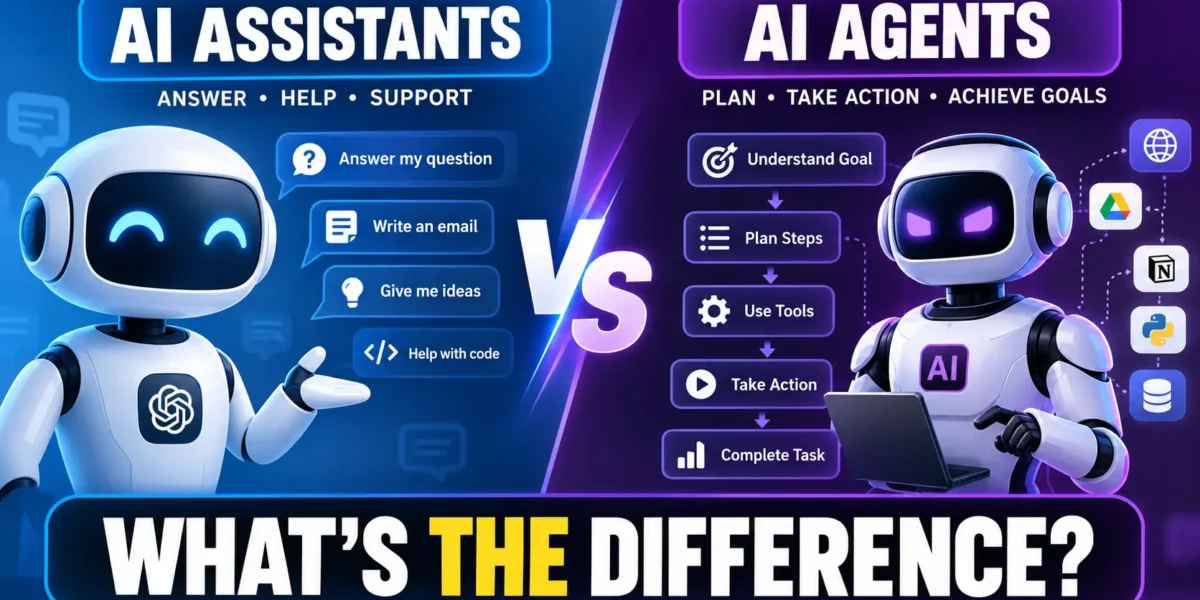
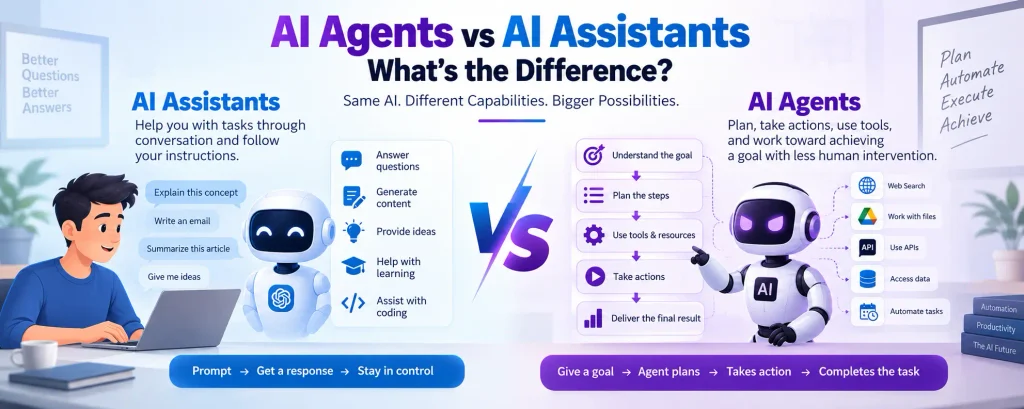
An AI Assistant generally helps users by responding to instructions, answering questions, generating information, and assisting with specific tasks.An AI Agent, however, can go beyond simply responding to instructions. It can understand a goal, plan the steps needed to achieve it, use available tools, and perform actions with minimal human intervention.
Knowing the difference between AI Agents and AI Assistants is essential for understanding how modern AI is being used for productivity, automation, and task execution.
Table of Contents
Complete Advance AI Topics: Click Here
SQL Tutorial: Click Here
What Is an AI Assistant?
An AI Assistant is an AI-powered system designed to help users complete tasks through interaction, usually by responding to prompts or commands.
AI assistants can understand natural language and provide useful responses based on the information and tools available to them. They are commonly used for writing, research, coding, customer support, productivity, and everyday questions.
For example, you can ask an AI assistant to:
- Write an email
- Explain a programming concept
- Summarize a document
- Generate ideas for a blog post
- Translate text
- Help debug code
- Answer questions
The user usually provides an instruction, and the AI assistant generates an appropriate response or performs the requested operation.
What Is an AI Agent?
An AI Agent is an intelligent system designed to achieve a specific goal by understanding tasks, creating a plan, using available tools, and taking the necessary actions.
Rather than simply responding to individual instructions, an AI Agent can decide which steps are needed to complete a task and work through them in sequence.
For example, instead of giving an AI Agent instructions for every step of a research task, you could simply provide a goal such as:
“Research the latest AI trends, compare the important developments, and prepare a summary.”
An agent could potentially break this goal into smaller tasks, gather information, analyze it, and produce the final result using the tools available to it.
AI Assistant vs AI Agent
| Feature | AI Assistant | AI Agent |
|---|---|---|
| Primary Purpose | Assist the user | Achieve a specific goal |
| Interaction | Usually prompt-based | Can operate through multiple steps |
| Planning | Usually limited | Can plan and sequence tasks |
| Tool Usage | May use available tools | Can actively select and use tools |
| Autonomy | Generally lower | Generally higher |
| Decision Making | Mostly responds to instructions | Can decide the next action needed |
| Task Execution | Often handles individual tasks | Can handle multi-step workflows |
How AI Assistants Work
An AI assistant typically follows a relatively simple interaction process.
- The user provides an instruction or question.
- The AI interprets the request.
- The AI generates a response.
- The user reviews the result or provides another instruction.
For example, a user might ask an AI assistant to create a Python function. The assistant generates the code, and the user can then ask it to modify or explain the code.
This makes AI assistants especially useful when humans want to remain actively involved in the workflow.
How AI Agents Work
AI agents generally involve a more advanced workflow. They can combine an AI model with tools, memory, planning, and an execution loop.
A typical AI Agent workflow can be understood through the following steps:
- Receive a goal: The user provides an objective.
- Understand the Task: The agent analyzes the given goal and identifies what needs to be completed.
- Create a plan: The task is divided into smaller steps.
- Use tools: The agent may interact with APIs, databases, websites, files, or other software.
- Evaluate results: Evaluate the Results: The agent reviews the outcome of its actions to determine whether the task is progressing as expected.
- Continue or adjust: If necessary, it performs additional steps.
- Complete the goal: The agent returns the final result.
The ability to plan and execute multiple connected steps is a key feature that sets AI Agents apart from traditional AI Assistants.
Example of an AI Assistant
Imagine you are preparing a presentation about Machine Learning.
You ask an AI assistant:
“Suggest five key topics that should be included in a Machine Learning presentation.”
The AI assistant can generate a list of topics such as supervised learning, unsupervised learning, neural networks, model evaluation, and real-world applications.
If you want more information, you can continue giving instructions such as:
- “Explain supervised learning.”
- “Create a slide about neural networks.”
- “Give me an example.”
The assistant responds to each request as you guide the workflow.
Example of an AI Agent
Now imagine giving an AI agent the goal:
“Prepare a complete presentation about Machine Learning.”
Depending on its available tools and level of access, an AI Agent can potentially perform tasks such as:
- Research relevant information
- Organize the presentation structure
- Create slide content
- Generate examples
- Use connected tools to create a presentation
- Review the generated material
- Make improvements
The main difference is that the user provides the overall goal, while the AI Agent can plan and carry out the individual steps needed to achieve it.
Key Characteristics of AI Agents
1. Autonomy
AI agents can operate with a greater degree of independence. Once given a goal, an AI Agent can identify the next steps and take appropriate actions without requiring the user to provide instructions for every stage.
2. Planning
Agents can break complicated objectives into smaller tasks. This makes them useful for workflows that involve multiple dependent steps.
3. Tool Usage
AI Agents can integrate with external tools and systems to access information, perform tasks, and automate workflows. Depending on their implementation, these tools may include APIs, databases, search systems, software applications, or file systems.
4. Memory and Context
Some AI Agent systems can retain relevant information from earlier steps or interactions, helping them maintain context throughout a workflow.This can help them continue longer workflows without starting from the beginning each time.
5. Goal-Oriented Behavior
AI assistants are often interaction-oriented, while AI agents are more strongly focused on achieving an objective.
Benefits of AI Assistants
AI assistants offer several advantages for individuals and businesses.
- Easy to use
- Fast responses
- Useful for everyday tasks
- Good for writing and brainstorming
- Helpful for learning and research
- Can improve productivity
- Usually keeps the human directly involved
Benefits of AI Agents
AI agents can be particularly useful for complex and repetitive workflows.
- Automate multi-step tasks
- Reduce manual work
- Use multiple tools
- Perform tasks toward a defined goal
- Handle repetitive workflows
- Support business process automation
- Potentially operate with less human intervention
Limitations of AI Assistants
AI assistants can still require significant user involvement, especially when a task involves many separate steps.
For example, an assistant may provide instructions for completing a workflow, but the user may still need to execute each action manually.
The quality of the result also depends on the instructions, available context, and capabilities of the AI system.
Limitations of AI Agents
Greater autonomy also introduces additional challenges.
- Agents can make incorrect decisions.
- Tool usage can introduce security risks.
- Complex workflows can be difficult to control.
- Incorrect actions can have real-world consequences.
- Agents require appropriate permissions and safeguards.
- Monitoring may be necessary for important tasks.
For these reasons, AI agents should be designed with appropriate access controls, validation, monitoring, and human oversight, especially when they can take consequential actions.
AI Agents and AI Assistants: Which One Should You Use?
The right choice depends on the type of task you want to accomplish.
Use an AI Assistant when:
- You want quick answers.
- You need help writing or editing content.
- You want to brainstorm ideas.
- You are learning a new topic.
- You want direct control over each step.
Use an AI Agent when:
- You have a complex multi-step task.
- You want to automate a workflow.
- The system needs to interact with multiple tools.
- You want the AI to work toward a broader objective.
- You want to reduce repetitive manual operations.
Are AI Agents Replacing AI Assistants?
AI agents are not necessarily replacing AI assistants. Instead, the two concepts can work together.
An AI assistant can provide an interface through which a user communicates with an AI system, while agentic capabilities can allow that system to perform more complex tasks behind the scenes.
As AI technology develops, the difference between assistants and agents may become less obvious because modern AI products can combine conversational assistance, tool use, planning, and task execution in a single system.
The Future of AI Agents and AI Assistants
The future of AI is moving beyond systems that simply generate responses. Increasingly capable AI systems are being designed to understand objectives, use tools, interact with software, and complete workflows.
AI assistants will continue to be valuable for everyday interaction, learning, content creation, and decision support. AI agents are likely to become increasingly important for automation, software development, business operations, research, and other multi-step processes.
YT:- DecodeIT
The combination of natural-language interaction and autonomous task execution could make AI systems significantly more useful across many industries.
Conclusion
The main difference between an AI Assistant and an AI Agent is the level of autonomy and task execution.
An AI assistant primarily helps users by responding to instructions and providing information or assistance. An AI agent goes a step further by working toward a goal, planning multiple steps, using tools, and potentially taking actions with less human intervention.
In simple terms, an AI Assistant helps you do a task, while an AI Agent can work toward completing a task for you.
As AI continues to evolve, understanding this distinction will become increasingly important for developers, businesses, students, and anyone interested in modern Artificial Intelligence.
Keywords: AI Agents vs AI Assistants, AI Agents, AI Assistants, Artificial Intelligence Agents, AI Agent vs Assistant, AI automation, AI technology, autonomous AI agents