
Join Operations in DBMS
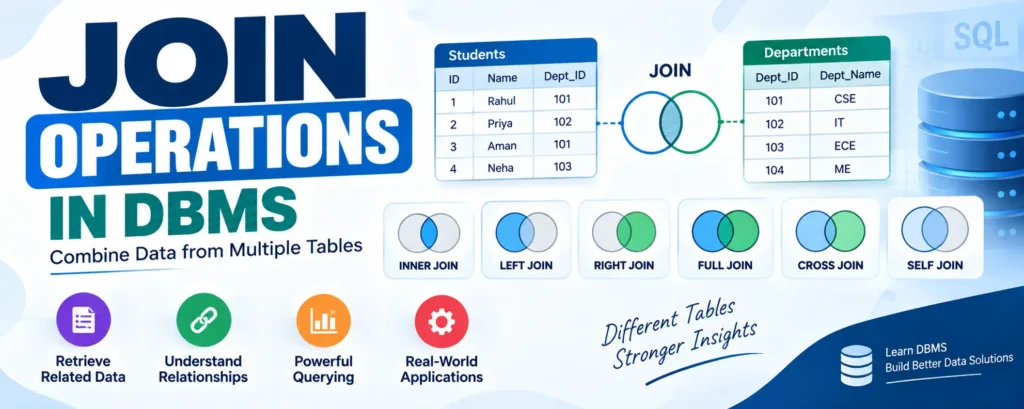
In relational databases, the Join operation retrieves meaningful information from multiple tables based on a condition. It consolidates related tuples from two or more relations when a defined join condition is met. This guide covers the main types with examples.
Table of Contents
Complete Advance AI Topics: Click Here
SQL Tutorial: Click Here
1. Natural Join
A Natural Join automatically matches columns with the same name across two relations and merges their values, removing duplicate columns from the result.
2. Outer Join
An Outer Join includes non-matching rows from one or both tables, filling gaps with NULL:
- Left Outer Join: All rows from the left table + matches from the right (NULL where no match).
- Right Outer Join: All rows from the right table + matches from the left.
- Full Outer Join: All rows from both tables, NULL where no match.
3. Equi Join (Inner Join)
An Equi Join (Inner Join) retrieves only records where the specified equality condition is satisfied.
| CLASS_ID | NAME | PRODUCT_ID | CITY |
|---|---|---|---|
| 1 | John | 1 | Delhi |
| 2 | Harry | 2 | Mumbai |
| 3 | Jackson | 3 | Noida |
Download New Real Time Projects:- Click here
Conclusion
Join operations merge data across tables based on conditions. From natural joins to complex outer joins, each serves a distinct purpose in ensuring data integrity and completeness. For more database tutorials, stay connected with .
join operations in dbms
joins in sql with examples
inner join cross join left join
full outer join
types of join operations
natural join in dbms
equi join in dbms
join operations in dbms with example