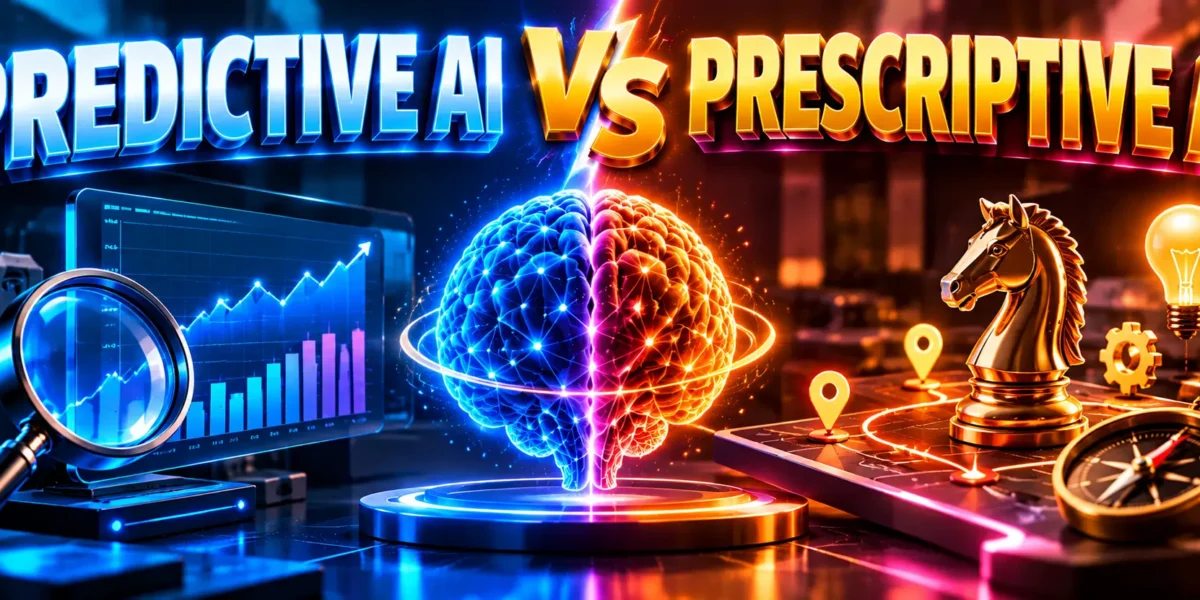
Predictive AI vs Prescriptive AI
Artificial Intelligence (AI) is helping businesses understand data, predict future outcomes, and make better decisions. Two important approaches in this field are Predictive AI and Prescriptive AI. Although both use data analytics and intelligent algorithms, they serve different purposes.
Predictive AI focuses on predicting what is likely to happen, while Prescriptive AI focuses on recommending what actions should be taken to achieve a desired outcome. Understanding Predictive AI vs Prescriptive AI helps students, developers, and business professionals identify the right approach for different real-world problems.
What Is Predictive AI?
Predictive AI uses historical data, statistical techniques, and machine learning algorithms to estimate future events or outcomes. It identifies patterns in existing information and uses them to generate predictions about what may happen next.
Predictive AI does not necessarily decide what action should be taken. Instead, it provides insights that help people or other systems make informed decisions.
Complete Advance AI Topics: Click Here
Real Time Projects on YouTube:- DecodeIT
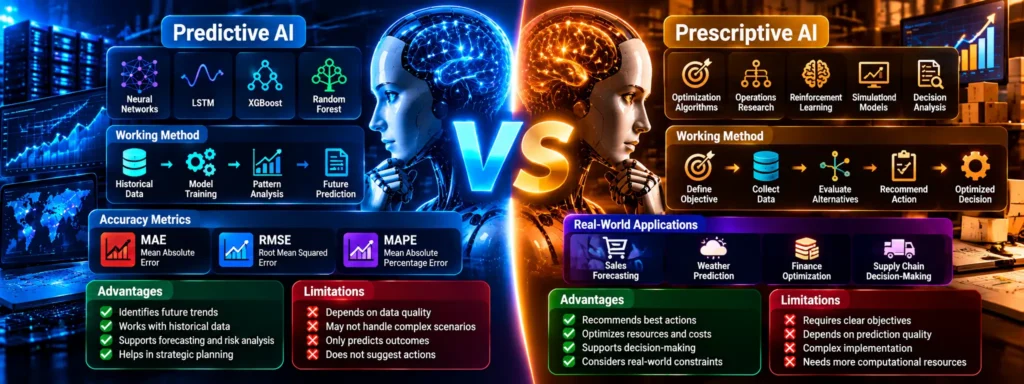
Common Predictive AI Techniques
- Regression Models: Predict numerical values such as sales, prices, and revenue.
- Classification Models: Predict categories such as fraudulent or legitimate transactions.
- Time-Series Forecasting: Estimates future values based on historical sequences.
- Random Forest: Combines decision trees to predict outcomes.
- Neural Networks: Learn complex relationships in data to support predictions.
Examples of Predictive AI
- Predicting future product demand.
- Estimating the likelihood of customer churn.
- Forecasting sales and revenue.
- Identifying potentially fraudulent transactions.
- Predicting equipment failures using sensor data.
What Is Prescriptive AI?
Prescriptive AI goes beyond predicting future outcomes. It analyzes available information, evaluates possible actions, and recommends decisions that may help achieve a specific objective.
It can combine machine learning predictions with optimization algorithms, business rules, simulations, and operational constraints. Depending on the application, a prescriptive system may recommend an action to a human or automatically execute an approved decision.
Common Prescriptive AI Techniques
- Optimization Algorithms: Identify suitable solutions while considering constraints.
- Operations Research: Helps allocate resources, schedule activities, and optimize operations.
- Reinforcement Learning: Learns action strategies through rewards and feedback.
- Simulation Models: Evaluate possible decisions under different scenarios.
- Decision Analysis: Compares alternatives using objectives, risks, costs, and expected outcomes.
Examples of Prescriptive AI
- Recommending the best inventory quantity to maintain.
- Suggesting delivery routes that reduce travel costs.
- Optimizing advertising budgets across marketing channels.
- Recommending suitable maintenance schedules.
- Suggesting pricing adjustments based on demand, costs, and business constraints.
Predictive AI vs Prescriptive AI: Key Differences
| Comparison Factor | Predictive AI | Prescriptive AI |
|---|---|---|
| Main Purpose | Predict future outcomes | Recommend suitable actions |
| Key Question | What is likely to happen? | What should we do? |
| Primary Output | Predictions and probabilities | Recommendations and action plans |
| Data Requirements | Historical data and relevant input variables | Predictions, objectives, constraints, costs, and available actions |
| Common Techniques | Regression, classification, forecasting, neural networks | Optimization, simulation, decision analysis, reinforcement learning |
| Decision Support | Provides information for decision-making | Helps select an appropriate action |
| Complexity | Depends on the model and problem | Often involves additional constraints and trade-offs |
| Example | Predicting high product demand | Recommending how much inventory to order |
How Does Predictive AI Work?
Predictive AI follows a process that transforms historical data into useful forecasts or probability estimates.
- Data Collection: Gather historical records from databases, applications, sensors, or other sources.
- Data Preparation: Clean the dataset and handle missing values or inconsistent information.
- Feature Selection: Identify variables that may influence the target outcome.
- Model Training: Train a suitable machine learning or statistical model.
- Model Evaluation: Test prediction quality using appropriate evaluation metrics.
- Prediction: Generate forecasts or probability estimates for new data.
How Does Prescriptive AI Work?
Prescriptive AI uses predictions and decision-making techniques to recommend actions based on a defined objective.
- Define the Objective: Establish the goal, such as reducing costs or improving delivery efficiency.
- Collect Relevant Data: Gather predictions, available resources, costs, and operational constraints.
- Generate Alternatives: Identify possible actions or strategies.
- Evaluate Alternatives: Use optimization, simulation, or decision models to compare outcomes.
- Recommend an Action: Select a suitable option based on the objective and constraints.
- Monitor Results: Evaluate the actual outcome and update the decision process when necessary.
Real-World Example: Inventory Management
Imagine an online store that sells electronic products and wants to manage its inventory more efficiently.
Using Predictive AI: The system analyzes historical sales, seasonal trends, and current demand indicators to estimate how many products customers may purchase next month.
Using Prescriptive AI: The system uses demand forecasts, current stock, supplier lead times, storage capacity, and ordering costs to recommend how many products should be ordered and when.
Predictive AI estimates future demand, while Prescriptive AI helps translate that estimate into an inventory decision. Combining the two can help businesses reduce stock shortages and unnecessary inventory costs.
Advantages and Limitations
Advantages of Predictive AI
- Identifies patterns in historical data.
- Supports forecasting and risk assessment.
- Helps businesses prepare for potential future events.
- Can improve planning when reliable data is available.
Limitations of Predictive AI
- Predictions can be inaccurate when data is incomplete or conditions change.
- It does not automatically determine the best action.
- Some models are difficult to interpret.
- Biased historical data can produce unreliable predictions.
Advantages of Prescriptive AI
- Helps compare different actions and possible outcomes.
- Can optimize resources, costs, and operational processes.
- Supports faster and more consistent decision-making.
- Can incorporate business objectives and constraints.
Limitations of Prescriptive AI
- Requires clearly defined objectives and constraints.
- Recommendations depend on the quality of predictions and assumptions.
- Complex optimization problems may require substantial computing resources.
- Human oversight may be necessary for high-impact decisions.
When Should You Use Predictive or Prescriptive AI?
Choose Predictive AI when the main goal is to estimate future outcomes, identify risks, forecast demand, or understand the likelihood of an event.
Choose Prescriptive AI when you need to select actions, allocate resources, optimize operations, or compare possible strategies under specific constraints.
For many business applications, using both approaches together is beneficial. Predictive AI supplies forecasts, and Prescriptive AI uses those forecasts to recommend actions. However, the quality of the final decision still depends on the data, objectives, assumptions, and constraints used by the system.
Frequently Asked Questions (FAQs)
1. What is the main difference between Predictive AI and Prescriptive AI?
Predictive AI estimates what may happen in the future, whereas Prescriptive AI recommends what action should be taken to achieve a particular objective.
2. Is Prescriptive AI more advanced than Predictive AI?
Prescriptive AI often involves additional decision-making and optimization steps, but neither approach is universally better. The appropriate choice depends on the problem being solved.
3. Can Predictive AI work without Prescriptive AI?
Yes. Predictive AI can provide useful forecasts and risk estimates without recommending actions. People or existing business processes can use these predictions to make decisions.
4. Can Predictive AI and Prescriptive AI be combined?
Yes. Predictive models can estimate future demand, while prescriptive models use those estimates to recommend inventory quantities, delivery schedules, or resource allocations.
5. Where is Prescriptive AI used?
Prescriptive AI is used in logistics, supply chain management, manufacturing, healthcare operations, marketing, and financial planning to support decisions and optimize resources.
Conclusion
Predictive AI and Prescriptive AI serve different but complementary purposes in modern analytics. Predictive AI focuses on forecasting future outcomes, while Prescriptive AI helps determine suitable actions based on predictions, objectives, and constraints.
Predictive AI vs Prescriptive AI,Predictive AI vs Prescriptive AI, Predictive AI vs Prescriptive AI: Forecasting vs Decision-Making, Predictive AI vs Prescriptive AI,Predictive AI, Prescriptive AI, Forecasting vs Decision-Making, Predictive AI vs Prescriptive AI,Predictive Analytics, Prescriptive Analytics, Artificial Intelligence, Machine Learning, AI Decision Making, AI Forecasting, Decision Intelligence, AI Optimization, Data Science, Predictive Modeling, Prescriptive Modeling, Business Analytics, Intelligent Decision Systems, Real-World AI Applications, AI Technology Tutorial,Predictive AI vs Prescriptive AI