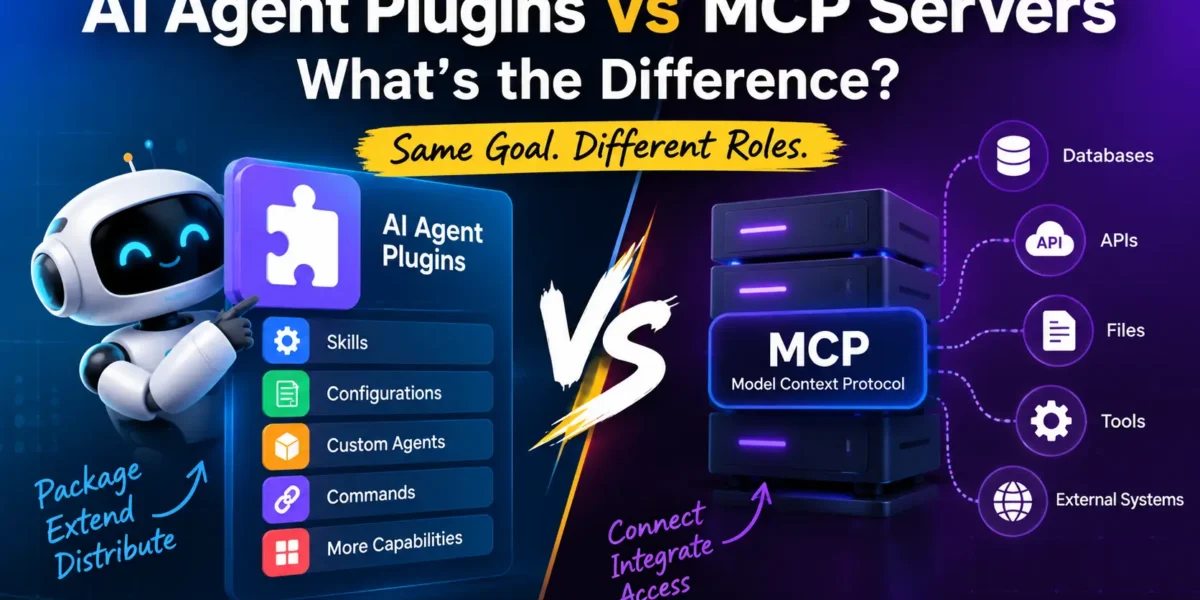
AI Agent Plugins vs MCP Servers
AI agents are rapidly changing the way we build and use modern software. Instead of only answering questions, modern AI agents can work with tools, access external data, follow instructions, and complete tasks with much less human involvement.
As AI agent development grows, you will often come across terms such as AI Agent Plugins, MCP Servers, and Agent Skills. These technologies are closely related, but they are not the same thing.
If you’re new to AI agents, understanding the differences between these technologies can take some time. In this guide, we’ll explain AI Agent Plugins vs MCP Servers in simple terms, show how they work together, and explain when each one makes sense.
Table of Contents
Complete Advance AI Topics: Click Here
SQL Tutorial: Click Here
What Is an AI Agent Plugin?
An AI Agent Plugin is a package that brings together different components an AI agent may need. Depending on the platform and plugin, it can include skills, MCP server configurations, agents, commands, hooks, and other supporting files.
The main idea is simple: instead of handling every component separately, developers can organize related agent capabilities into a single package.
A basic plugin might have a structure like this:
my-plugin/
├── plugin.json
├── skills/
│   └── reporting/
│       └── SKILL.md
├── mcp.json
└── client-specific/
Here, the plugin acts as the package or distribution layer. It brings the necessary pieces together so they can be easier to share, install, and reuse in compatible AI environments.
What Is an MCP Server?
MCP stands for Model Context Protocol. It provides a standard way for AI applications to communicate with external tools, services, and data sources.
Think of an MCP server as a bridge between an AI agent and an outside system.
For example, an AI agent may need information from a customer database. Instead of building a completely different connection for every AI application, an MCP server can expose the required functionality through a standardized interface.
A simple workflow could look like this:
Customer Database
       ↓
   MCP Server
       ↓
    AI Agent
       ↓
Customer information or requested action
An MCP server can expose tools and resources that an AI application can use. These could include database operations, APIs, files, business systems, or other external services.
AI Agent Plugins vs MCP Servers
The biggest difference becomes easier to understand when you look at their roles.
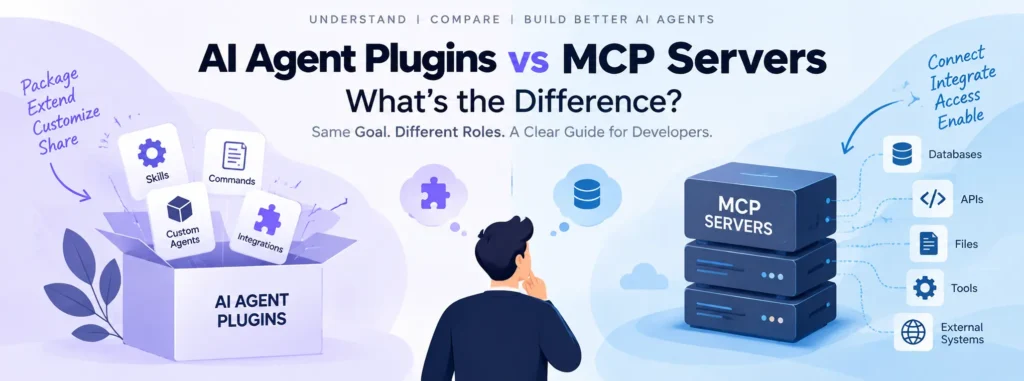
An MCP Server is primarily about connecting an AI application to external capabilities, while an Agent Plugin is about packaging and distributing agent components.
| Feature | AI Agent Plugin | MCP Server |
|---|---|---|
| Primary purpose | Package and distribute agent capabilities | Connect AI applications with external capabilities |
| Main role | Packaging and distribution | Communication and integration |
| Can include skills | Yes | Not its primary purpose |
| Can include MCP configuration | Yes | It provides the MCP server functionality |
| Works with external systems | Through included integrations | Yes |
| Standardizes communication | No | Yes |
| Reusable | Yes | Yes |
So, although both can be part of an AI agent architecture, they solve different problems.
How Do AI Agent Plugins and MCP Servers Work Together in AI Applications?
One important thing to understand is that AI Agent Plugins and MCP Servers are not necessarily alternatives. In many cases, they can be used together.
Imagine you are creating an AI agent for generating business reports.
The agent needs instructions for creating reports, but it also needs access to the company’s data.
You could organize the project like this:
Reporting Plugin
│
├── plugin.json
│
├── skills/
│   └── generate-report/
│       └── SKILL.md
│
└── mcp.json
The skill can contain instructions that explain how the agent should approach the reporting task.
The MCP server can provide access to the required data or tools.
The plugin can package these pieces together.
A simple way to remember their roles is:
- Agent Skill: Provides instructions.
- MCP Server: Provides access to tools and external systems.
- Agent Plugin: Packages related components together.
What Is an Agent Skill?
An Agent Skill is another important part of the modern AI agent ecosystem. A skill gives an agent reusable instructions and supporting resources for completing a particular type of task.
For example, a data-analysis skill could contain instructions and resources related to analyzing datasets.
A simple structure could look like this:
skills/
└── data-analysis/
    ├── SKILL.md
    ├── scripts/
    └── references/
The skill focuses on how the agent should perform a task.
This is different from an MCP server, which focuses on providing access to external capabilities.
That gives us three useful concepts:
Skill  → Instructions
MCP    → External capabilities
Plugin → Package
Example: AI Customer Support Agent
Let’s take a practical example.
Suppose you want to create an AI customer support agent. The agent needs to understand customer questions, look up orders, check information, and follow the company’s support workflow.
Different components can handle different parts of the job.
Agent Skill
The skill could provide instructions for handling customer requests:
When handling a customer request:

1. Understand the customer's issue.
2. Find the relevant customer information.
3. Check the order details.
4. Follow the support workflow.
5. Prepare a suitable response.
MCP Server
The MCP server could expose tools that allow the agent to interact with the required systems:
get_customer()
get_order()
search_orders()
check_refund_status()
Agent Plugin
The plugin could package the skill and MCP configuration together:
customer-support-plugin/
├── plugin.json
├── skills/
│   └── customer-support/
│       └── SKILL.md
└── mcp.json
This approach keeps the different responsibilities separate while allowing them to work together as part of the same agent workflow.
Benefits of AI Agent Plugins
1. Easier Distribution
Related agent components can be organized and distributed as one package instead of being handled individually.
2. Better Organization
A plugin provides a structured place for skills, MCP configurations, and other supported components.
3. Reusable Workflows
Developers can create reusable packages for specific types of AI agent tasks.
4. Easier Setup
Packaging related components together can simplify the process of getting an agent workflow ready in a compatible environment.
5. Portable Agent Capabilities
A standardized package structure can make it easier to share agent capabilities between supported environments.
Benefits of MCP Servers
1. Standardized Connections
MCP provides a consistent approach for connecting AI applications with external tools and resources.
2. Access to External Data
An MCP server can make information and functionality from external systems available to an AI application.
3. Reusable Integrations
Once an MCP server is properly configured, compatible AI clients can use the exposed capabilities without each integration having to be built from scratch.
4. Separation Between AI and External Systems
The AI application can focus on reasoning and task orchestration, while the MCP server handles interaction with the connected system.
5. Flexible Architecture
MCP can be used as part of different AI agent architectures, depending on the application’s requirements and supported deployment model.
When Should You Use an MCP Server?
An MCP server is a good choice when your main requirement is to connect an AI application with an external tool, service, or source of information.
You may consider using MCP when:
- Your AI agent needs access to an external database.
- You want to expose APIs or tools to an AI application.
- You need a standardized integration approach.
- You want an integration that can work with multiple compatible clients.
- Your agent needs access to external resources.
When Should You Use an AI Agent Plugin?
An Agent Plugin makes more sense when you want to package and distribute a collection of agent capabilities.
You may consider a plugin when:
- You have multiple agent components that belong together.
- You want to package skills and MCP configurations.
- You are creating a reusable AI workflow.
- You want to distribute agent capabilities in a structured format.
- Your target AI environment supports the Agent Plugin format.
When Should You Use Both?
In some projects, using both technologies can be the most practical approach.
For example, an AI agent may need instructions for completing a task and access to an external service to complete it.
The architecture could look like this:
                    AI Agent
                       │
             ┌─────────┴─────────┐
             │                   │
          Agent Skill        MCP Server
             │                   │
       Task Instructions     External Tools
             │                   │
             └─────────┬─────────┘
                       │
                  Agent Plugin
                    Package
In this setup, each component has a clear responsibility.
Are AI Agent Plugins Replacing MCP Servers?
No. Agent Plugins and MCP Servers are designed to solve different problems.
An Agent Plugin can contain an MCP server configuration, but that does not mean the plugin replaces MCP.
MCP is focused on the communication and integration layer, while the plugin provides a way to organize and distribute agent components.
A useful way to remember this is:
- MCP: How an AI application connects to external capabilities.
- Skill: How an agent is guided to perform a task.
- Plugin: How related components can be packaged and distributed.
Why the Difference Matters for AI Developers
As AI agents become capable of handling more complex workflows, developers need more than just a powerful language model.
An agent may need to work with databases, APIs, files, business applications, and specialized instructions. Managing all of these components becomes easier when each layer has a clear purpose.
Understanding the difference between AI Agent Plugins vs MCP Servers can therefore help developers choose the right architecture for their projects.
Instead of treating every agent component as the same type of technology, developers can decide whether they need instructions, external tool access, packaging, or a combination of these capabilities.
AI Agent Plugins vs MCP Servers: Quick Summary
| Technology | What It Does |
|---|---|
| Agent Skill | Provides instructions and resources for completing a task. |
| MCP Server | Connects an AI application with external tools, data, and services. |
| Agent Plugin | Packages agent capabilities and configurations for distribution. |
YT:- DecodeIT
Conclusion
AI Agent Plugins and MCP Servers are related, but they are not the same thing.
An MCP Server focuses on connecting an AI application to external tools, data, and services. An Agent Skill provides instructions that help an AI agent perform a specific task. An Agent Plugin brings related components together into a package that can be distributed and reused.
If you are building an AI agent, the choice does not always have to be between a plugin and an MCP server. In many cases, they can work together.
The easiest way to remember the difference is:
MCP connects. Skills instruct. Plugins package.
Once you understand these three roles, designing and organizing modern AI agent workflows becomes much easier.
Keywords
AI Agent Plugins, MCP Servers, AI Agent Plugins vs MCP Servers, MCP vs Plugins, Model Context Protocol, AI Agent Skills, Agent Plugins, MCP Server, AI Agents, AI Agent Tools, Agentic AI, AI Development, AI Automation, Generative AI, Artificial Intelligence, AI Tools, AI Integration, MCP Tools, AI Agent Framework, AI Technology 2026