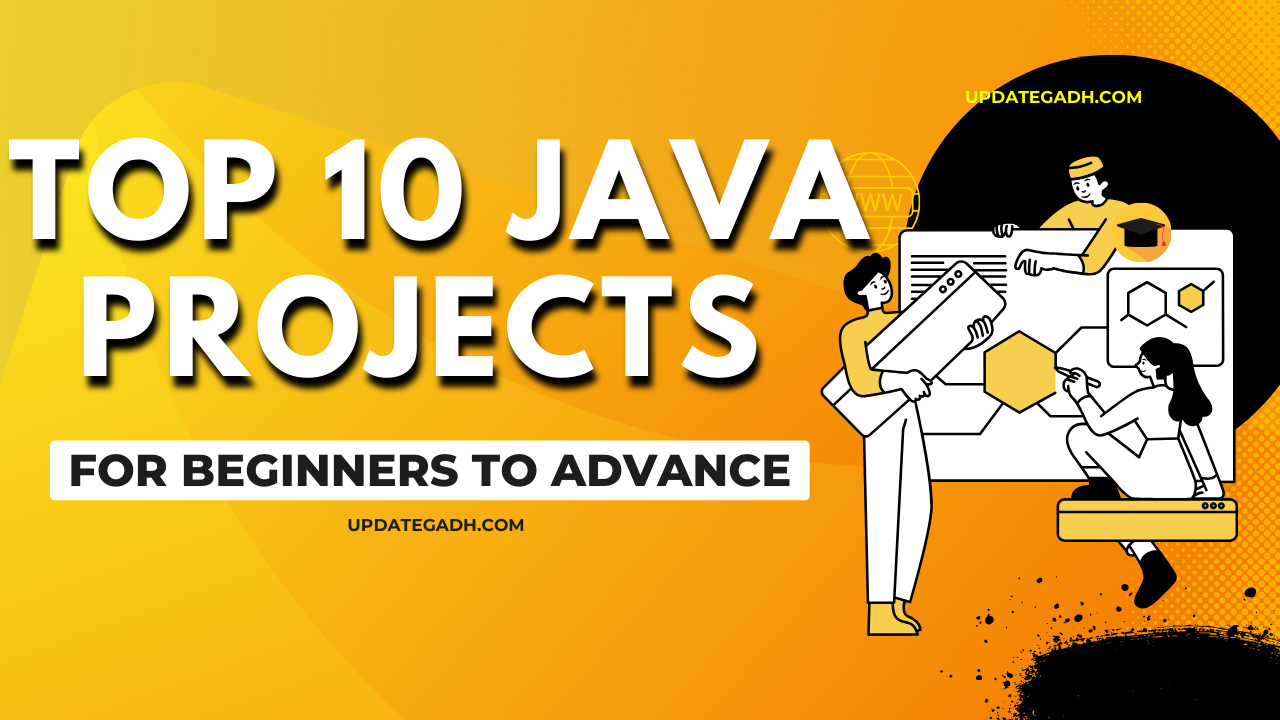
If you are a BCA, MCA, or B.Tech CS/IT student looking to stand out during placements, working on Java projects for final year is one of the smartest decisions you can make. Java remains one of the most widely adopted programming languages in enterprise software development, and a well-built project on your resume speaks louder than any certification. In this post, you will find the top 10 Java projects for 2026 — each designed to sharpen your coding skills, prepare you for viva questions, and demonstrate real-world development capabilities to recruiters.
Whether you are a beginner just starting with Java or an advanced learner building production-grade systems, these project ideas cover a broad spectrum of domains — from banking and e-commerce to blockchain and hotel management. Each project listed here is available with full source code, project report, synopsis, and PPT through Updategadh.
| Field | Details |
|---|---|
| Post Topic | Top 10 Java Projects for Final Year Students |
| Primary Language | Java |
| Frameworks Covered | Spring MVC, Spring Boot, Hibernate, JavaServer Faces (JSF), Java EE |
| Database Options | MySQL, PostgreSQL, Oracle |
| Project Type | Web Application, Desktop Application, Enterprise System |
| Difficulty Range | Beginner to Advanced |
| Best For | BCA, MCA, B.Tech CS/IT, M.Tech, MBA (IT) Students |
| Platform | Web-based & Desktop |
| Year | 2026 |
| Category | Final Year Project, Java Project |
| Developer / Publisher | Updategadh |
About These Java Projects
The challenge most students face is not a lack of interest but a lack of direction — choosing the right project that is complex enough to impress a viva panel yet manageable enough to complete before submission deadlines. Java-based projects bridge this gap perfectly. They are industry-relevant, backed by robust frameworks, and cover domains like finance, healthcare, logistics, and social networking that align directly with placement opportunities at leading IT companies.
Each project in this list has been curated to ensure that students gain hands-on experience with core Java concepts such as object-oriented programming, multithreading, database connectivity via JDBC or Hibernate, and web development using Spring or Java EE. Beyond the code, these projects help you build a narrative for interviews — explaining design decisions, handling edge cases, and discussing scalability, which are exactly the conversations that impress hiring managers.
Key Features Across These Java Projects
Inventory Management System
- Product CRUD Operations: Add, update, delete, and search products with real-time inventory counts.
- Low Stock Alerts: Automatic notifications when stock falls below a defined threshold.
- Database Integration: MySQL-backed data persistence with JDBC or Hibernate ORM.
Online Voting System
- Secure User Authentication: OTP-based or token-based login to prevent duplicate voting.
- Candidate Registration Module: Admin panel for registering and managing election candidates.
- Live Result Dashboard: Real-time vote count and graphical result analysis.
E-Commerce Website
- Product Catalogue and Search: Filter products by category, price range, and ratings.
- Shopping Cart and Checkout: Session-based cart with order summary and invoice generation.
- Payment Gateway Integration: Simulated or real secure payment processing.
Blockchain Application
- SHA-256 Hashing: Every block is cryptographically hashed to ensure data integrity.
- Digital Signatures: Transactions are signed and verified using public-private key pairs.
- Consensus Algorithm: Proof-of-work implementation to validate new blocks.
Social Media Platform
- User Profiles and Feeds: Create profiles, follow users, and view a personalised post feed.
- Posts, Likes, and Comments: Full interaction system with timestamps and notifications.
- Spring MVC or JSF Backend: MVC architecture ensuring clean separation of concerns.
Online Banking System
- Account Management: Create savings and current accounts with KYC validation.
- Fund Transfer and Transaction History: IMPS/NEFT-style internal transfer with full audit trail.
- Role-Based Access: Separate dashboards for admin, teller, and customer roles.
Recipe Finder Application
- Ingredient-Based Search: Enter available ingredients and get matching recipes instantly.
- Favourites and Collections: Save and organise recipes into custom collections.
- Social Sharing: Share recipes via link or export as PDF.
Hotel Management System
- Room Reservation and Availability: Calendar-based booking with real-time room status.
- Billing and Invoice Generation: Automated bill calculation with GST support.
- Customer and Staff Management: Complete profiles for guests, staff, and housekeeping.
Car Rental System
- Vehicle Booking and Scheduling: Book cars by date, location, and vehicle type.
- Availability Checker: Live calendar showing rental status for each vehicle.
- Customer Feedback Module: Post-rental rating and review system.
Online Exam Portal
- Question Bank Management: Add, categorise, and randomise questions per subject.
- Timed Exam Scheduling: Set start time, duration, and per-question time limits.
- Automated Result Generation: Instant score display with detailed answer review.
Technologies Used in These Java Projects
| Layer | Technology | Purpose |
|---|---|---|
| Primary Language | Java (JDK 11 / 17) | Core application logic and business rules |
| Web Framework | Spring MVC / Spring Boot / JSF | MVC architecture, REST API development |
| ORM / Persistence | Hibernate / JPA / JDBC | Database abstraction and query management |
| Frontend | HTML5, CSS3, Bootstrap, JavaScript | Responsive UI and client-side interactions |
| Database | MySQL / PostgreSQL | Relational data storage and retrieval |
| Build Tool | Maven / Gradle | Dependency management and project build |
| Server | Apache Tomcat / Embedded Tomcat (Spring Boot) | Application deployment and request handling |
| Security | Spring Security / Custom Auth | Authentication, authorisation, session management |
How These Java Projects Work
- User Authentication: Every project begins with a login or registration flow. Credentials are validated against the database, with session tokens or JWT managing the authenticated state.
- Dashboard Navigation: Once logged in, the user lands on a role-specific dashboard. Admins see management controls; end-users see personalised data views.
- Core Feature Execution: The main module (e.g. inventory update, vote casting, hotel booking) is handled by a Java service layer that processes the request, applies business rules, and calls the repository layer.
- Database Interaction: The repository layer communicates with MySQL or PostgreSQL via Hibernate or JDBC to read, write, or update records atomically.
- Response and Feedback: The controller returns a response — either a rendered JSP/Thymeleaf view or a JSON payload — which the frontend displays to the user with appropriate success or error messages.
- Admin Controls: A separate admin panel allows privileged users to manage data, generate reports, and monitor system activity without touching production code.
How to Run These Java Projects
Step 1: Prerequisites
Ensure the following tools are installed on your machine before proceeding:
- JDK 11 or JDK 17
- Apache Tomcat 9.x (for WAR-based projects) or use embedded Tomcat via Spring Boot
- MySQL 8.x or PostgreSQL 14+
- Maven 3.6+ or Gradle 7+
- IntelliJ IDEA, Eclipse IDE, or NetBeans
Step 2: Download and Extract the Project
Download the project package from Updategadh. Extract the ZIP file to your preferred workspace directory.
Step 3: Import into IDE
Open your IDE and import the project as a Maven or Gradle project. The IDE will automatically download all declared dependencies from the pom.xml or build.gradle file.
Step 4: Configure the Database
Create a new database in MySQL:
CREATE DATABASE project_db;
USE project_db;
Import the provided SQL dump file:
mysql -u root -p project_db < database/schema.sqlUpdate the database credentials in application.properties or db.properties:
spring.datasource.url=jdbc:mysql://localhost:3306/project_db
spring.datasource.username=root
spring.datasource.password=yourpassword
Step 5: Build and Run the Application
For Spring Boot projects:
mvn spring-boot:runFor WAR-based projects, build first and deploy to Tomcat:
mvn clean package
# Copy target/project.war to Tomcat webapps directory
Why These Are Great Final Year Java Projects
- Industry-Aligned Tech Stack: Java, Spring, and Hibernate are actively used in large-scale enterprise applications at banks, e-commerce platforms, and government portals — making these projects directly relevant to job roles.
- Viva-Ready Architecture: Each project follows the MVC or layered architecture pattern, giving you confident answers to questions about design patterns, data flow, and system design.
- Resume Differentiation: Projects like Blockchain Application and Social Media Platform go beyond standard CRUD systems, signalling depth and initiative to hiring managers.
- Full Package Included: You receive source code, project report, synopsis, and PPT — saving hundreds of hours of documentation work before submission.
- Scalable Codebase: Built with best practices like separation of concerns and ORM-based data access, these codebases are easy to explain, extend, and demonstrate during college evaluations.
- Broad Domain Coverage: From finance (banking system) to logistics (car rental) to education (exam portal), you can pick a domain that aligns with your target industry and internship interests.
How to Download These Java Projects
Each Java project from Updategadh comes with a complete package that includes everything you need for submission and presentation:
- Complete Java source code (well-commented and structured)
- Project report in DOCX format (NIST-style or university format)
- Project synopsis (2–3 pages, submission-ready)
- PowerPoint presentation (PPT) with 15–20 slides
- SQL database dump file
For quick delivery, custom modifications, or any queries, reach us directly on WhatsApp:
WhatsApp: +91 79834 34684
Possible Extensions and Future Enhancements
- Integrate a REST API layer to expose project functionality as a microservice, consumable by mobile applications.
- Add Spring Security with JWT-based authentication for stateless, token-driven session management across distributed systems.
- Implement real-time notifications using WebSockets or Server-Sent Events for live dashboards (voting results, stock alerts).
- Deploy the application on a cloud platform such as AWS Elastic Beanstalk, Heroku, or Azure App Service for live production exposure.
- Introduce a reporting module using JasperReports or Apache POI to generate downloadable PDF and Excel reports.
- Add a mobile front-end using React Native or Flutter that consumes the Java Spring Boot REST API backend.
- Incorporate machine learning predictions (e.g. demand forecasting in inventory, fraud detection in banking) via a Python microservice called from Java.
- Implement containerisation using Docker and orchestration with Kubernetes for scalable cloud-native deployment.
Watch Project Demos on YouTube
See these Java projects in action — full demo walkthroughs, viva tips, and feature explanations are available on the DecodeIT2 YouTube channel.
Subscribe to DecodeIT2 on YouTube
Frequently Asked Questions
Which Java framework is used in these projects?
Most projects in this list are built using Spring MVC or Spring Boot for the backend, with Hibernate or JPA for database interaction. Some projects additionally use JavaServer Faces (JSF) or Java EE for enterprise-grade web features. The choice of framework is documented in the project report included with each package.
Are these Java projects suitable for BCA, MCA, and B.Tech students?
Yes. These projects are specifically curated for BCA, MCA, B.Tech CS/IT, and M.Tech students as final year submissions. The difficulty ranges from beginner-friendly (Inventory Management, Recipe Finder) to advanced (Blockchain Application, Online Banking System), so you can select one that matches your current skill level and academic requirements.
Does the project package include a report, synopsis, and PPT?
Every project package from Updategadh includes the complete source code, a detailed project report (DOCX), a concise synopsis, and a ready-to-present PowerPoint slideshow. This means you receive everything needed for submission and viva preparation in a single download.
Can I customise these Java projects for my college requirements?
Absolutely. The source code is fully accessible and well-structured, making it straightforward to add or remove features, rename modules, change the UI theme, or adapt the database schema to your institution’s specific requirements. For custom modifications or one-to-one assistance, you can contact Updategadh directly via WhatsApp at +91 79834 34684.