In 2026, recruiters are no longer shortlisting resumes on degrees alone. What actually pulls a resume out of the pile is a set of working AI and automation projects that solve a real, boring, expensive problem that a company already pays people to do manually.
If you are a student, a fresher, or an automation tester trying to move up, the project you choose matters more than the number of certifications you collect. This post lists high-impact AI and automation project ideas that hiring teams actually value, the stack to build each one in, and exactly what to write on your resume so the project gets read instead of skipped.
Why Projects Decide Shortlisting in 2026
Every fresher resume now claims Python, machine learning, and Selenium. Those words have stopped carrying signal. A recruiter scanning fifty resumes in twenty minutes is looking for one thing: proof that you have shipped something end to end and can explain the trade-offs behind it.
A good project answers four questions before the interview even starts. What problem did it solve? What did you build with? What measurable difference did it make? And can you defend the design choices when someone pushes back? Projects that answer all four are the ones that survive the shortlist.
What Separates a Strong Project From a Weak One
- Solves a real workflow: Something a human currently does by hand, slowly and repeatedly.
- Runs end to end: Input goes in, output comes out, without you editing files halfway through.
- Has a visible interface: A dashboard, an API, a report, or a CLI that someone else could actually use.
- Handles failure: Retries, logging, and error states. This alone puts you ahead of most freshers.
- Is explainable in ninety seconds: If you cannot pitch it that fast, the interviewer will not follow it.
Quick Comparison of the Top Project Ideas
| Project Idea | Core Stack | Difficulty | Best For |
|---|---|---|---|
| AI Resume Screening & Ranking | Python, spaCy, LLM API, Streamlit | Medium | MCA, B.Tech CS |
| Self-Healing Test Framework | Playwright, TypeScript, LLM API | Advanced | Automation testers |
| RAG Document Assistant | Python, FastAPI, vector DB | Medium | MCA, M.Tech |
| Invoice Data Extraction Bot | Python, OCR, LLM API | Medium | BCA, MCA |
| AI API Test Case Generator | Python, OpenAPI spec, pytest | Medium | QA freshers |
| CI/CD Regression Pipeline | GitHub Actions, Docker, Playwright | Medium | Automation testers |
| Multi-Agent Research Assistant | Python, agent framework, LLM API | Advanced | M.Tech, MCA |
| RPA Report Automation Bot | Python, Pandas, scheduler | Beginner | BCA, MBA |
| Fraud & Anomaly Detection | Python, scikit-learn, Flask | Medium | B.Tech IT, MCA |
| AI Code Review Assistant | Python, Git hooks, LLM API | Advanced | B.Tech CS |
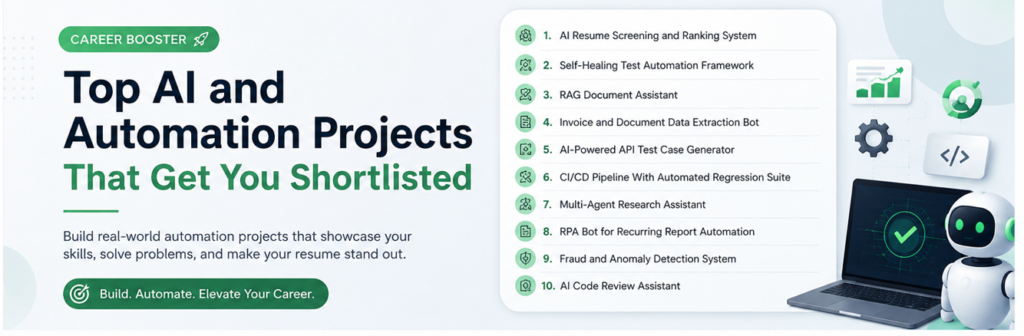
Top AI and Automation Projects That Get You Shortlisted
1. AI Resume Screening and Ranking System
Upload a job description and a folder of resumes, and the system parses each one, scores it against the required skills, and returns a ranked list with the reasoning shown. The irony is not lost on anyone in the interview room, and that makes it memorable.
Why recruiters like it: it touches parsing, embeddings, scoring logic, and bias handling, which gives an interviewer four solid follow-up questions to ask you.
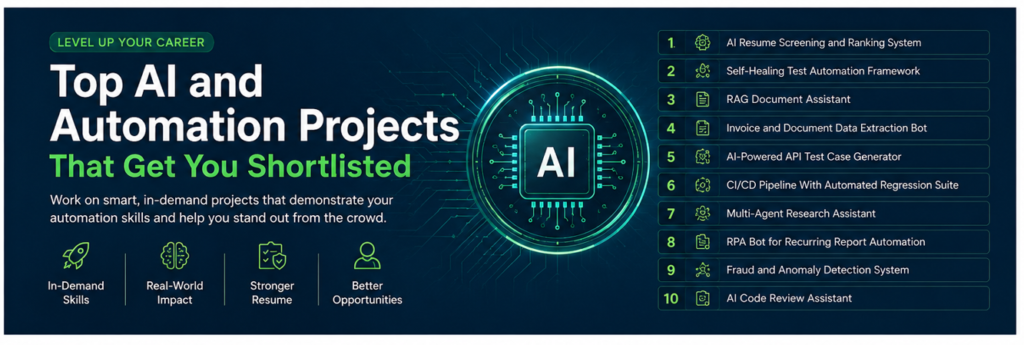
2. Self-Healing Test Automation Framework
A Playwright framework that detects a broken locator at runtime, asks a model to suggest the closest matching element from the DOM, and updates the selector instead of failing the whole suite. Log every heal so the change is auditable.
Why recruiters like it: flaky locators are the single biggest maintenance cost in test automation. Solving that problem is directly relevant to what a QA team pays for.
3. RAG Document Assistant
Point it at a set of PDFs, policy documents, or course notes. It chunks them, stores embeddings in a vector database, and answers questions with citations back to the source page. Add a fallback response for when the answer is not in the documents.
Why recruiters like it: Retrieval-augmented generation is the pattern most enterprise AI work is built on right now. Knowing chunking strategy and citation handling is genuinely employable.
4. Invoice and Document Data Extraction Bot
Scanned invoices go in, structured JSON comes out. Combine OCR for text extraction with a model pass for field mapping, then validate totals against line items so bad extractions get flagged rather than saved.
Why recruiters like it: finance and operations teams still do this by hand. The validation layer is what turns it from a demo into something usable.
5. AI-Powered API Test Case Generator
Feed it an OpenAPI specification and it generates a pytest suite covering happy paths, boundary values, authentication failures, and malformed payloads. Run the generated suite and report coverage against the endpoints.
Why recruiters like it: it shows you understand testing theory, not just how to write assertions. Boundary and negative case design is a standard interview topic.
6. CI/CD Pipeline With Automated Regression Suite
Every push triggers a Dockerized Playwright run in GitHub Actions, publishes an HTML report, and blocks the merge if critical tests fail. Add parallel execution across browsers to cut runtime.
Why recruiters like it: most freshers can write a test. Very few can explain how tests fit into a release process. This project puts you in the second group.
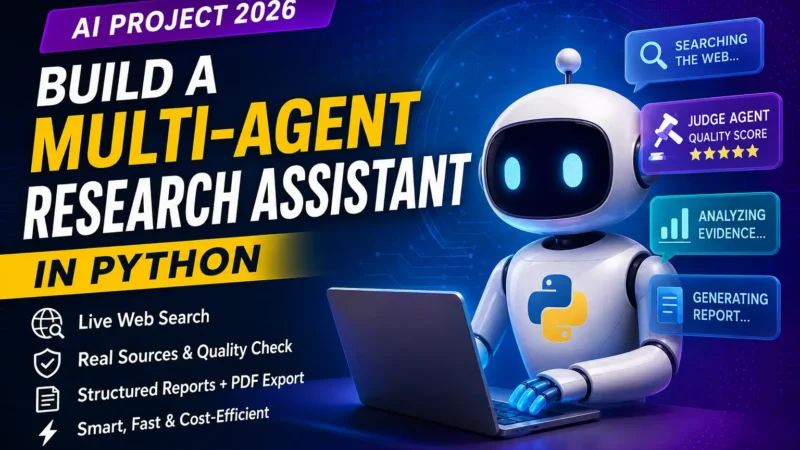
7. Multi-Agent Research Assistant
One agent searches, one summarises, one fact-checks, and a coordinator assembles the final brief with sources. The interesting engineering is in handling disagreement between agents and capping the loop so it terminates.
Why recruiters like it: agent orchestration is where a lot of applied AI hiring is currently concentrated, and very few candidates have built one properly.
8. RPA Bot for Recurring Report Automation
A scheduled bot that pulls data from a database or spreadsheet, cleans it, builds a formatted report, and emails it out every Monday morning. Simple to build, and the easiest of these AI and automation projects to finish in a week.
Why recruiters like it: it maps directly to work that exists in every operations team. Quantify the manual hours it replaces and the project sells itself.
9. Fraud and Anomaly Detection System
Train a model on transaction data to flag outliers, then expose it behind a small API with a dashboard showing flagged records and confidence scores. Handle the class imbalance properly and be ready to explain why accuracy is the wrong metric here.
Why recruiters like it: the precision and recall trade-off conversation it opens up is exactly what a data interviewer wants to hear you reason through.
10. AI Code Review Assistant
A bot that runs on pull requests, reviews the diff for common issues, and posts inline comments. Restrict it to a defined checklist so the output stays consistent instead of drifting into vague advice.
Why recruiters like it: it demonstrates Git internals, webhook handling, and prompt design in one project.
Skills These Projects Prove on Your Resume
- Practical AI integration: working with model APIs, prompts, embeddings, and output validation.
- Automation engineering: Playwright or Selenium, page object structure, and reliable waits.
- Backend fundamentals: REST APIs, authentication, and database design.
- DevOps awareness: Docker, pipelines, environment configuration, and secrets handling.
- Data handling: cleaning messy input, validation rules, and structured output.
- Communication: a README and a demo video that let someone else run your work.
New Project : https://updategadh.com/matrimonial-portal/
How to Present These Projects So They Get Read
- Lead with the outcome. Write the result first, then the stack. “Cut manual invoice entry from four hours to six minutes” beats “built using Python and OCR”.
- Keep it to two lines. One line on what it does, one line on the measurable effect.
- Link a working demo. A short video is more convincing than a repository nobody will clone.
- Write a real README. Setup steps, environment variables, and a screenshot. This is the first thing a technical reviewer opens.
- Know your weak points. Interviewers ask what you would fix. Having a specific answer signals honesty and maturity.
Mistakes That Kill an Otherwise Good Project
- Cloning a tutorial without changing the problem it solves.
- Listing ten half-finished projects instead of two complete ones.
- Hardcoding API keys into the repository.
- No error handling, so the demo breaks on the first unexpected input.
- Being unable to explain a single line of the code when asked.
Watch the Build Walkthroughs
Step-by-step walkthroughs for several of these AI and automation projects, including framework setup and demo runs, are published on the channel.
Subscribe to DecodeIT2 on YouTube
Frequently Asked Questions
How many projects do I actually need on my resume?
Two strong ones are enough. A pair of complete, well documented AI and automation projects will always outperform a list of six unfinished repositories.
Do I need machine learning knowledge to build these?
Not for most of them. Projects built on model APIs, OCR, or test automation need solid programming and integration skills rather than model training. Only the fraud detection project requires proper ML fundamentals.
Which project is best for an automation tester moving into AI roles?
The self-healing test framework or the API test case generator. Both build directly on testing experience you already have while adding the AI layer that hiring managers are currently screening for.
Are these suitable for BCA and MCA final year submissions?
Yes. Each idea scales up or down depending on how many modules you implement, and all of them are defensible in a viva because the problem statement is concrete and easy to demonstrate.
How long does one project take to build?
Plan for two to four weeks of consistent work for a medium difficulty project, including documentation and a demo recording. The RPA report bot can be finished considerably faster.