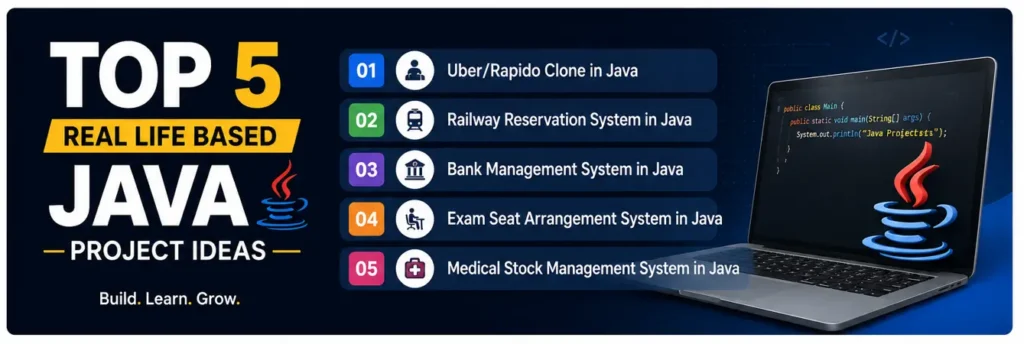
Most lists of real life based Java project ideas hand you the same five management systems with different nouns swapped in. Library, hospital, school, hotel, gym. Underneath, they’re all the same four screens and the same CRUD queries, which is exactly why examiners stop paying attention halfway through the demo.
These five are picked because each one teaches something the others don’t. One has a real algorithm. One has a concurrency problem. One has money moving between accounts. Pick any of them, and you’ll have something to actually talk about when the examiner asks why you built it that way.
Table of Contents
What This Post Covers
- Five Java projects that solve genuinely different problems
- What each one teaches, and the question your examiner will ask about it
- Rough time commitment for each
- How to choose between them if you’re short on time
All five use Java with MySQL, so the setup knowledge carries across. Source code and documentation are available for each.
Short on Time? Start Here
If you have three weeks, build the Exam Seat Arrangement System. It’s the smallest of the five and it’s the only one with a real algorithm, which means you get the strongest viva material for the least work. If you have two months and want something that stands out in a placement interview, build the Uber/Rapido clone.
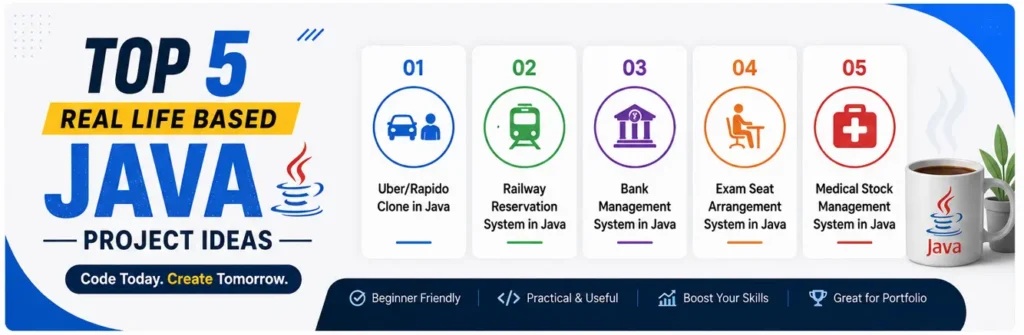
1. Uber/Rapido Clone in Java
A ride-hailing system where riders request trips, drivers accept or decline them, and the system tracks the trip through to fare calculation. It’s the closest thing on this list to software people actually use every day.
What makes it worth building isn’t the booking form. It’s the matching step. When a rider requests a ride, which driver gets it, and what happens when two riders request at the same moment and only one driver is free? That’s a real design question with no single correct answer, which is exactly what you want to be asked about.
You’ll learn: multi-role authentication, state management across a trip lifecycle, fare calculation logic, and modelling relationships between users, drivers, vehicles and trips.
The question you’ll get: how did you decide which driver receives a request? Have an answer ready. Nearest available, first to accept, and round-robin are all defensible — pick one and know why.
Time: roughly 40 to 50 hours.
Uber/Rapido Clone Project in Java — full source code, database, and documentation.
2. Railway Reservation System in Java
Booking, cancelling and checking train seats against a live availability count. Every Indian student understands the problem without being told, which saves you five minutes of your viva explaining the premise.
The interesting part is the thing that goes wrong. Two users book the last seat at the same time. Without a lock, both bookings succeed and you’ve sold a seat twice. Handling that properly with a transaction is a genuinely useful thing to learn, and most students building booking projects never notice the problem exists.
You’ll learn: database transactions, row locking, seat allocation across classes, PNR generation, and cancellation with refund rules.
The question you’ll get: What stops two people from booking the same seat? If you can answer this one properly you’ll be ahead of most of your batch.
Time: around 30 to 40 hours.
Railway Reservation System in Java and MySQL — includes source code and setup guide.
3. Bank Management System in Java
Accounts, deposits, withdrawals, transfers and statements. It’s the most common project on this list, which is both its weakness and its strength — heavy competition, but examiners know exactly what to look for, so a good implementation reads clearly as a good implementation.
A transfer is two operations: debit one account, credit another. If the second one fails, the money has vanished. That’s the whole reason transactions exist, and a bank project is the cleanest place to demonstrate you understand them. If your code doesn’t roll back on failure, you’ve built a spreadsheet with a login screen.
You’ll learn: ACID transactions and rollback, balance validation, audit trails, and role separation between customer and bank staff.
The question you’ll get: what happens if the system crashes between the debit and the credit? Walk them through your rollback.
Time: about 35 to 45 hours.
Bank Management System in Java + MySQL — complete project with database.
4. Exam Seat Arrangement System in Java
Assign students to rooms and seats for an examination, under the constraint that no two students sitting next to each other are taking the same paper. Colleges do this manually every semester and it takes hours.
This is the one project here that isn’t a form over a database. There’s an actual constraint to satisfy, and your solution can be good or bad in a way an examiner can evaluate. It’s also the smallest project on the list, so it’s the right choice when the deadline is close.
You’ll learn: constraint-based allocation, working with 2D seating layouts, room capacity handling, and generating printable seating charts.
The question you’ll get: what does your system do when there aren’t enough seats to satisfy the constraint? “It throws an error” is an acceptable answer if you say it deliberately.
Time: roughly 25 to 30 hours.
Exam Seat Arrangement System with Java and MySQL — source code and documentation included.
5. Medical Stock Management System in Java
Inventory for a pharmacy or hospital store: what’s in stock, what’s running low, and what’s about to expire.
Ordinary inventory projects track a quantity. Medicine has an expiry date attached to each batch, which changes everything. The same drug arrives in three batches with three different expiry dates, and you have to dispense the oldest one first. That single requirement makes the data model meaningfully harder than a generic stock system, and it’s the reason this one is worth building over the tenth library management system.
You’ll learn: batch-level inventory, first-expiry-first-out dispensing, reorder-level alerts, and supplier records.
The question you’ll get: how do you handle two batches of the same medicine with different expiry dates? Your answer is your data model.
Time: around 30 to 35 hours.
Medical Stock Management System in Java — full guide with source code.
Where Students Lose Marks
Building the login screen for two weeks
Authentication is the least interesting part of every project here, and it’s where most students spend the most time because it’s the first thing they hit. Get a working login in a day and move on. Nobody has ever been failed for a plain login page.
String concatenation in SQL queries
If your code builds a query by joining strings together, you have a SQL injection vulnerability, and examiners do check. Use PreparedStatement with ? placeholders everywhere, from the first query you write.
No error handling on the demo path
The demo always breaks. A stack trace on the projector is avoidable — wrap the operations you’re going to demonstrate and show a readable message instead.
Not being able to explain your own database design
Examiners ask why a table is structured the way it is far more often than they ask about code. Be able to explain every foreign key on your ER diagram.
Picking the same project as four classmates
If three library management systems come up in the same session, the third one is judged against the first two whether that’s fair or not. Variety is worth more than familiarity.
Comparing the Five
| Project | Core skill and time |
|---|---|
| Uber/Rapido Clone | Request matching and trip state — 40 to 50 hours |
| Railway Reservation | Concurrency and seat locking — 30 to 40 hours |
| Bank Management | Transactions and rollback — 35 to 45 hours |
| Exam Seat Arrangement | Constraint-based allocation — 25 to 30 hours |
| Medical Stock | Batch and expiry tracking — 30 to 35 hours |
Common Questions
Are these suitable for BCA and MCA final year submissions?
Yes, all five work for BCA, MCA, B.Tech CS/IT, and Diploma. MCA students usually add one extra module to raise the complexity, since MCA evaluation tends to expect more scope than BCA.
Should I use Swing or a web interface?
If your college specifies one, use that. If not, Swing is faster to build and easier to demo offline, which matters when the exam hall internet fails. A web interface looks better on a resume. Both are accepted.
Is core Java still fine in 2026, or do I need Spring Boot?
Core Java with JDBC is fine for a college submission and it’s better for learning, because you can see every layer. Spring Boot helps if you’re building the project mainly to talk about in placement interviews.
Can I modify the source code for my college requirements?
Yes. The code is readable and commented, so changing the college name, adding fields, or extending a module is straightforward. You should modify it — an unchanged project is easy to spot.
Read Next
- Full Java Project List — all 27 projects, if none of these five fit your requirement
- Spring Boot Projects — the next step up if you want framework experience
- Interview Questions — what gets asked about these projects in placement rounds
- Free Projects — smaller builds to practise on before committing to a final year project
More walkthroughs on DecodeIT2.