Mastering SQL for Data Analytics and Interview Success
SQL is one of the most important skills for anyone planning a career in data analytics. It allows professionals to retrieve information, combine records, calculate metrics, clean datasets, and prepare data for reporting. SQL is also widely used during technical interviews to evaluate how candidates work with databases and solve practical data problems.
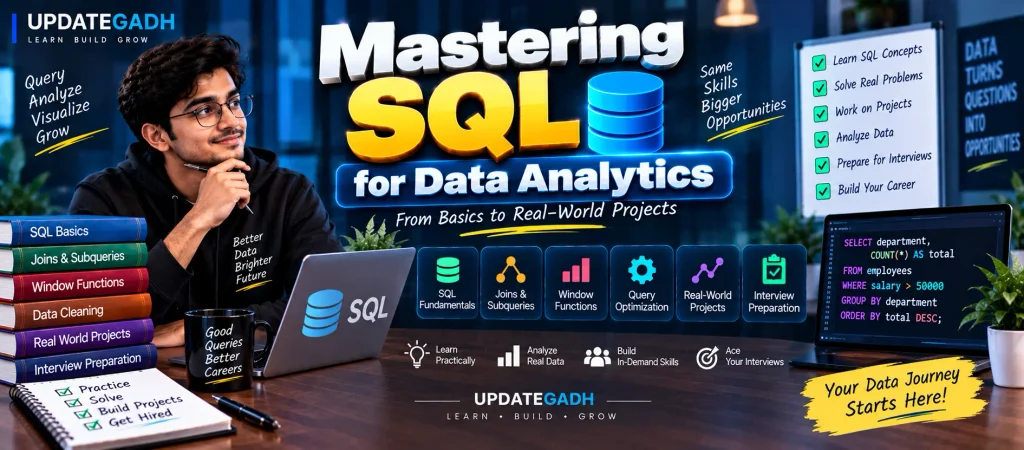
To become confident with SQL, it is important to combine concepts with regular practice. The following roadmap covers the major SQL areas that can help you build stronger analytical and interview skills.
Table of Contents
1. Build a Strong SQL Foundation
Start by becoming comfortable with the commands used in everyday database queries. Understanding these statements makes it much easier to construct larger queries later.
- SELECT: Chooses the columns or expressions you want to retrieve.
- FROM: Identifies the table or tables containing the required data.
- WHERE: Filters individual rows according to conditions.
- GROUP BY: Creates groups so aggregate calculations can be performed.
- HAVING: Filters the groups produced by
GROUP BY. - LIMIT: Restricts how many rows are returned.
SELECT first_name, last_name, COUNT(*) AS record_count
FROM employees
WHERE department = 'Sales'
GROUP BY first_name, last_name
HAVING COUNT(*) > 5
LIMIT 10;
This query filters Sales records, groups them by employee name, keeps groups containing more than five records, and returns a maximum of ten results.
2. Learn Advanced SQL Querying
YT:- DecodeIT
Once basic statements become familiar, move toward techniques that are frequently required for real-world analysis and technical interviews.
- Joins: Practice INNER JOIN, LEFT JOIN, RIGHT JOIN, SELF JOIN, and CROSS JOIN.
- Aggregate Functions: Work with functions such as
SUM(),AVG(),MIN(), andMAX(). - Window Functions: Learn
ROW_NUMBER(),RANK(),DENSE_RANK(),LEAD(),LAG(), andSUM() OVER(). - Conditional Logic: Use
CASEto create condition-based results. - Pattern Matching: Use
LIKEwhen searching for text patterns. - Subqueries and CTEs: Break complicated data operations into manageable steps.
SELECT e.first_name,
       e.last_name,
       d.department_name,
       SUM(s.salary) AS total_salary
FROM employees e
JOIN salaries s
    ON e.employee_id = s.employee_id
JOIN departments d
    ON e.department_id = d.department_id
GROUP BY e.first_name, e.last_name, d.department_name
ORDER BY total_salary DESC;
Window functions are particularly useful when you need calculations across related rows without collapsing the original result set.
SELECT employee_id,
       salary,
       RANK() OVER (ORDER BY salary DESC) AS salary_rank,
       LEAD(salary) OVER (ORDER BY salary DESC) AS next_salary
FROM salaries;
3. Improve SQL Query Performance
Knowing how to produce the correct result is only one part of SQL. When databases contain large amounts of information, inefficient queries can take much longer to execute.
Learn how indexes work, understand execution behavior, avoid unnecessary operations, and practice writing queries that retrieve only the information actually required.
CREATE INDEX idx_department
ON employees(department_id);
An index can improve lookup and join performance for suitable queries involving the indexed column. However, indexes should be designed according to the workload because they also require storage and maintenance.
4. Practice With Real Data Problems
Reading SQL syntax is not enough to develop strong analytical skills. Solve practical problems where you have to decide which tables to use, how they should be joined, and which calculations are required.
For every topic you learn, try solving several problems independently. A useful practice method is to study a short tutorial and immediately reproduce the technique using your own query.
SELECT p.product_name,
       c.category_name,
       SUM(o.quantity) AS total_sold
FROM products p
JOIN orders o
    ON p.product_id = o.product_id
JOIN categories c
    ON p.category_id = c.category_id
GROUP BY p.product_name, c.category_name
ORDER BY total_sold DESC;
This example combines product, order, and category information and calculates the quantity sold for each product.
5. Work on End-to-End SQL Projects
Projects help connect individual SQL concepts into a complete workflow. Instead of solving isolated questions, work with a dataset from beginning to end.
A typical project can involve extracting records, preparing the data, calculating metrics, identifying patterns, and producing results for reporting.
SELECT customer_id,
       order_date,
       total_amount
FROM orders
WHERE order_date BETWEEN '2023-01-01' AND '2023-12-31';
This type of query can serve as the starting point for analyzing customer orders during a selected period.
6. Apply SQL to Real-World Analysis
Real datasets are rarely perfectly organized. Analytical work may require dealing with duplicate records, missing values, inconsistent information, and relationships between multiple tables.
Practice identifying data-quality issues before performing calculations. This helps prevent incorrect results from reaching reports or dashboards.
DELETE FROM orders
WHERE order_id IN (
    SELECT order_id
    FROM (
        SELECT order_id,
               ROW_NUMBER() OVER (
                   PARTITION BY customer_id, order_date
                   ORDER BY order_id
               ) AS row_num
        FROM orders
    ) AS duplicates
    WHERE row_num > 1
);
The example identifies repeated records using ROW_NUMBER() before removing the additional rows.
7. Learn Data Cleaning and Preparation
Data preparation is an important part of analytics. Learn how to identify NULL values, handle inconsistent records, remove duplicates, and combine information from related tables.
Understanding relationships between tables is equally important because incorrect joins can produce duplicate rows or misleading results.
UPDATE employees
SET salary = 0
WHERE salary IS NULL;
This example replaces missing salary values with zero. In an actual project, the appropriate replacement should depend on the meaning of the missing data and the analytical requirement.
8. Develop Reporting and Advanced Analysis Skills
After learning data retrieval and cleaning, focus on transforming information into useful metrics. SQL can be used to prepare datasets for reports, dashboards, and business analysis tools.
Window functions are especially useful for calculations such as running totals, rankings, and comparisons between rows.
SELECT order_date,
       SUM(total_amount) OVER (
           ORDER BY order_date
       ) AS cumulative_sales
FROM orders;
This query produces a running sales total based on the order date.
9. Prepare for SQL Interviews
Interview preparation should include both conceptual questions and hands-on SQL problems. Practice joins, grouping, subqueries, window functions, NULL handling, duplicate detection, and analytical calculations.
Try solving questions without immediately checking the solution. After completing a problem, review your query for correctness, readability, and efficiency.
SELECT first_name,
       last_name,
       salary
FROM employees
WHERE salary > (
    SELECT AVG(salary)
    FROM employees
);
This query identifies employees whose salary is higher than the average salary across the table.
Complete Advance AI Topics: Click Here
SQL Tutorial: Click Here
Final Thoughts
Mastering SQL for data analytics requires consistent practice rather than memorizing individual commands. Begin with fundamental statements, gradually introduce joins and window functions, and then apply those concepts to realistic datasets and projects.
For interviews, focus on understanding why a query works, how tables are related, and how your solution can be improved. Regular problem-solving practice will make complex SQL tasks much easier to approach with confidence.
Frequently Asked Questions
Is SQL important for data analytics?
Yes. SQL is widely used to retrieve, transform, clean, and analyze structured data stored in relational databases.
Which SQL topics should beginners learn first?
Start with SELECT, WHERE, GROUP BY, HAVING, ORDER BY, aggregate functions, and basic joins before moving to advanced topics.
Are SQL joins important for interviews?
Yes. Join-based problems are commonly used to test whether candidates understand relationships between database tables.
Why should I practice window functions?
Window functions are useful for rankings, running totals, comparisons, and other analytical calculations that operate across related rows.
How can I improve my SQL interview skills?
Practice real SQL problems regularly, understand query logic, analyze performance, and learn to explain your approach clearly.
Keywords: Mastering SQL for Data Analytics, SQL for data analytics, SQL interview preparation, SQL interview questions, data analytics SQL, learn SQL for data analysis, SQL tutorial for beginners, advanced SQL, SQL joins, SQL window functions, SQL data cleaning, SQL projects,SQL for data analytics SQL data analytics tutorial SQL interview preparation SQL interview questions SQL for data analysis SQL tutorial for beginners Learn SQL for data analytics Advanced SQL techniques SQL joins SQL window functions SQL aggregate functions SQL data cleaning SQL query optimization SQL analytics projects,Mastering SQL for Data Analytics and Interview Success,,Mastering SQL for Data Analytics and Interview Success SQL practice questions Data analytics interview questions SQL for data analysts SQL roadmap for data analytics SQL projects for beginners ,SQL for data analystSQL interview questions for freshers Data analysis using SQL SQL reporting and dashboards SQL real-world projects Advanced SQL queries SQL coding interview questions,SQL for data analyst,SQL for Data AnalyticsSQL for Data Analytics