Decentralized voting system using Blockchain
In today’s digital world, trust and transparency are very important in any election process. The Decentralized Voting System Using Ethereum Blockchain is a smart and modern project that shows how blockchain technology can improve the way voting is handled. Instead of relying on a fully centralized system, this project leverages Ethereum to create a voting platform where records are secure, transparent, and harder to manipulate.
Table of Contents
About the Voting System Project
The Decentralized Voting System is designed to create a secure election environment where users can cast votes digitally while maintaining trust in the result. Traditional voting systems often face challenges like data tampering, lack of transparency, dependency on intermediaries, and security concerns. This project tries to solve those issues by using the Ethereum blockchain as the core layer for vote recording.
Why blockchain for voting?
| Problem | Blockchain Solution |
|---|---|
| Admin could change votes | Can’t smart contract code is immutable |
| Someone votes twice | Contract tracks each wallet address, rejects duplicates |
| Central server goes down | Blockchain is decentralized no single point of failure |
| “Who voted for what?” | Transparent every transaction is auditable |
| Database can be hacked | Blockchain records can’t be deleted or overwritten |
Why This Project is Best for College Students
This project is best for college students because it is based on a modern and in-demand concept. Many students build simple management systems, but a blockchain-based voting system stands out during project evaluation, viva, and interviews. It shows that the student understands advanced technologies and can work on a project that has both technical depth and practical use.
Main Features of the Voting System
- Secure voter authentication and authorization using JWT
- Transparent and tamper-proof voting records using the Ethereum blockchain
- Trustless voting process with reduced dependency on intermediaries
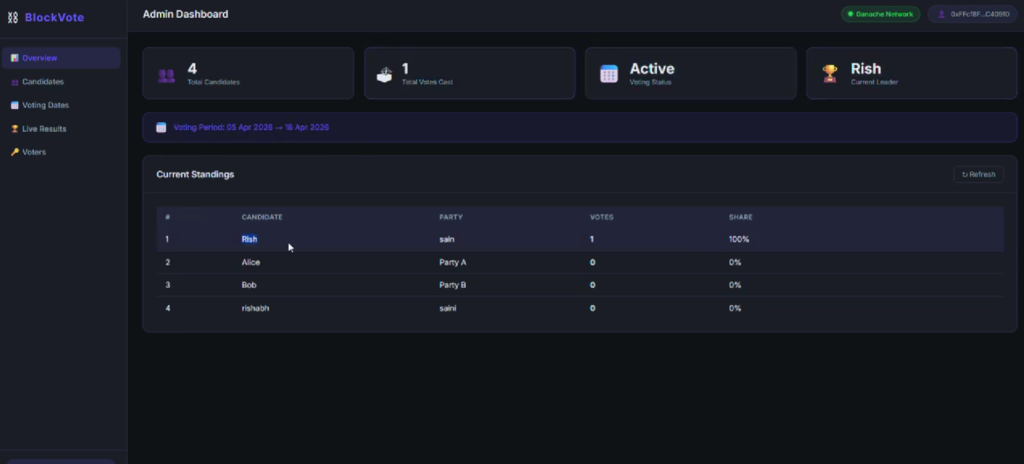
- Admin panel to manage candidates and election activities
- Option to set and manage voting dates
- Real-time monitoring of voting results
- Simple and intuitive user interface for voters
- Candidate information display for easy decision-making
- Blockchain-based security for better election integrity
Check Another Project: AI Chatbot for College and Hospital
Technology Used
| Component | Technology |
|---|---|
| Blockchain | Ethereum |
| Smart Contract Tools | Truffle, Ganache |
| Frontend | HTML, CSS, JavaScript |
| Backend Support | Node.js |
| API Layer | FastAPI |
| Database | MySQL |
| Wallet Integration | MetaMask |
System Requirements
- Node.js version 18.14.0
- Python version 3.9
- FastAPI
- MetaMask browser extension
- MySQL database running on port 3306
- Ganache for local blockchain testing
- Truffle installed globally
How the Voting System Works
The system allows authorized users to log in and take part in an election process through a secure digital platform. The admin manages the candidate list, controls election timing, and oversees the system. When a voter casts a vote, the action is recorded through blockchain-based logic, which improves trust and transparency.
At the same time, the project also uses database support for storing user-related details and handling authentication-based operations. This combination makes the project educational as well as practical for demonstration purposes.
Advantages of This Project
- Shows practical use of blockchain in a real application
- Improves trust in election systems
- Useful for academic demonstration and final year submission
- Strong project for Viva and interview discussion
- Helps students understand decentralized architecture
- Can be extended for university elections, club voting, and private polls
How to Run the Project
- Open the project folder in your system.
- Install and open Ganache, then create the required development workspace.
- Set up the browser wallet and connect it to the local blockchain network.
- Create the required MySQL database and voter table.
- Install Truffle globally on your system.
- Install all Node.js dependencies in the main project folder.
- Install all Python dependencies for the database API module.
- Update the database credentials in the environment file inside the database API folder.
- Open the project directory in the terminal and start the Truffle console for contract compilation.
- Bundle the application JavaScript file for the browser.
- Start the Node.js server.
- Open another terminal, move to the database API folder, and start the FastAPI server.
- In a new terminal, migrate the smart contracts to the local blockchain.
- After completing these steps, open the local application in the browser and start using the voting system.
Future Improvements
This project can be improved further by adding biometric verification, mobile responsiveness, cloud deployment, advanced analytics, OTP-based login, and support for public blockchain networks. Students can also extend it with role-based dashboards, election reports, and better encryption methods.
Download
Buy Now: Click Here
Conclusion
The Decentralized Voting System Using Ethereum Blockchain is a powerful and innovative project idea for college students. It is much more than a simple software project because it demonstrates security, transparency, and trust using blockchain technology. If you want a project that looks advanced, feels practical, and gives you strong learning value, this is a very solid choice for your academic journey.
This project can help students understand how emerging technologies like blockchain can solve real-life problems. It is ideal for final year submission, portfolio building, and technical discussions during project reviews.
Watch Project Videos on YouTube