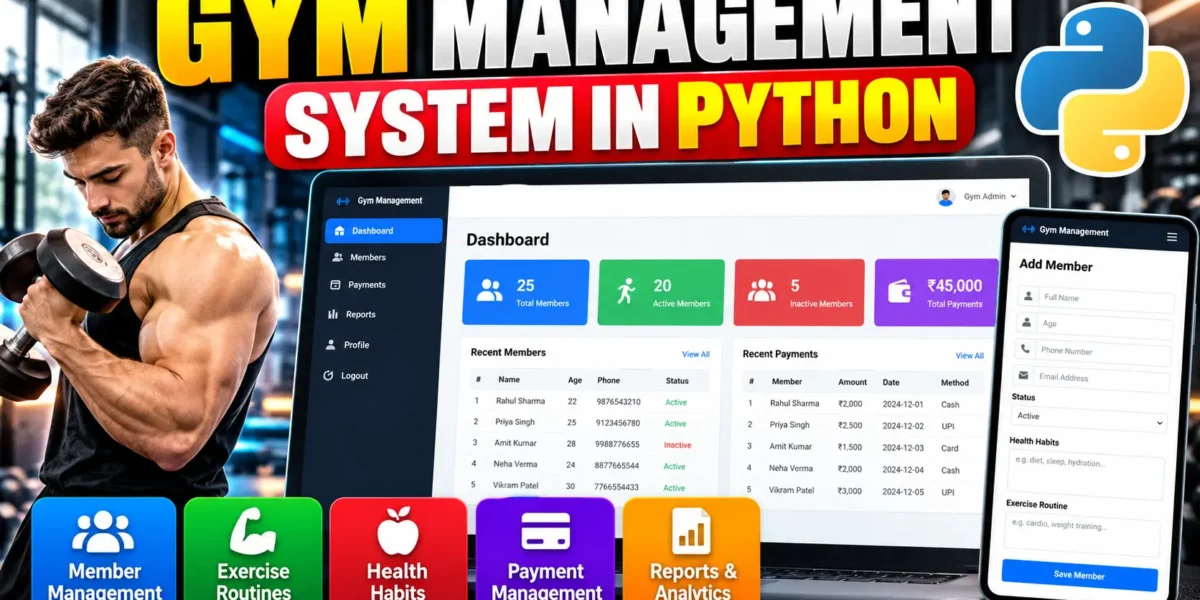
Gym Management System in Python
The Gym Management System in Python is a practical medium-level college project designed to organize gym member information, health habits, exercise routines, and payment records through a clean management interface. The original concept focused on a simple Python application for storing customer details and performing basic CRUD operations. This improved college-project version keeps that core purpose while presenting the workflow through a professional responsive dashboard and a SQLite database.
Complete Advance AI Topics: Click Here
Real Time Projects on YouTube:- DecodeIT
Project Overview
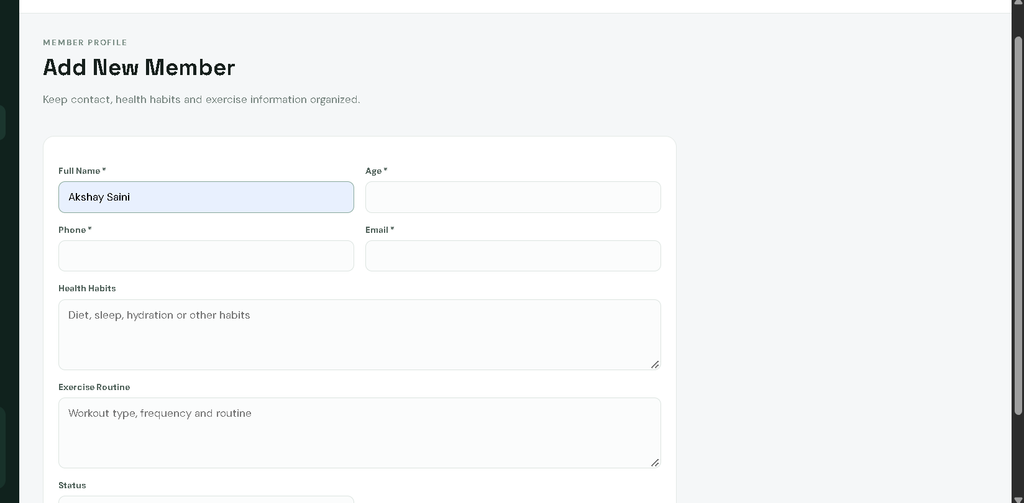
This system gives a gym manager one place to maintain member profiles and payment activity. A member record contains the name, age, phone number, email address, health habits, exercise routine, and current status. The application also provides search and filtering so that records can be located quickly. Payment entries can be connected with members, making it easier to review individual payment history and prepare a simple transaction report.
The project is suitable for students who want to understand how Python can be used to build a real-world management application. Instead of remaining a single-file console demonstration, it follows a connected application structure while keeping the implementation understandable for a college-level developer.
Key Features
- Member Management: Add, view, edit, and delete gym member records.
- Health Habit Records: Store useful information about diet, sleep, hydration, and other habits entered for a member.
- Exercise Routine Records: Maintain workout descriptions and routine details as part of the member profile.
- Search and Filtering: Find members by name, email, or phone number and filter records by active or inactive status.
- Payment Management: Record payment amount, date, payment method, status, and an optional note.
- Payment History: Review payments associated with an individual member.
- Dashboard: View total members, active members, inactive members, total recorded payments, recent members, and recent payment activity.
- Reports: View a simple payment transaction report for the stored records.
- Responsive Interface: The layout adapts to desktop, laptop, tablet, and mobile screens.
Technologies Used
| Technology | Purpose |
|---|---|
| Python | Core application logic |
| Flask | Web application framework |
| SQLite | Relational data storage |
| SQLAlchemy | Database model and query handling |
| HTML and CSS | Interface and responsive layout |
| JavaScript | Small client-side interface behavior |
Project Modules
Dashboard
The dashboard provides an operational summary as soon as the application opens. KPI cards show the current member and payment figures, while recent sections provide a quick view of newly added members and recorded transactions.
Member Management
The member module is the central part of the system. Staff can create a profile, update existing information, open a detailed member view, or remove a record when it is no longer required. Status values help separate active and inactive members. Search and filtering make the directory easier to manage when the number of records grows.
Health and Exercise Information
Health habits and exercise routines remain attached to each member instead of being maintained as disconnected notes. This allows the manager to open a profile and see the information together with contact details and status.
Payment Management
The payment module records the member, amount, date, payment method, status, and optional note. Payments are linked to the member table, allowing the member detail page to display payment history. A separate report page provides a straightforward transaction view.
User Role
The project is designed around a Gym Manager or Administrator role. This user manages member records, maintains health and exercise information, records payments, and reviews reports. A complex enterprise permission system is intentionally avoided so the project remains understandable and appropriate for college evaluation.
Database Design
The application uses SQLite for local data storage. The main database tables are Member and Payment. A member can have multiple payment records, creating a simple one-to-many relationship. Primary and foreign keys keep the relationship organized. This structure is more practical than temporary in-memory storage because records remain available after the application is restarted.
Download complete source code
Screenshot
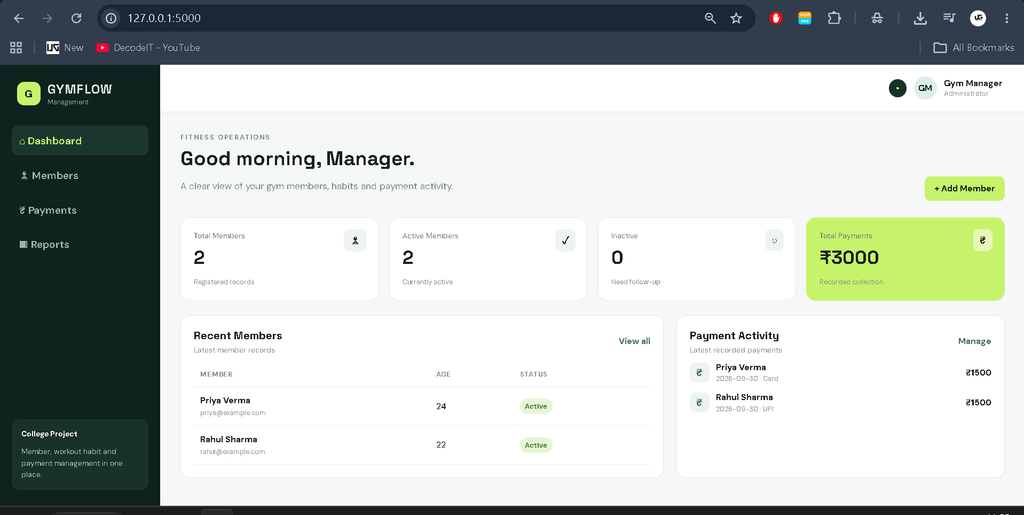
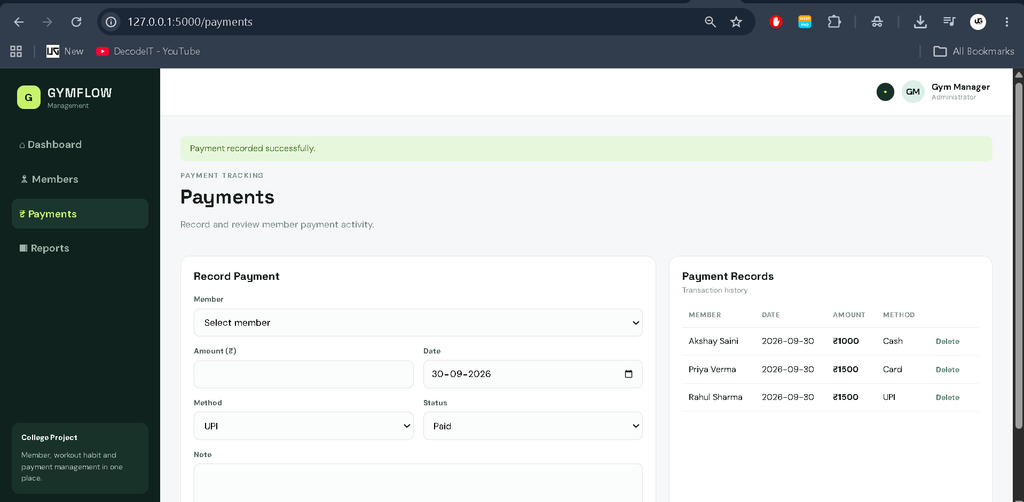
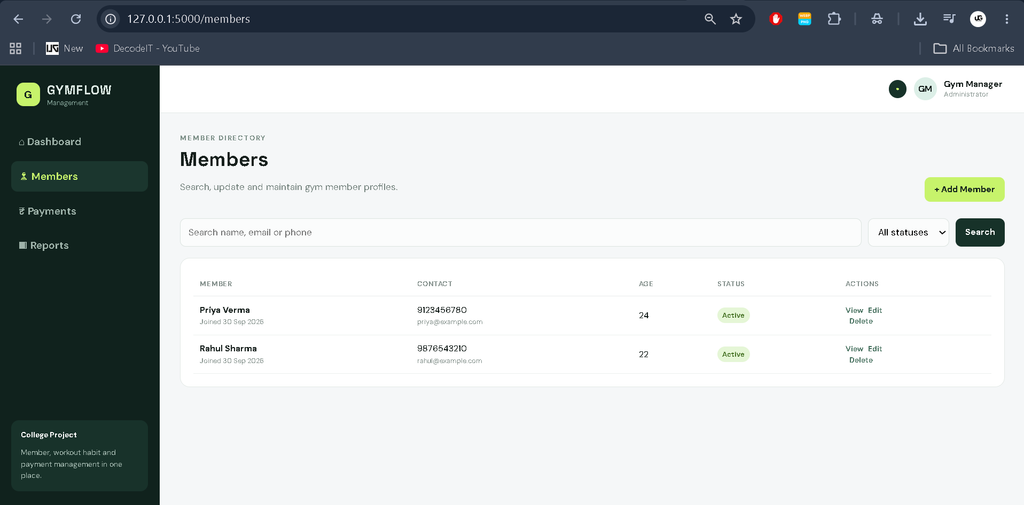
How the System Works
When the application starts, Flask initializes the database and creates the required tables if they do not already exist. The dashboard loads summary information from the database. The manager can then open the member directory, search for a record, add a new member, or edit an existing profile. Payment records can be entered from the payment module and are connected to the selected member. The reports page reads stored payment information and presents it in a table.
Installation and Setup
Install Python on the computer and open the project folder in Visual Studio Code. Create and activate a virtual environment, then install the packages listed in requirements.txt.
python -m venv venv
venv\Scripts\activate
pip install -r requirements.txt
python run.py
After the server starts, open http://127.0.0.1:5000/ in a browser. The SQLite database is created automatically when the application runs for the first time.
Usage
Start from the dashboard and select Members to manage profiles. Use Add Member for new records and the action controls to view, edit, or delete existing records. Use the search box when a specific member needs to be located. Open Payments to record a transaction and review the payment table. The Reports section can then be used to view the stored payment activity in one place.
Frequently Asked Questions
What is the purpose of this project?
It is a Python-based management application for organizing gym members, health habits, exercise routines, and payment information.
Which database does it use?
The project uses SQLite with SQLAlchemy for local relational data management.
Can members be searched?
Yes. The member directory supports searches using name, email, or phone number and also provides status filtering.
Can payment history be viewed for a member?
Yes. A member’s detail page displays the payment records connected to that profile.
Is Django Admin required?
No. The project uses Flask and its own dashboard interface, so management tasks are handled through the custom UI.
Is the project suitable for college submission?
Yes. It demonstrates Python application development, database relationships, CRUD operations, validation, searching, reporting, and responsive UI design without becoming an enterprise-level system.
Future Scope
- Add secure login and password-based authentication for staff accounts.
- Add membership plans and automatic renewal dates.
- Add attendance tracking for members.
- Introduce printable or downloadable payment reports.
- Add more detailed workout and progress tracking.
- Provide stronger role-based access for managers and staff.
From an academic perspective, the project also demonstrates how a simple idea can be organized into reusable application components. Students can inspect the database models to understand relationships, the routes to understand request handling, and the templates to understand how stored information is presented. This makes the system useful not only as a submission project but also as a learning reference for Python web development and database-backed applications.
The interface is intentionally focused on practical tasks rather than decorative complexity. Each major screen supports a clear management action, and the navigation keeps members, payments, and reports easy to reach. This balance helps keep the project realistic for a student while still showing meaningful application development skills.
Conclusion
The Gym Management System in Python provides a balanced college-level implementation of a real-world gym management workflow. It preserves the original idea of maintaining customer details, health habits, exercise routines, search operations, CRUD functionality, and payments, while giving the project a more structured database and professional interface. Because the code is divided into models, routes, templates, and static resources, students can study each part separately and extend the system as their academic requirements grow.
Keywords:
Gym Management System
Gym Management System – Google Search
gym management system project
gym management system github
gym management system project with source code
gym management system project in python
gym management system er diagram
gym management system ui
gym management system project in java
gym management system template
gym management system codecanyon