Understanding Versioning in Software
Versioning is the practice of assigning unique numbers or names to different releases of a software program as it develops over time. In many cases, the first public release is identified as version 1.0.
However, there is no single standard that every company follows for software versioning. Version numbers can change when developers introduce new features, fix bugs, or release security updates and patches.
Complete Advance AI Topics: Click Here
SQL Tutorial: Click Here
MySQL Versions and Releases
According to the information provided, the latest stable version of MySQL is MySQL 8.0. It was initially released in April 2018 and is expected to be supported until April 2026.
MySQL 8.0 introduced several improvements, new features, bug fixes, and security updates, making it an important upgrade compared with earlier versions.
When installing MySQL, you generally need to choose between two types of releases:
- Development Release: Includes the newest features but may not be completely stable. It is not recommended for production environments.
- General Availability (GA) Release: Also referred to as the stable release. It has undergone extensive testing and is suitable for production use.
New Features in MySQL 8.0
1. Data Dictionary
- MySQL 8.0 introduced a transactional data dictionary that replaces traditional metadata files, helping improve consistency and performance.
2. Atomic DDL Statements
- Storage engine operations, data dictionary changes, and binary logging can be combined into a single atomic transaction.
3. Automatic Upgrade Procedures
- Starting with MySQL 8.0.16, manually running the
mysql_upgradecommand is no longer required.
4. Enhanced Security and Account Management
- MySQL 8.0 provides greater flexibility for DBAs when managing user accounts and security policies.
5. Resource Management
- MySQL allows the creation of resource groups, where threads can be assigned to specific groups to help optimize performance.
6. Table Encryption Management
- Table encryption settings can be controlled globally using
default_table_encryptionand theDEFAULT ENCRYPTIONclauses.
7. InnoDB Enhancements
- MySQL 8.0 includes improvements related to auto-increment counters, tablespace encryption, the storage engine, and the memcached plugin.
8. Character Set Upgrade
- The default character set was changed from latin1 to utf8mb4, providing better support for multiple languages.
9. JSON Enhancements
- New functions such as
JSON_PRETTY(),JSON_MERGE_PATCH(), andJSON_TABLE()were introduced to improve JSON handling.
10. Optimizer Enhancements
- Features including invisible indexes, descending indexes, and functional indexes provide additional options for improving query performance.
11. Window Functions
- Functions such as
RANK(),LAG(), andNTILE()improve analytical query capabilities.
Deprecated Features in MySQL 8.0
Several MySQL features have been deprecated and are expected to be removed in future releases. These include:
utf8mb3character set.sha256_passwordauthentication, replaced withcaching_sha2_password.validate_passwordplugin.SQL_CALC_FOUND_ROWSand theFOUND_ROWS()function.MYSQL_PWDenvironment variable for specifying MySQL passwords.
Removed Features in MySQL 8.0
Some features were completely removed in MySQL 8.0, including:
InnoDB_locks_unsafe_for_binlogsystem variable.- Some account management features, including using the GRANT statement to create users, the
PASSWORD()function, and theold_passwordssystem variable. - Query cache commands such as
FLUSH QUERY CACHEandRESET QUERY CACHE. .frmfiles, makingsync_frmobsolete.mysql_install_db, which was replaced by the--initializeand--initialize_insecureoptions.
MySQL Version History
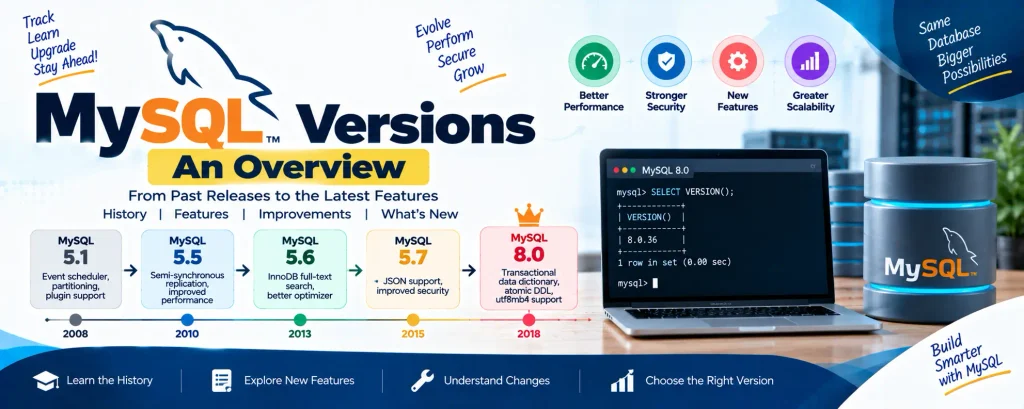
The following table provides an overview of major MySQL versions, their initial release years, support end dates, and key improvements.
| MySQL Version | Initial Release | Support End Date | Key Improvements |
|---|---|---|---|
| MySQL 5.1 | 2008 | 2013 | Event scheduler, partitioning, plugin support |
| MySQL 5.5 | 2010 | 2018 | Semi-synchronous replication, improved performance |
| MySQL 5.6 | 2013 | 2021 | InnoDB full-text search, better optimizer |
| MySQL 5.7 | 2015 | 2023 | JSON support, improved security |
| MySQL 8.0 | 2018 | 2026 | Transactional data dictionary, atomic DDL, utf8mb4 support |
Download New Real Time Projects :- Click here
Conclusion
MySQL has continued to evolve over the years, with different versions introducing improvements in performance, security, and scalability. Each release has brought changes designed to improve the overall database experience.
If you are still working with an older MySQL version, upgrading to MySQL 8.0 can provide access to its various features and improvements. It is also useful to keep track of future releases as MySQL continues to develop as a database management system.
For more updates on MySQL and other technology trends, stay connected!
SEO Keywords
mysql versions list, mysql versions history, mysql versions command, mysql versions download, mysql latest version 2025, mysql 9, mysql eol, mysql release notes, mysql versions, aurora mysql versions, rds mysql versions, docker mysql versions, brew mysql versions, mariadb vs mysql versions, percona mysql versions, azure mysql versions, all mysql versions, supported mysql versions