Starting out in artificial intelligence is easier when you build something instead of only reading about it. These AI projects for beginners are chosen because each one teaches a distinct concept, runs on a normal laptop, and finishes in days rather than months.
Table of Contents
Every project below includes what it does, the stack to build it in, the concept it teaches you, and a realistic time estimate. Work through three or four of them in order and you will have covered classification, regression, natural language processing, computer vision, and recommendation logic.
What You Need Before Starting
None of these require a powerful machine or a paid cloud account. What they do require is comfort with basic Python, since every project here is built on the same small set of libraries.
- Python basics: lists, dictionaries, loops, functions, and reading files.
- Pandas and NumPy: loading data, filtering rows, and handling missing values.
- Scikit-learn: the train-test split, fitting a model, and checking accuracy.
- Jupyter Notebook or VS Code: either works, Notebook is friendlier for experimentation.
- A dataset source: Kaggle and the UCI repository cover almost everything on this list.
Quick Overview of the Ten Projects
| Project | Core Concept | Main Library |
|---|---|---|
| Spam Email Classifier | Text classification | Scikit-learn |
| House Price Predictor | Regression | Scikit-learn |
| Handwritten Digit Recogniser | Image classification | TensorFlow or Keras |
| Movie Recommendation System | Similarity matching | Pandas, Scikit-learn |
| Sentiment Analysis Tool | Natural language processing | NLTK, Scikit-learn |
| Rule-Based Chatbot | Intent matching | NLTK, Flask |
| Face Detection App | Computer vision | OpenCV |
| Iris Flower Classifier | Multi-class classification | Scikit-learn |
| Stock Price Trend Predictor | Time series basics | Pandas, Scikit-learn |
| Resume Keyword Matcher | Text similarity | Scikit-learn, spaCy |
Top 10 AI Projects for Beginners
1. Spam Email Classifier
Feed the model a labelled set of spam and legitimate messages, convert the text into numerical features, and train a classifier to predict which category a new message belongs to. The SMS Spam Collection dataset is the standard starting point.
What you learn: text vectorisation with TF-IDF, the Naive Bayes algorithm, and why accuracy is misleading when one class dominates the data. This is the best first project on the list because the result is immediately understandable.
AI-Powered English Learning App using React
2. House Price Predictor
Given features such as area, number of bedrooms, location, and age, predict a continuous price value. Start with linear regression, then compare against a random forest to see the difference in error.
What you learn: the difference between regression and classification, feature scaling, encoding categorical columns, and evaluating with mean absolute error rather than accuracy.
3. Handwritten Digit Recogniser
Train a small neural network on the MNIST dataset to identify digits from zero to nine in 28 by 28 pixel images. A basic model reaches high accuracy within a few minutes of training on a CPU.
What you learn: how images become arrays of numbers, what layers and activation functions actually do, and how training epochs affect performance. This is the gentlest possible introduction to deep learning.
4. Movie Recommendation System
Build a content-based recommender that suggests films similar to one the user picks, using genre, cast, and description text to compute similarity between titles. The MovieLens dataset works well here.
What you learn: cosine similarity, converting text metadata into vectors, and the practical difference between content-based and collaborative filtering approaches.
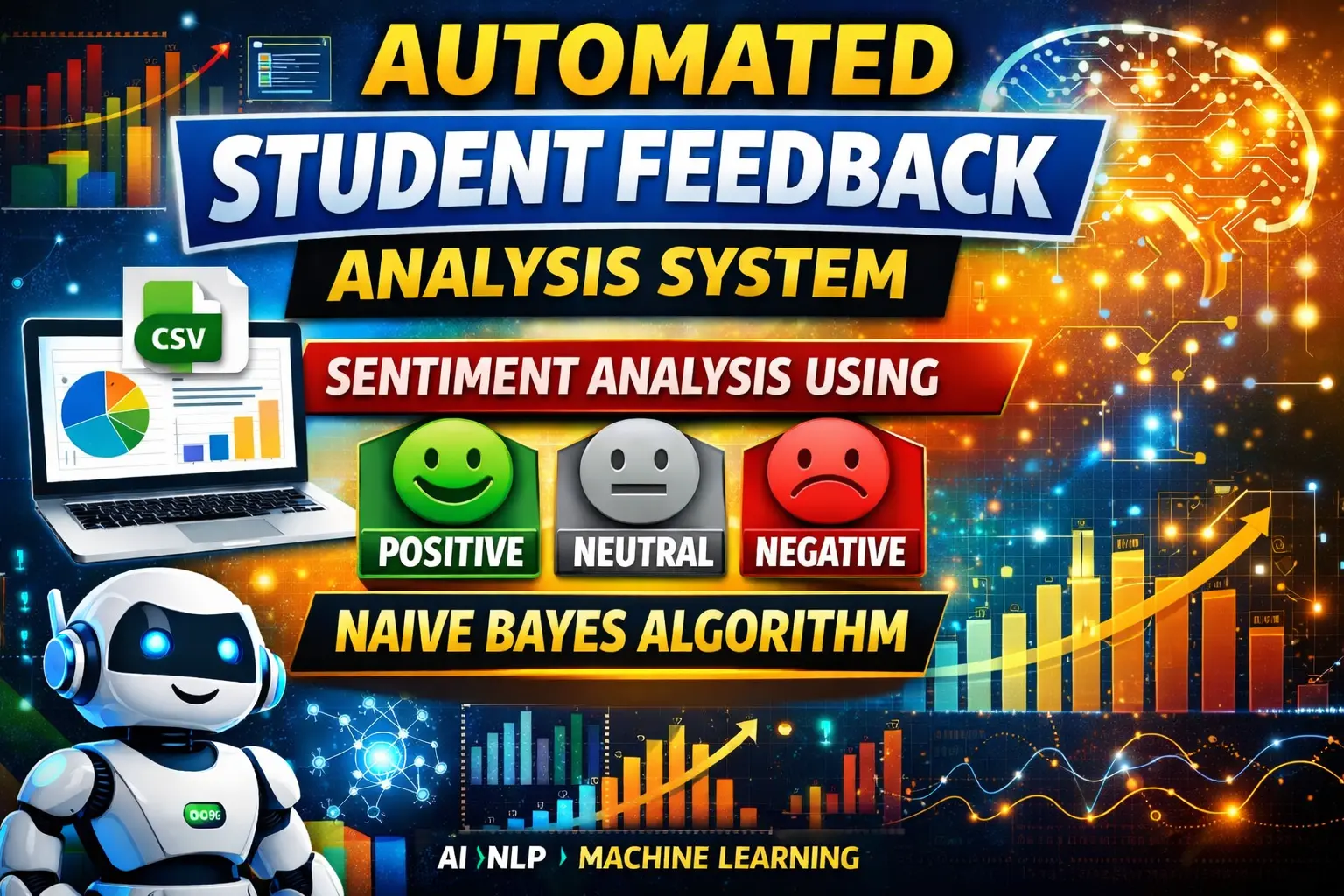
5. Sentiment Analysis Tool
Classify product reviews or tweets as positive or negative. Begin with a rule-based approach using a sentiment lexicon, then train a model on labelled data and compare which performs better on sarcastic or mixed reviews.
What you learn: text preprocessing including tokenisation, stopword removal, and stemming, plus why simple keyword counting breaks on real human language.
6. Rule-Based Chatbot
Build a bot that recognises user intent from a set of predefined patterns and returns an appropriate response. Wrap it in a small Flask interface so it runs in a browser rather than a terminal.
What you learn: intent matching, handling unrecognised input gracefully, and connecting a Python model to a web front end. The fallback response design is more important than it first appears.
7. Face Detection Application
Use OpenCV with a pre-trained Haar cascade or DNN model to detect faces in an image or a live webcam feed, then draw bounding boxes around each detection. Extend it by counting the faces present.
What you learn: reading video frames, working with pre-trained models instead of training your own, and the trade-off between detection speed and accuracy.
8. Iris Flower Classifier
The classic starting dataset. Four measurements of a flower predict which of three species it belongs to. It takes an afternoon and every step is easy to inspect.
What you learn: the complete machine learning workflow from loading data to splitting, training, predicting, and reading a confusion matrix. Build this first if any of the above felt intimidating.
9. Stock Price Trend Predictor
Use historical closing prices to predict whether the next day closes higher or lower. Treat it as a learning exercise in handling sequential data, not as a trading system.
What you learn: rolling averages, lag features, and why a random train-test split leaks future information into training when the data is ordered by time. That last lesson is genuinely valuable.
10. Resume Keyword Matcher
Compare a resume against a job description and return a match score plus the skills that are missing. Parse the documents, extract keywords, and compute similarity between the two texts.
What you learn: document parsing, keyword extraction with spaCy, and similarity scoring. Among these AI projects for beginners it is also the most directly useful to you personally.
The Order to Build Them In
- Iris classifier to see the full workflow once, end to end, with nothing complicated in the way.
- Spam classifier to add text handling and learn why imbalanced data distorts accuracy.
- House price predictor to switch from predicting categories to predicting numbers.
- Digit recogniser for a first look at neural networks on a well-behaved dataset.
- Anything from the remaining six depending on whether vision, language, or recommendation interests you most.
Mistakes That Slow Beginners Down
- Copying a notebook without changing it: swap the dataset or add a feature so you are forced to understand each line.
- Chasing accuracy percentages: a model at ninety-nine percent on imbalanced data may be predicting one class every time.
- Skipping the data cleaning: most of the real work is handling missing values and inconsistent formats, not model selection.
- Starting with deep learning: classical models train faster, are easier to debug, and often win on small datasets.
- Leaving projects in a notebook: wrap at least one in a simple interface so it becomes something you can demonstrate.
Watch the Build Walkthroughs
Step-by-step Python and machine learning walkthroughs, including several of these beginner builds explained line by line, are published on the channel
Subscribe to DecodeIT2 on YouTube
Frequently Asked Questions
Do I need to know mathematics before starting these projects?
Not to begin. Basic statistics helps you interpret results, but you can build every project on this list with library functions first and study the underlying mathematics afterwards, once the concepts have context.
Which programming language should I use?
Python. The library ecosystem for machine learning is far ahead of the alternatives, and nearly every tutorial and dataset example you find will be written in it.
Do I need a GPU?
No. Every project here trains on a standard CPU in minutes. Google Colab provides free GPU access if you later move to larger image or language models.
Are these AI projects good enough for a final year submission?
Individually they are on the simpler side, but any of them can be scaled up with a proper interface, a database, and a second model for comparison. The resume matcher and the recommendation system extend most naturally into full submissions.
How long before I can call myself job ready?
Three to four completed projects with clean code, a README, and the ability to explain your design choices puts you ahead of most freshers. Depth on a few projects consistently beats a long list of half-finished ones.