AI with Python Tutorial
Welcome to this in-depth AI with Python Tutorial, where you will explore both fundamental and advanced concepts of Artificial Intelligence (AI) using the powerful and versatile Python programming language. This guide is designed for everyone, from complete beginners to experienced professionals, and follows a step-by-step approach to help you understand and work with AI techniques using Python.
Table of Contents
Complete Advance AI Topics: Click Here
SQL Tutorial: Click Here
Why Use Python for AI?
Python is one of the most popular programming languages for Artificial Intelligence because of its simple syntax, readable code structure, and extensive ecosystem of libraries and frameworks designed for AI and machine learning.
Some of the major reasons Python is widely used for AI development include:
- Ease of Use and Flexibility: Python’s straightforward syntax allows developers to focus on building AI solutions without getting distracted by complicated programming structures.
- Extensive Library Support: Python provides a powerful collection of libraries and frameworks such as
TensorFlow,PyTorch, andscikit-learn, making it easier to implement sophisticated AI and machine learning algorithms. - Thriving Community: Python has a large community of developers, researchers, and AI enthusiasts who share tutorials, resources, solutions, and practical knowledge.
Prerequisites
Before starting with AI using Python, it is helpful to have a basic understanding of Python programming. Knowledge of data types, loops, functions, and libraries can make AI concepts easier to understand.
If you are new to Python, it is recommended to first review the fundamentals of Python programming and then move toward AI-specific concepts and applications.
Download New Real Time Projects: Click here
Key Topics
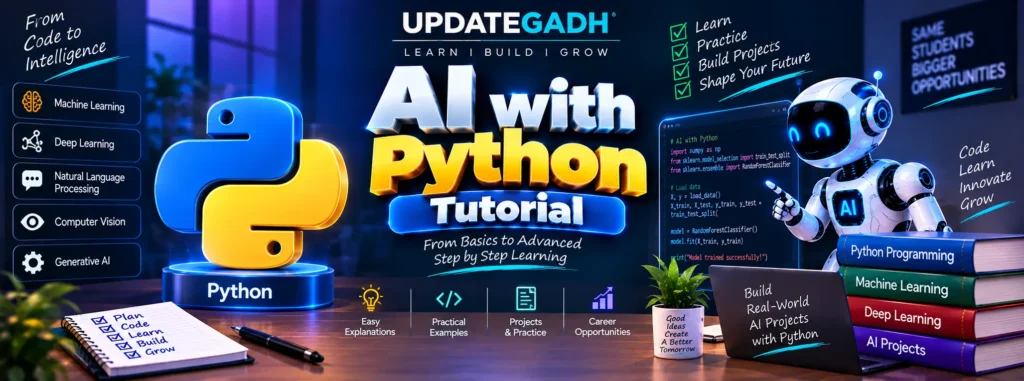
This AI with Python Tutorial covers several important areas of Artificial Intelligence, including Machine Learning, Deep Learning, Natural Language Processing, Computer Vision, and Generative AI.
- Machine Learning: Algorithms that allow systems to learn from data and make predictions or decisions.
- Deep Learning: Advanced machine learning techniques based on multi-layered artificial neural networks that can analyze complex data.
- Natural Language Processing (NLP): A field of AI focused on enabling computers to understand, interpret, and generate human language.
- Computer Vision: The process of enabling machines to interpret and make decisions using visual information such as images and videos.
- Generative AI: AI models capable of generating new content such as text, audio, and images.
Artificial Intelligence Concepts with Python
1. Machine Learning (ML)
Machine Learning is a branch of Artificial Intelligence focused on developing techniques that allow computers to learn patterns from data without being explicitly programmed for every individual task.
Python libraries such as scikit-learn make it relatively straightforward to implement different machine learning techniques.
- Supervised Learning: Algorithms learn from labeled data. Common applications include classification and regression.
- Unsupervised Learning: Algorithms identify patterns and structures within unlabeled data, such as clustering.
- Reinforcement Learning: Algorithms learn by interacting with an environment and optimizing their actions based on rewards.
Common Machine Learning Algorithms
- Regression Algorithms: Linear Regression, Polynomial Regression
- Classification Algorithms: Support Vector Machines (SVM), Decision Trees, Logistic Regression
- Clustering Algorithms: K-means, Hierarchical Clustering
- Dimensionality Reduction: Principal Component Analysis (PCA)
2. Deep Learning (DL)
Deep Learning is a branch of Machine Learning that uses multi-layered artificial neural networks to identify complex patterns within data. It is particularly useful when working with complex data such as images, audio, and other large datasets.
Python libraries such as TensorFlow and PyTorch provide powerful tools for developing and training deep learning models.
Important concepts in Deep Learning include:
- Gradient Descent and Backpropagation: Techniques used to optimize neural network performance.
- Feedforward Neural Networks: Neural network architectures where information moves through the network in a forward direction.
- Convolutional Neural Networks (CNNs): Neural networks commonly used for image-related tasks.
- Recurrent Neural Networks (RNNs): Neural networks designed to work with sequential or time-dependent data.
Deep Learning is useful in areas that require detailed analysis of complex data, including medical imaging and voice recognition.
3. Natural Language Processing (NLP)
Natural Language Processing (NLP) focuses on enabling machines to understand, interpret, process, and generate human language.
Python provides several useful NLP libraries, including NLTK and spaCy, which can be used for a wide range of language-processing tasks.
Important NLP Topics
- Text Processing: Tokenization, stemming, and lemmatization.
- Text Representation: Word embeddings such as Word2Vec and GloVe.
- NLP Applications: Named Entity Recognition (NER), sentiment analysis, and language translation.
The combination of Python and NLP can be used to develop applications such as chatbots, automated translation systems, and sentiment analysis tools.
4. Computer Vision (CV)
Computer Vision is an area of Artificial Intelligence that focuses on enabling machines to understand and interpret visual information.
Python libraries such as OpenCV and Keras provide useful tools for developing computer vision applications ranging from image classification to real-time object detection.
Core Computer Vision Concepts
- Image Processing: Techniques such as edge detection and color transformation.
- Convolutional Neural Networks (CNNs): Neural network architectures widely used for image-related applications.
- YOLO (You Only Look Once): A method used for object detection.
- U-Net: A neural network architecture used for image segmentation.
Python-powered computer vision has applications in autonomous vehicles, medical diagnostics, surveillance, and other visual-data-based systems.
5. Generative AI
Generative AI uses AI models to create new content based on patterns learned from existing data. Generative models can be used to produce different types of content, including images, text, and audio.
Python frameworks such as TensorFlow and PyTorch can be used to develop and train generative AI models.
Generative AI Applications
- Image Generation: GANs can be used to generate realistic images.
- Text Generation: Models such as GPT can generate coherent and contextually relevant text.
- Audio Generation: Neural networks can be trained to produce synthetic audio.
Frameworks and Tools
1. TensorFlow
TensorFlow, created by Google, is a widely used framework for deep learning and neural network development. It provides tools for creating, training, and deploying machine learning and deep learning models.
2. PyTorch
PyTorch is a popular machine learning and deep learning framework known for its flexibility and ease of use. It is widely used in research and development for building neural network models.
3. scikit-learn
scikit-learn is a beginner-friendly Python machine learning library that provides tools for implementing classification, regression, clustering, dimensionality reduction, and other machine learning techniques.
Together, these frameworks and tools provide developers with the functionality needed to create scalable and powerful AI solutions using Python.
Frequently Asked Questions
1. What is AI?
Artificial Intelligence refers to the simulation of human intelligence in computer systems. AI allows machines to perform tasks such as problem-solving, language translation, pattern recognition, and decision-making.
2. Why is Python popular for AI?
Python is popular for AI because of its readable syntax, extensive collection of libraries and frameworks, flexibility, and large developer community.
3. What are the career opportunities in AI with Python?
Learning AI with Python can support career paths such as Machine Learning Engineer, Data Scientist, AI Researcher, NLP Engineer, and Computer Vision Specialist.
4. What resources should I use to learn AI with Python?
Beginners can start with online courses, tutorials, documentation, and practical projects involving tools such as TensorFlow, PyTorch, and scikit-learn. Hands-on projects can help strengthen concepts and develop practical experience.
YT:- DecodeIT
Conclusion
AI with Python combines the simplicity of Python programming with powerful Artificial Intelligence techniques. By learning Machine Learning, Deep Learning, NLP, Computer Vision, and Generative AI, beginners and experienced developers can build a strong foundation for developing intelligent applications.
With the help of Python libraries and frameworks such as TensorFlow, PyTorch, and scikit-learn, developers can move from basic AI concepts to practical implementations and real-world projects.
Keywords
AI with Python Tutorial, AI with Python Tutorial: Your Guide to Exploring AI, python ai code copy and paste, ai programming with python free, python ai chatbot, ai with python pdf, python artificial intelligence projects for beginners, ai with python course, python ai library, ai python for beginners, ai with python tutorial w3schools, ai with python tutorial for beginners, ai with python tutorial geeksforgeeks, Artificial Intelligence with Python, Python AI tutorial