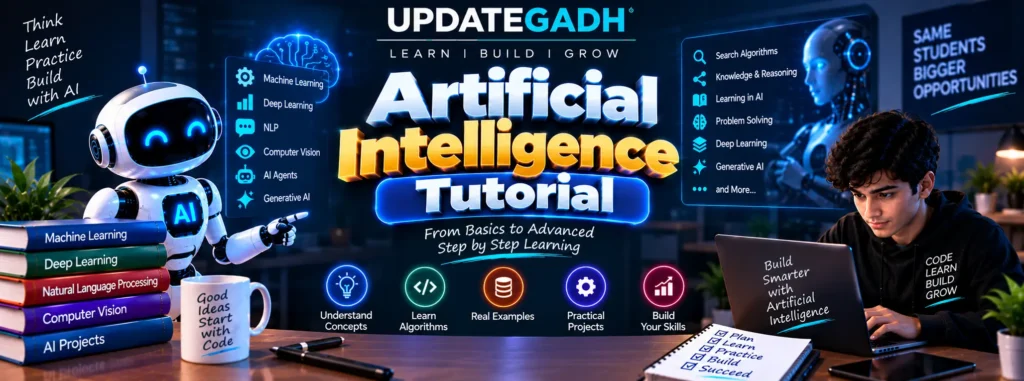
Artificial Intelligence Tutorial
Artificial Intelligence (AI) is a fascinating field of computer science that focuses on bringing human-like intelligence to machines. Using sophisticated algorithms and computational techniques, AI-powered systems can perform tasks that traditionally require human intelligence, such as recognizing images, translating languages, making decisions, and understanding speech.
From self-driving cars to healthcare innovations, Artificial Intelligence is transforming industries and changing the way people interact with technology every day.
Table of Contents
Complete Advance AI Topics: Click Here
SQL Tutorial: Click Here
What is Artificial Intelligence?
At its core, Artificial Intelligence is about creating intelligent systems that can simulate cognitive abilities. These systems are designed to perceive their environment, learn from data, make decisions, reason about problems, and take appropriate actions.
AI is no longer limited to science fiction. It has become an important technology for solving complex problems, supporting innovation, and transforming many areas of modern society.
Definitions of Artificial Intelligence
Artificial Intelligence has been defined by experts from different fields, with each definition highlighting a different aspect of this broad technology:
- Knight and Rich (1991): Artificial Intelligence is the study of how to make computers perform tasks at which, at the moment, people are better.
- Winston (1992): Artificial Intelligence is the study of computations that make it possible to perceive, reason, and act.
- McDermott and Charniak (1985): AI is the study of mental faculties through the use of computational models.
History of Artificial Intelligence
- 1940s–1950s: The foundations of AI were established through neural network theories and Alan Turing’s work, including the famous Turing Test. In 1956, the Dartmouth Conference formally introduced the term Artificial Intelligence.
- 1960s–1970s: AI research expanded with developments such as early industrial robots and ELIZA, an early chatbot. However, limitations in technology and research funding contributed to periods known as AI winters.
- 1980s: AI experienced renewed interest through expert systems and advancements in neural networks. Despite these developments, another slowdown occurred toward the end of the decade.
- 1990s–2000s: Major milestones, including IBM’s Deep Blue defeating chess champion Garry Kasparov, demonstrated the growing capabilities of AI. Advances in machine learning and neural networks also helped shape the future of AI.
- 2010s: AI experienced rapid growth, particularly in Natural Language Processing (NLP), computer vision, and autonomous systems. Google DeepMind’s AlphaGo became a notable example of advanced AI capabilities.
- 2020s: AI became increasingly integrated into everyday applications. Developments such as GPT-3 and AlphaFold attracted significant attention, while ethical, social, and technological questions surrounding AI also became increasingly important.
Download New Real Time Projects: Click here
Types of Artificial Intelligence
Artificial Intelligence can be categorized in two primary ways: based on capabilities and based on functionalities.
1. AI Based on Capabilities
- Narrow AI: AI systems designed to specialize in a specific task, such as facial recognition.
- General AI: A concept of artificial intelligence capable of performing a broad range of intellectual tasks comparable to human intelligence.
- Superintelligent AI: A hypothetical form of AI that would surpass human intelligence across all areas.
2. AI Based on Functionalities
- Reactive Machines: Basic AI systems that react to current stimuli without storing memories of previous experiences. Deep Blue is an example.
- Limited Memory: AI systems that can use information from previous observations or experiences for decision-making, such as systems used in autonomous vehicles.
- Theory of Mind: An advanced AI concept involving the ability to understand emotions, intentions, and mental states. This remains an area of research.
- Self-Aware AI: A hypothetical type of AI that would possess self-awareness.
What is an AI Agent?
An AI agent is a machine or software system that performs tasks autonomously to achieve predetermined goals. AI agents perceive their environment, process information, make decisions, and execute actions based on those decisions.
Types of AI Agents
- Simple Reflex Agents
- Model-Based Reflex Agents
- Goal-Based Agents
- Utility-Based Agents
- Learning Agents
- Multi-Agent Systems
Problem Solving in AI
Problem-solving is a central part of Artificial Intelligence. AI systems use different algorithms and techniques to explore possible solutions and identify appropriate actions.
1. Search Algorithms in AI
- Uninformed Search: Searches for solutions without using additional information about the problem. Examples include BFS and DFS.
- Informed Search: Uses heuristic information to guide the search toward a solution. A* is a common example.
- Local Search: Focuses on optimization by exploring neighboring states. Hill Climbing and Genetic Algorithms are examples.
- Adversarial Search: Handles competitive environments in which one agent works against another. Minimax and Alpha-Beta Pruning are examples.
2. Constraint Satisfaction Problems (CSPs)
Constraint Satisfaction Problems involve finding values for variables that satisfy a specific set of constraints. CSPs are widely applied to scheduling, planning, and optimization tasks.
Knowledge, Reasoning, and Planning in AI
Knowledge representation plays an important role in enabling AI systems to understand and interact with their environment. Different forms of knowledge can be represented depending on the task.
- Declarative Knowledge: Represents facts and information about the world.
- Procedural Knowledge: Represents rules or methods for performing tasks.
- Heuristic Knowledge: Represents rules of thumb that can help with decision-making.
Techniques for Knowledge Representation
- Semantic Networks
- Frames
- Ontologies
- Logical Representation
First Order Logic (FOL)
First Order Logic (FOL) is a formalism used in Artificial Intelligence to represent and reason about knowledge in a structured way. It can represent complex relationships between objects and support logical reasoning.
Reasoning in AI
AI reasoning enables machines to make decisions, draw conclusions, and infer new information from available knowledge.
Types of Reasoning
- Deductive Reasoning
- Inductive Reasoning
- Abductive Reasoning
Learning in AI
Learning allows AI systems to improve their performance over time by using data, experiences, and feedback. Different learning approaches are used depending on the type of problem and available data.
- Supervised Learning: Learns from labeled data.
- Unsupervised Learning: Identifies patterns and structures in unlabeled data.
- Semi-Supervised Learning: Uses a combination of labeled and unlabeled data.
- Reinforcement Learning: Learns through trial and error using rewards and penalties.
- Self-Supervised Learning: Generates learning signals or labels from the data itself and is widely used in modern deep learning.
Deep Learning
Deep Learning uses multi-layered neural networks to identify complex patterns in large datasets. It has played an important role in areas such as healthcare, Natural Language Processing, and image recognition.
Uncertain Knowledge and Reasoning in AI
Uncertainty is a common challenge in Artificial Intelligence, especially when available data is incomplete, noisy, or insufficient. AI systems can use different techniques to handle uncertain information.
- Markov Decision Processes
- Fuzzy Logic
- Probabilistic Models
Generative AI
Generative AI refers to AI systems that can generate new content based on learned patterns from data. Depending on the model and application, Generative AI can create content such as text, images, music, and other forms of media.
Generative Adversarial Networks (GANs) are one example of generative models and have been used in applications such as image synthesis and creative design.
YT:- DecodeIT
Conclusion
Artificial Intelligence is a broad and evolving field that combines learning, reasoning, knowledge representation, problem-solving, and intelligent decision-making. From traditional search algorithms and expert systems to deep learning and Generative AI, the field continues to expand into new applications and areas of research.
Understanding these fundamental concepts provides a strong foundation for students, developers, and anyone interested in learning how intelligent systems work.
Keywords
artificial intelligence tutorial pdf, artificial intelligence tutorial w3schools, artificial intelligence tutorialspoint, artificial intelligence javatpoint, artificial intelligence tutorial free, artificial intelligence tutorial for beginners, artificial intelligence tutorial geeksforgeeks, artificial intelligence tutorialspoint pdf, artificial intelligence, AI,