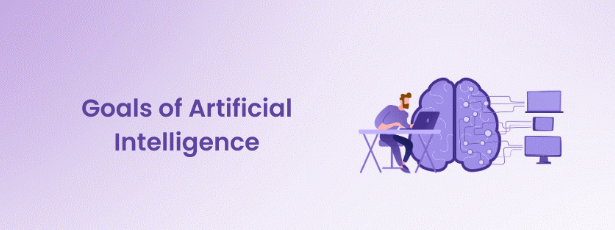
Goals of Artificial Intelligence
Artificial Intelligence (AI) is changing the way machines interact with humans by enabling computer systems to learn, make decisions, solve problems, and perform tasks intelligently. AI research focuses on developing systems that can reproduce or support certain aspects of human intelligence and apply them to real-world problems.
The main goal of Artificial Intelligence is to develop intelligent systems that can reason, learn, plan, solve problems, and improve efficiency across different areas. In this article, we will explore the goals of Artificial Intelligence, the methods used to achieve them, major application areas, and the benefits and challenges associated with AI.
Table of Contents
Download New Real Time Projects: Click here
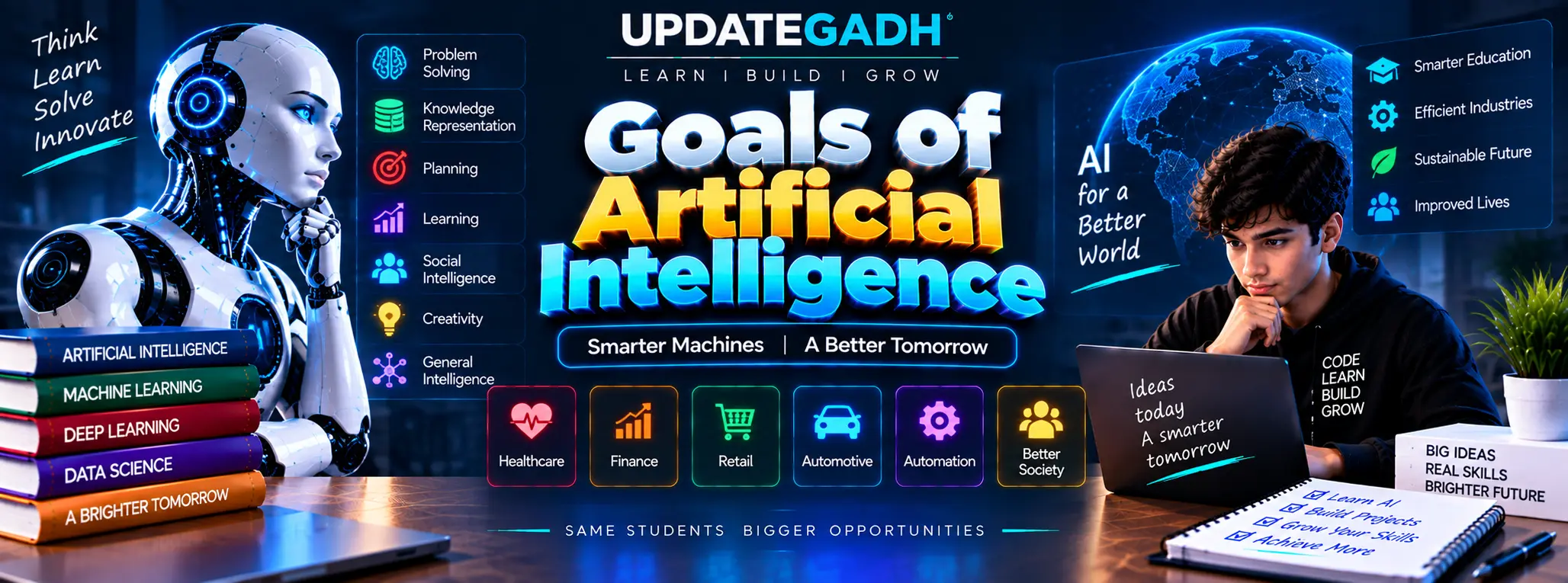
Goals of Artificial Intelligence
The broader objective of AI is to develop computer systems that can perform tasks involving reasoning, learning, decision-making, and intelligent action. This objective can be divided into several important goals.
1. Logic and Problem-Solving
One of the major goals of AI is to develop algorithms that can simulate aspects of human reasoning and solve complex problems. Early AI systems often relied on step-by-step logical deductions. As problems became more complex, approaches involving probability and economic reasoning were introduced to handle uncertain or incomplete information.
- Key Challenge: The combinatorial explosion problem occurs when the number of possible solutions grows extremely rapidly as a problem becomes larger.
- Solution: AI researchers continue to improve algorithms and techniques to use computational resources more efficiently.
2. Knowledge Representation
Intelligent systems need knowledge about the world to solve real-world problems effectively. Knowledge representation focuses on organizing information so that an AI system can use it for reasoning and decision-making.
Ontologies provide a structured way to represent objects, concepts, relationships, and events.
AI systems may need to represent information such as:
- Relationships between objects and events
- Cause-and-effect relationships
- Information about what other individuals or systems know
3. Planning
Intelligent systems need to establish goals, predict possible outcomes, and select actions that can help achieve desired results. AI planning involves reasoning about future actions and choosing an appropriate sequence of decisions.
Challenges in Planning
- In multi-agent environments, systems may need to make decisions while dealing with uncertainty.
- AI systems need adaptive capabilities to respond to changing environments and unexpected situations.
4. Learning
Machine Learning (ML) is one of the most important areas of AI and enables systems to improve their performance by learning from data and experience.
Two fundamental learning approaches include:
- Supervised Learning: Systems learn from labeled training data to classify information or predict outputs.
- Unsupervised Learning: Systems identify patterns, structures, or relationships within unlabeled data.
5. Social Intelligence
Another goal of AI is to develop systems that can recognize and respond appropriately to human emotions and social behavior. This area combines concepts from computer science, psychology, and cognitive science.
Socially intelligent systems aim to understand human interactions and provide responses that are appropriate to different situations.
6. Creativity
AI research also explores the possibility of developing systems capable of producing novel and useful outputs. This area includes computational creativity, artificial intuition, and AI-assisted artistic expression.
AI-based systems can be designed to generate or assist with creative outputs in areas such as art, music, writing, and design.
7. General Intelligence
Artificial General Intelligence (AGI) refers to a hypothetical form of AI capable of performing a broad range of intellectual tasks with human-like flexibility.
Developing general intelligence remains an ambitious area of AI research. Concepts such as artificial consciousness and brain-inspired computing are sometimes discussed in relation to this long-term goal.
Methods of Artificial Intelligence
AI research can be broadly described through different approaches to creating intelligent systems.
1. Symbolic Method (Top-Down Approach)
The symbolic approach represents knowledge using symbols, rules, and logical structures. AI systems use these predefined representations to reason and solve problems.
For example, a symbolic system could be programmed to recognize numbers by comparing input information with predefined geometric patterns.
2. Connectionist Method (Bottom-Up Approach)
The connectionist approach is inspired by the structure of the human brain. It uses artificial neural networks that learn patterns from data through repeated exposure and training.
Unlike purely rule-based systems, connectionist approaches can be particularly useful for complex problems involving large amounts of real-world data.
Other AI Methods
- Logic-Based AI: Focuses on formal reasoning, logic, and abstract problem-solving.
- Knowledge-Based AI: Uses stored facts and rules to support intelligent decision-making.
- Statistical Learning: Uses mathematical and statistical models to analyze data and make predictions.
Application Areas of Artificial Intelligence
Artificial Intelligence is being applied across a wide range of industries and domains.
1. Healthcare
AI-powered systems can support areas such as medical diagnosis, drug research, medical imaging, and personalized healthcare. For example, wearable devices can monitor health-related information and may provide alerts when unusual conditions are detected.
2. Financial Services
Financial organizations use AI for applications such as fraud detection, forecasting, automated auditing, risk analysis, and other data-driven processes.
3. Retail Sector
AI can support inventory management, demand forecasting, market analysis, recommendation systems, and personalized shopping experiences.
4. Automobile Industry
AI plays an important role in autonomous driving research and advanced driver-assistance systems. These technologies can use sensors and intelligent algorithms to analyze the surrounding environment and support driving-related decisions.
Benefits of Artificial Intelligence
AI can provide several benefits when appropriately designed and implemented.
- Reduces Human Error: AI systems can perform certain repetitive and data-intensive tasks consistently.
- Handles Challenging Tasks: AI can assist with tasks that may be difficult, dangerous, or impractical for humans, such as certain forms of deep-sea exploration.
- Enhances Daily Life: Virtual assistants and other AI-powered applications can provide convenient services and automate routine activities.
Disadvantages of Artificial Intelligence
Despite its potential benefits, Artificial Intelligence also presents several challenges.
- High Costs: Developing, training, deploying, and maintaining advanced AI systems can require significant technological and financial resources.
- Lack of Human Creativity: AI systems generate outputs based on their training and design, while human creativity is influenced by personal experiences, emotions, culture, and broader life experiences.
- Potential Unemployment: Automation of certain tasks can change workforce requirements and may reduce demand for some roles while creating demand for others.
Complete Advance AI Topics: Click Here
SQL Tutorial: Click Here
Conclusion
The goals of Artificial Intelligence extend from solving problems and representing knowledge to learning, planning, creativity, social intelligence, and the long-term pursuit of general intelligence. Different approaches, including symbolic reasoning, connectionist systems, logic-based AI, knowledge-based AI, and statistical learning, contribute to these objectives.
AI is already being applied in healthcare, finance, retail, transportation, and many other fields. While it can improve efficiency and support challenging tasks, issues such as cost, creativity, employment, and responsible development must also be considered.
Understanding the goals and methods of AI provides a strong foundation for students and developers who want to explore Artificial Intelligence and its real-world applications.
Keywords
goals of artificial intelligence pdf, goals of AI class 9, goals of artificial intelligence ppt, goals of AI geeksforgeeks, what are the goals of AI class 8, future goals of AI, what is artificial intelligence, what is artificial intelligence with examples, applications of artificial intelligence, types of artificial intelligence, goals of artificial intelligence Wikipedia, Goals of Artificial Intelligence: A Journey Towards Smarter Systems, Goals of Artificial Intelligence