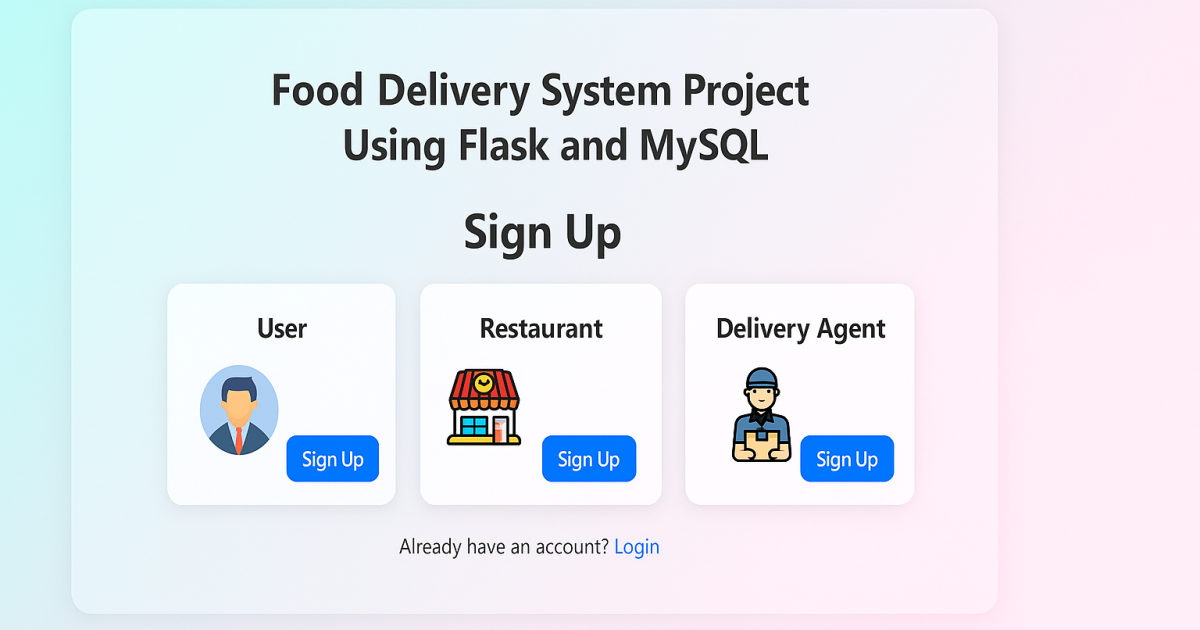
Best Food Delivery System
A simple project based on a Food Delivery System, which is developed as a complete web application to streamline the process of online food ordering. This system is designed to serve multiple user roles, including customers, restaurant owners, and delivery drivers — each with their own dedicated dashboards and functionalities. By integrating ordering, tracking, and management features into one platform, it eliminates the manual hassle of food orders and makes the process smooth and efficient.
The application is built using Python Flask for backend development and MySQL as the database, ensuring both speed and reliability. To make the login process secure and modern, the system also includes Google OAuth authentication. This allows users to sign in with their Google accounts, avoiding the need for multiple registrations.
More than just a coding project, the Food Delivery System demonstrates how technology can create real-world impact by connecting customers with restaurants and enabling drivers to deliver efficiently. It’s especially useful for students, developers, or freelancers who want to learn full-stack web development, practice database management, and implement role-based systems in a single project.
Project Overview
| Project Detail | Information |
|---|---|
| Project Name | Food Delivery System |
| Language/s Used | Python (Flask) |
| Database | MySQL |
| Authentication | Google OAuth (app2.py) |
| Type | Web Application |
Download New Real Time Projects :-Click here
Available Features
The Food Delivery System comes with all the major functionalities needed to make an online food ordering platform work smoothly. Each user role (Customer, Restaurant Owner, Delivery Agent) is given separate access and controls, ensuring that the system runs efficiently without overlaps or confusion.
1. Google OAuth Login
The system allows secure sign-in using Google accounts, removing the need for multiple registrations.
With OAuth integration, user identity is verified by Google, ensuring both security and convenience.
2. Role-Based Dashboards
The project is designed with role-specific dashboards to make sure every user has a tailored experience:
Customers: Can browse the restaurant menu, add items to their cart, place orders, and check order history.
Restaurant Owners: Get full control of their digital menu, manage food items, and handle incoming orders in real-time.
Delivery Agents: View assigned orders, update the delivery status, and mark deliveries as complete.
3. Dynamic Menu Management
Restaurant owners can add, edit, or remove food items in real-time.
Updated menu items reflect instantly on the customer dashboard without needing a restart.
4. Order Tracking
Customers can track their order status live, from “Order Placed” → “Processing” → “On the Way” → “Delivered”.
Delivery agents can update the order status as they complete each step of the process.
5. Clean User Interface
Built with HTML, CSS, Bootstrap, and Flask Jinja2 templates for dynamic page rendering.
Provides a smooth and professional user experience across all devices.
6. MySQL Database Integration
A robust backend powered by MySQL stores all user details, food menus, orders, and delivery status.
Ensures fast access, secure storage, and scalability for large datasets.
Google Authentication
One of the standout features of this project is its Google OAuth integration.
The
app2.pyfile is used to activate Google sign-in functionality.It connects the system with Google Developer credentials through a
client.jsonfile.Once configured, users can log in directly using their Google account, making the system more secure and user-friendly compared to traditional username/password methods.
This ensures that only verified users can access the platform, reducing risks like fake registrations or weak passwords.
Overall, these features make the Food Delivery System a complete, real-world application that mirrors professional platforms like Zomato or Swiggy, but in a simpler, student-friendly structure. It’s not only practical for learning but also impressive for showcasing in final-year projects or freelance portfolios.
We have projects Available in all languages:–Click Here


food delivery system project using flask and mysql with source code
food delivery system project using flask and mysql github
food delivery system project using flask and mysql example
online food ordering system project in php github
food delivery website project using html, css and javascript github
online-food-ordering-system project source code github
online food ordering system project in python django
online food ordering system project pdf
🎓 Need Complete Final Year Project?
Get Source Code + Report + PPT + Viva Questions (Instant Access)
🛒 Visit UpdateGadh Store →