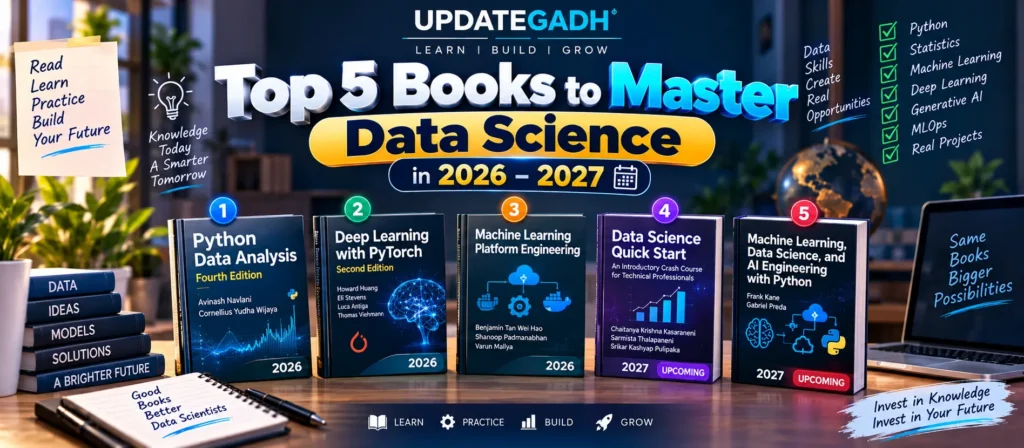
Top 5 Books to Master Data Science
Data Science is continuously evolving with new developments in Machine Learning, Deep Learning, Generative AI, Large Language Models, MLOps, and AI engineering. If you are a student, developer, aspiring data scientist, or machine learning engineer, keeping your learning resources updated is just as important as learning the fundamentals.
Many popular Data Science books are still useful, but the technology landscape has changed significantly. Newer books published in 2026 and titles scheduled for 2027 now cover areas such as PyTorch, generative AI, ML platform engineering, LLMs, RAG, MLOps, and production-ready AI systems.
In this article, we have updated the list with five recent and upcoming books that can help you build modern Data Science and AI skills for 2026–2027.
Table of Contents
Complete Advance AI Topics: Click Here
SQL Tutorial: Click Here
1. Python Data Analysis – Fourth Edition
Authors: Avinash Navlani and Cornellius Yudha Wijaya
Publisher: Packt
Edition: Fourth Edition
Publication Date: June 26, 2026
Length: 766 pages
Python Data Analysis – Fourth Edition is a modern resource for learning practical data analysis with Python. The fourth edition was published in June 2026 and focuses on the Python ecosystem used for data analysis and related machine learning workflows.
The book is particularly useful for learners who want to strengthen their understanding of Python-based data analysis before moving deeper into Machine Learning and AI. Its contents cover areas related to Python libraries, data analysis, visualization, machine learning, deep learning, and newer AI-focused workflows.
What You Can Learn
- Python for data analysis
- Working with modern Python data libraries
- Data cleaning and preparation
- Data visualization
- Machine Learning concepts
- Deep Learning workflows
- Generative AI and LLM-related topics
- Data engineering concepts and scalable processing
This book can be a useful choice for students who want to build a strong practical foundation in Python Data Science while also becoming familiar with modern AI technologies.
Official book: Python Data Analysis – Fourth Edition
2. Deep Learning with PyTorch, Second Edition
Authors: Howard Huang, Eli Stevens, Luca Antiga, and Thomas Viehmann
Publisher: Manning
Edition: Second Edition
Publication: February 2026
Length: 544 pages
Deep Learning with PyTorch, Second Edition is an updated resource for developers and machine learning practitioners who want to work with modern deep learning systems. The second edition was published in February 2026 and expands its coverage to include Transformers, Large Language Models, and generative AI.
The book focuses on building neural networks with PyTorch and combines fundamental concepts with practical projects. It also covers model training, architecture improvements, fine-tuning, and deployment-related concepts.
What You Can Learn
- PyTorch fundamentals
- Neural network development
- Deep Learning architectures
- Transformers
- Large Language Models
- Diffusion models
- Model training and fine-tuning
- Deep Learning model deployment
For students who already know basic Python and Machine Learning, this book can help them move toward advanced Deep Learning and modern generative AI development.
Official book: Deep Learning with PyTorch, Second Edition
3. Machine Learning Platform Engineering
Authors: Benjamin Tan Wei Hao, Shanoop Padmanabhan, and Varun Mallya
Publisher: Manning
Publication: February 2026
Length: 504 pages
As Machine Learning projects become larger and more complex, knowing how to train a model is no longer the only requirement. Modern teams also need systems that can support experimentation, development, deployment, monitoring, and the overall Machine Learning lifecycle.
Machine Learning Platform Engineering focuses on building internal developer platforms for ML and AI systems. The book introduces concepts around MLOps and ML engineering and explains how organizations can create platforms that support machine learning workflows.
What You Can Learn
- Machine Learning engineering
- MLOps foundations
- Machine Learning lifecycle
- Building ML platforms
- Development, staging, and production workflows
- ML engineering skills
- Platform design for AI systems
This book is especially relevant for learners who want to move beyond model development and understand how Machine Learning systems are organized and operated in real-world environments.
Official book: Machine Learning Platform Engineering
4. Data Science Quick Start: An Introductory Crash Course for Technical Professionals
Authors: Chaitanya Krishna Kasaraneni, Sarmista Thalapaneni, and Srikar Kashyap Pulipaka
Publisher: Apress
Expected Publication: March 13, 2027
Series: Apress Pocket Guides
Data Science Quick Start is an upcoming 2027 title designed as a practical introduction to the complete Data Science lifecycle. Springer Nature currently lists the book for March 2027, making it one of the newer resources to watch for learners planning their Data Science studies into 2027.
The book starts with data collection and management before moving through data cleaning, exploratory data analysis, visualization, statistics, Machine Learning, Deep Learning, NLP, time series, and responsible AI practices.
What You Can Learn
- Data collection and management
- Data cleaning and wrangling
- Exploratory Data Analysis
- Data visualization
- Statistical modeling
- Supervised and unsupervised learning
- Deep Learning
- Natural Language Processing
- Time series forecasting
- Responsible AI and ethical AI practices
- Reproducible Data Science pipelines
- Cloud-ready Machine Learning workflows
Because the book covers the Data Science lifecycle from beginning to deployment-oriented practices, it can be useful for technical professionals and students looking for a structured introduction to modern Data Science.
Official book: Data Science Quick Start
5. Machine Learning, Data Science, and AI Engineering with Python
Authors: Frank Kane and Gabriel Preda
Publisher: Packt
Publication Date: March 5, 2027
Edition: First Edition
Length: 439 pages
Machine Learning, Data Science, and AI Engineering with Python is an upcoming 2027 book focused on taking learners from Data Science and Machine Learning fundamentals toward production-ready AI systems.
The book combines traditional Machine Learning with modern AI engineering topics. Its planned content includes Python-based Machine Learning, Deep Learning, Transformers, LLMs, Retrieval-Augmented Generation, MLOps, APIs, containerized deployment, and AI agents.
What You Can Learn
- Machine Learning with Python
- scikit-learn and PyTorch
- Deep Learning for vision and NLP
- Transformer-based LLMs
- Retrieval-Augmented Generation (RAG)
- Vector databases
- FastAPI and Docker
- MLflow and DVC
- Model versioning and experiment management
- LLM agents
- Responsible AI and interpretability
This book is aimed at learners who want to understand not only how to create Machine Learning models but also how modern AI applications can be developed and deployed as complete systems.
Official book: Machine Learning, Data Science, and AI Engineering with Python
How to Choose the Right Data Science Book?
Choosing a Data Science book depends on your current skill level and the area you want to explore. Beginners may benefit from starting with Python, data analysis, statistics, and fundamental Machine Learning concepts before moving into advanced AI engineering.
If your goal is to work with deep learning, Deep Learning with PyTorch, Second Edition focuses strongly on PyTorch, Transformers, LLMs, and generative AI. If you are interested in MLOps and infrastructure, Machine Learning Platform Engineering focuses on the engineering and platform side of Machine Learning.
For a broader Data Science introduction, Data Science Quick Start covers the complete lifecycle from data preparation to Machine Learning and responsible AI. For learners interested in production-focused AI development, Machine Learning, Data Science, and AI Engineering with Python brings together Machine Learning, LLMs, RAG, MLOps, APIs, and AI agents.
Why Learn Data Science with Books in 2026–2027?
Online tutorials and short videos are useful for learning individual concepts, but books can provide a more structured learning path. A well-organized book can take you from fundamental concepts to practical implementation without requiring you to search for every topic separately.
The Data Science field is also expanding beyond traditional statistical analysis and Machine Learning. Modern Data Science increasingly overlaps with Generative AI, LLMs, Transformers, MLOps, RAG, AI engineering, and production deployment. The books listed above reflect several of these newer areas.
YT:- DecodeIT
Final Thoughts
Data Science is changing quickly, so learning from updated resources can help students and professionals keep their knowledge aligned with current technologies. The five books in this list cover different parts of the modern Data Science ecosystem, from Python data analysis and Deep Learning to ML platform engineering and production-ready AI systems.
If you are starting your Data Science journey, focus first on Python, statistics, data analysis, and Machine Learning fundamentals. Once your foundation is strong, you can move toward Deep Learning, LLMs, MLOps, RAG, and AI engineering.
The 2026 editions and upcoming 2027 titles listed here provide a useful starting point for building modern Data Science skills and preparing for the rapidly developing AI ecosystem.
Keywords: Top 5 Data Science Books to Master Data Science in 2026–2027,Top 5 Books to Master Data Science, best data science books 2026, data science books 2027, latest data science books, Python data science books, machine learning books 2026, deep learning books 2026, PyTorch books, MLOps books, AI engineering books, LLM books, RAG books, data science learning resources, best books for data science students, machine learning engineering books Top 5 Books to Master Data Science, Top 5 Books to Master Data Science, Top 5 Books to Master Data Science