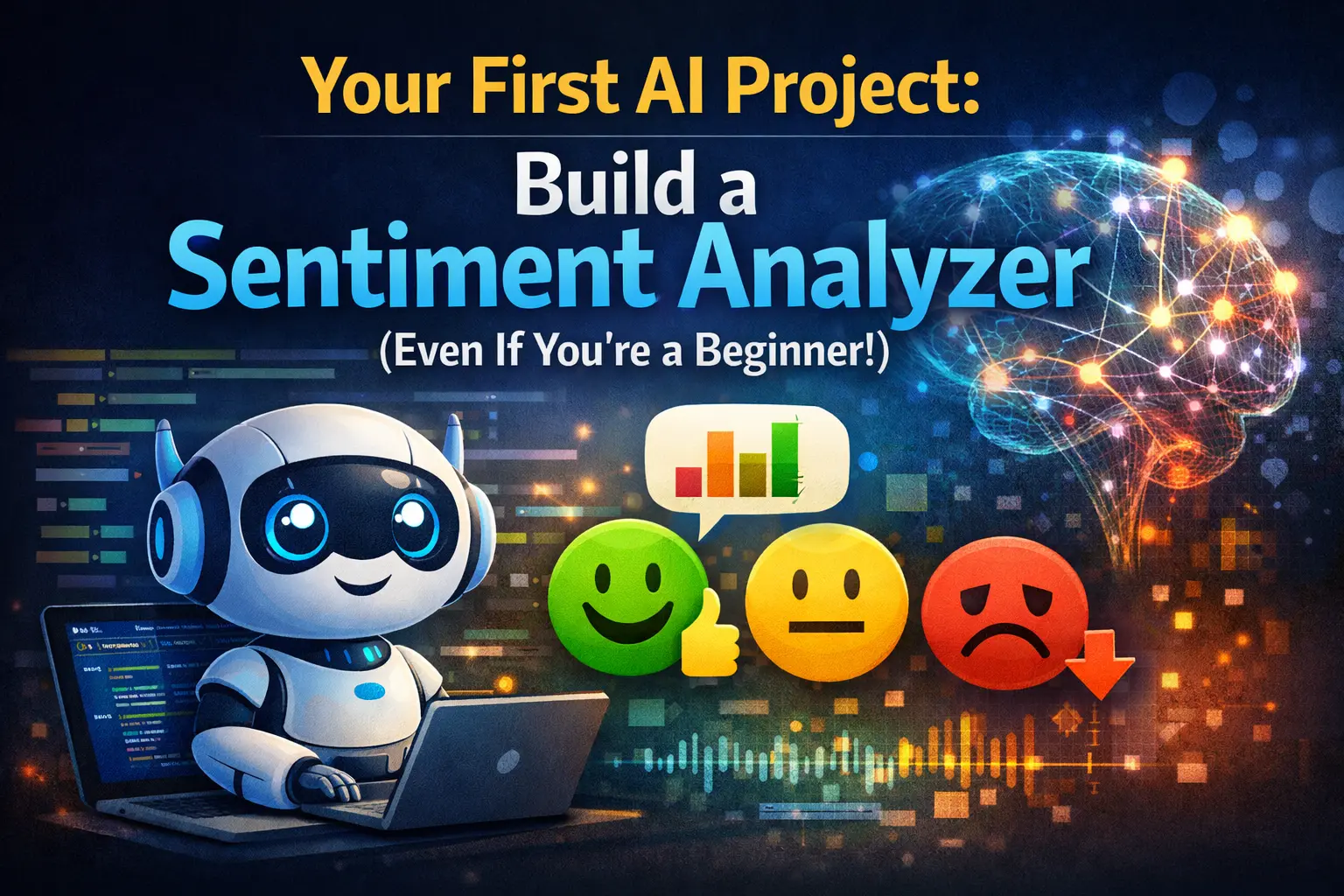
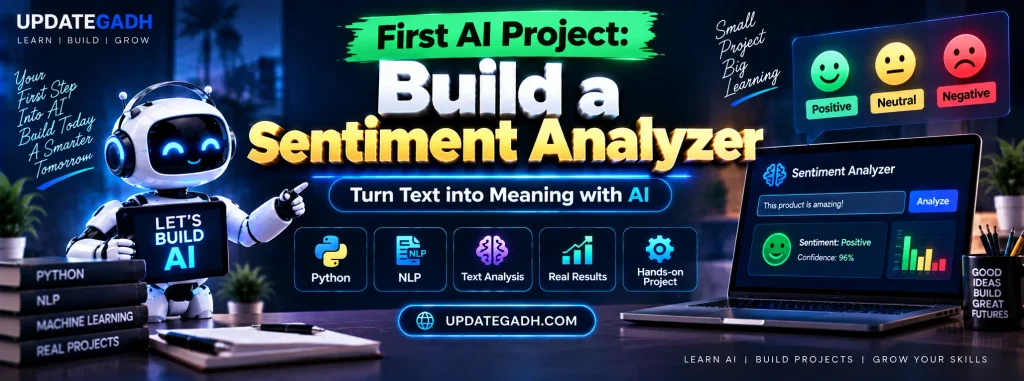
Want to build your first AI project as a Sentiment Analyzer in Python? You are in the right place. If you are a BCA, B.Tech, MCA, or MSc IT student staring at a blank screen and dreading your next project submission, this guide is for you. Terms like “AI” and “Machine Learning” can sound intimidating, but your first impressive AI project is much closer than you imagine. In this beginner-friendly tutorial, you will build a working sentiment analyzer in Python using NLTK VADER – no complex neural networks, no machine learning math, just clean Python code that classifies text as positive, negative, or neutral.
Table of Contents
Project Overview
| Project Name | Sentiment Analyzer in Python (First AI Project) |
| Language Used | Python 3.x |
| Main Library | NLTK (VADER Sentiment) |
| Approach | Lexicon-based sentiment classification |
| Output | Positive / Negative / Neutral classification with compound score |
| Difficulty | Beginner |
| Best For | BCA, MCA, B.Tech, MSc IT – First AI / Mini Project |
| Time to Build | Under 30 minutes |
| Developer | Updategadh |
Why Sentiment Analysis Is the Perfect First AI Project
College projects can be tough, but what if you could build something cool, highly relevant, and actually useful? Sentiment Analysis is exactly that. It is not just a fancy AI term – it is a superpower that lets computers understand human emotions from text.
Imagine knowing if customers are happy or angry about a product just by scanning their reviews, or understanding public opinion on a new policy from social media posts. That is sentiment analysis in action – and companies use it every day for market research, brand monitoring, and customer service.
Why This Is the Ideal First AI Project
- It is practical: Real-world companies use this daily for product reviews, social listening, and support ticket triage.
- It is achievable: You can start with a few lines of Python and add complexity as you learn – no need for complex neural networks on day one.
- It is impressive: Telling a professor or interviewer that you built an AI that understands human emotions is a guaranteed head-turner.
- It scales easily: Once the basic version works, you can plug it into a web app, a Twitter dataset, or a product review dashboard.
How Sentiment Analysis Works (The Simple Version)
At its core, sentiment analysis tries to classify text such as positive, negative, or neutral. The big question is – how does it actually do this?
For beginners, the easiest approach is the lexicon-based approach. Think of it as a dictionary where words are pre-assigned a “score” for how positive or negative they are. Words like amazing are highly positive, while words like terrible are highly negative.
Our tool of choice is the Natural Language Toolkit (NLTK) in Python, specifically its VADER (Valence Aware Dictionary and sEntiment Reasoner) sentiment analysis module. VADER is special because it understands more than just individual words – it also handles:
- Intensifiers – “really good” scores higher than “good”
- Negations – “not good” is treated as negative, not positive
- Punctuation – “good!!!” is stronger than “good”
- Capitalisation – “GREAT” is more intense than “great”
No machine learning model training is required to get a solid start. Just a few lines of Python and you are good to go.
Technologies Used
| Technology | Purpose |
| Python 3.x | Programming language |
| NLTK | Natural Language Toolkit – core NLP library |
| VADER Lexicon | Pre-trained sentiment dictionary |
Build Your Sentiment Analyzer Step by Step
Step 1: Install Python and NLTK
Make sure Python is installed on your machine. Then open your terminal or command prompt and run:
pip install nltk
python -m nltk.downloader vader_lexicon
Step 2: Write the Sentiment Analyzer Code
Create a new file called sentiment_analyzer.py and paste the following code:
from nltk.sentiment.vader import SentimentIntensityAnalyzer

# Initialise the VADER sentiment analyzer
sid = SentimentIntensityAnalyzer()

def get_sentiment(text):
    # Get polarity scores for the text
    scores = sid.polarity_scores(text)

    # Decide sentiment based on the 'compound' score
    # Compound score ranges from -1 (most negative) to +1 (most positive)
    if scores['compound'] >= 0.05:
        return 'Positive'
    elif scores['compound'] <= -0.05:
        return 'Negative'
    else:
        return 'Neutral'

# Let's test it out
test_sentences = [
    "This course is absolutely amazing and super helpful!",
    "I hate this product, it's terrible and a complete waste of money.",
    "The movie was okay, not great but not bad either.",
    "Learning Python for AI is a fantastic journey!",
    "I am not happy with the slow customer support."
]

print("--- Sentiment Analysis Results ---")
for sentence in test_sentences:
    sentiment = get_sentiment(sentence)
    print(f"Text: \"{sentence}\"\nSentiment: {sentiment}\n")

print("---------------------------------")
Step 3: Run the Script
python sentiment_analyzer.pyYou will instantly see each test sentence classified as Positive, Negative, or Neutral. Congratulations – you just built your first AI project.
Code Breakdown – What Each Line Does
SentimentIntensityAnalyzer()– loads the VADER model into memory.sid.polarity_scores(text)– returns a dictionary with four scores:neg,neu,pos, andcompound.compoundscore – the normalised, weighted composite score. It is the standard metric for overall sentiment and ranges from -1 (most negative) to +1 (most positive).- Thresholds (0.05 and -0.05) – the official VADER cut-offs. Anything above 0.05 is positive, anything below -0.05 is negative, and the middle band is neutral.
Take Your Sentiment Analyzer to the Next Level
Now that you have a working model, here is how to turn it into an A+ project that recruiters notice:
- Expand your data: Run it on real Twitter posts (using Tweepy), YouTube comments, or a Kaggle product reviews dataset instead of hard-coded sentences.
- Build a web UI: Use Flask or Django to create a page where users paste text and instantly see the sentiment. This shows full-stack ability.
- Add visualisations: Use Matplotlib or Seaborn to draw bar charts of positive vs negative vs neutral counts across a dataset. Data visualisation is always a plus.
- Try advanced models: Once comfortable, train your own Naive Bayes or Logistic Regression classifier with scikit-learn on a labelled dataset like IMDb reviews.
- Handle sarcasm: VADER struggles with sarcasm – mentioning this in your viva shows you understand model limitations, which examiners love.
- Multi-language support: Add Hindi or other regional language support using multilingual transformer models from Hugging Face.
- Interview Tips – How to Present This Project
When asked about projects in an interview, do not just describe what you built. Structure your answer around five points:
- The Problem: “I wanted to understand how machines can interpret human emotion from text.”
- Your Approach: “I used Python’s NLTK VADER library because it is lexicon-based, fast, and works without training data.”
- The Challenges: “Handling sarcasm and domain-specific language was tricky, which made me think about future improvements.”
- Key Learnings: “I learned about natural language processing, text pre-processing, polarity scoring, and model evaluation.”
- Future Improvements: “Next, I would integrate a custom labelled dataset and explore deep learning models like BERT for better accuracy on sarcasm and context.”
Watch More Free Project Tutorials on YouTube
Subscribe to DecodeIT2 for daily Python tutorials, AI project walkthroughs, and placement preparation guides – all free.
Subscribe to DecodeIT2 on YouTube
Final Thoughts – Start Building Your AI Future
You have just taken your first real step into the world of AI projects. This is not just about getting a good grade – it is about building foundational skills that will make you genuinely valuable in the tech industry. Every senior AI engineer started with a single line of code, just like you.
Do not stop here. Play with the code, break it, fix it, and make it your own. The best way to learn is by doing. Your AI journey has officially begun.
Frequently Asked Questions (FAQ)
What is the easiest first AI project for beginners?
A Sentiment Analyzer in Python using NLTK VADER is one of the easiest and most impressive first AI projects. It requires no machine learning training, just a few lines of code, and produces results that look genuinely intelligent.
Do I need to know machine learning to build a sentiment analyzer?
No. The lexicon-based approach using VADER does not require any machine learning knowledge. It uses a pre-built dictionary of sentiment scores, so you can build a working project on day one.
What does the compound score in VADER mean?
The compound score is the normalised, weighted total of all the word-level sentiment scores in the text. It ranges from -1 (very negative) to +1 (very positive). VADER uses 0.05 and -0.05 as the standard thresholds for positive and negative classification.
Can I use this sentiment analyzer for Twitter or product reviews?
Yes. VADER was originally designed for short, social-media style text – so it works very well on tweets, YouTube comments, and product reviews. For long formal text like news articles, machine learning models usually perform better.
Is sentiment analysis a good final year project topic?
Yes. A basic sentiment analyzer makes a strong mini project, and an extended version with a Flask UI, custom dataset, and a trained scikit-learn or BERT model is excellent for a full final year project in BCA, MCA, or B.Tech.
What are VADER’s main limitations?
VADER struggles with sarcasm, irony, domain-specific language (such as medical or legal text), and very long passages. For these cases, training a custom machine learning model or using a transformer model like BERT gives better results.
Related Python and AI Projects You Might Like
Top 10 Final Year Project Ideas for CSE Students